Tuesday, September 24, 2019

The Road, The Movie, The Part 2


Blog #8                                                                                             9/24/19
Junhong Li                                                                                         Period 1

So, today we returned to our adventures with the boy and his father, traversing down The Road. 

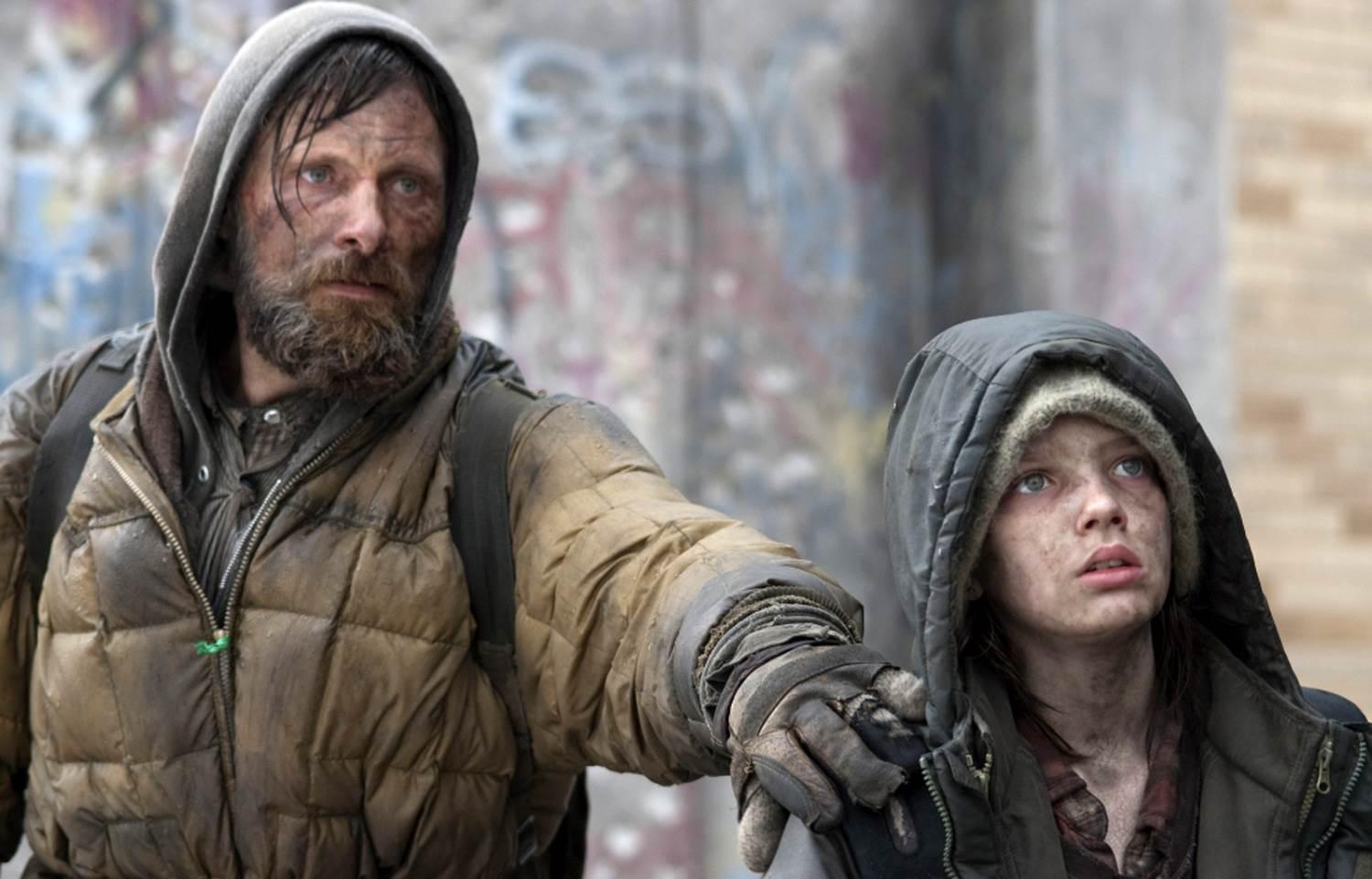
Beginning at 34:04, the two spot a large house on the side of the road and decide to check it out. As the two enter, we hear whimpering and blood dripping. The father discovers the cellar and enters with a small lighter, to discover a huge group of people huddled up in there, naked and dirty, asking for help. A key line that was left out of the book but presented in the movie was one of the captives screaming, "Wait! Wait! They're taking us to the smokehouse!"(at 37:22). As the two escape from the cellar, the boy notices the people who live in the large house coming back, just in time to warn his father. The two then escape up into the second-floor bathroom, where we see a sink and a bathtub, both covered in blood. When the father overhears someone coming to the bathroom to change, he immediately pulls out the gun and tries to give it to the boy. Interestingly enough, he tells the boy "When they get ahold of you, you're going to have to do it." In this case, the father means the boy has to commit suicide, not kill his captor. Unfortunately, the boy declines the gun, causing the father to attempt to kill the boy. The father isn't encouraging survival anymore, here he is encouraging a swift painless death. This extreme change in behavior depicts how much he loves the boy. With the remaining bullet left, he would rather suffer in place of the boy than have any chance of the boy suffering. Fortunately enough, one of the captives attempts an escape right before the father pulls the trigger, preventing the person who wanted to change to ever reach the bathroom. The father notices before it is too late, and the two run out of the house. That night, the boy questions if they would ever eat people. The father's answer was no, no matter how much they were starving-- because they were the good guys, the ones carrying the fire. 
In the next scene, the two discover the father's childhood home. As a show of character development, the boy is now afraid of homes, afraid of what they would find in there. The same is true when they discover the bunker. Right before that, a scene of the two traveling is shown, with a monologue from the father over it. He says, "Everyday is a lie, but I am slowly dying. That is not a lie. I am trying to prepare him for the day when I am gone"(at 49:05). In the book, such a line would mean the father was teaching the boy how to survive by himself. In contrast, with the father's actions in the movie, it depicts a darker tone, implying the father teaching the boy how to commit suicide when he is gone.
When the two discovers the bunker, the boy begs his father to not go down there, once again in fear of what they might find. The father does not listen and goes down anyways, to discover food, water, and a place to stay for days. This shows a contrast in the boy's and the father's characteristics. If the boy was traveling alone, he would've never entered this bunker, he wouldn't be able to survive by himself for long. The father knows this and is taking all the risks for the boy, but in doing so, he also knows he cannot keep the boy safe forever. But for now, the two are safe and happy. Here the two spend a few days and the father teaches the boy to be thankful. Another very important line here is the boy saying "Cheetas" only for the father to correct him, showing once again the boy's poor childhood experience. The two spent a few more days in the bunker until the father heard something approaching. They quickly left the bunker, taking all that they could, showing the father's caution, but also his fear. 
In the next scene, we meet Ely, the traveling old man. The first thing Ely does when the father and boy approach, is throw down his bag and declare he's got nothing valuable. This shows the dangers one would encounter on the road, and how nobody is a "good guy" anymore. A difference between the film and the book is how Ely mentions he had a son too. The father also does not question Ely's name, claiming it's not real. The father invites Ely to have dinner with them, and the two talked for a bit after the boy goes to sleep. As a sign of trust, the father even shows Ely their gun. We stopped watching right after the two talk about being the last man alive, at 1:10:25.
(Credits: The Road (2009) directed by John Hillcoat)

Modern Mythology 2020

9/23/2019
Angel Li 
PD 1

Today in class, we watched the first half of our summer reading book, The Road by Cormac McCarthy. During previous classes, we analyzed recurring symbols and themes throughout the book and highlighted the importance of it in a broader spectrum. Just recently, our class presented numerous ideas of what could have happened prior to the book and what would drive humans to make the choices that they do. After a full breakdown of the novel, it was time to watch the film to be able to spot what differences were made to the movie and how it can help us further our understanding of what happened.

The film starts off with a flashback of the man with his wife enjoying their life with the depiction of them smiling and laughing. I concluded this as before the child was born and during the pre-apocalyptic world, where the colors are vivid and alive. Already differing from the book where the wife plays a much smaller role. Soon after the man wakes up from the loud noise of the waterfall that he was sleeping next to, he pulls more blankets on top of the child and takes a walk outside. The scenery and everything are grayed out which shows a good portrayal of the post-apocalyptic world. During the day time, the man and the child get up to continue their journey along the road until their next checkpoint where they would settle down and take a small rest. With another flashback to the man's older life, we figured out that the child was born during or after the apocalyptic world as he is raised from their diminishing supplies. It is then revealed in the film that the wife did not want to continue on with their child because they did not have enough food to care for three people. She constantly brings up the idea of not wanting to go on with life even though the man tries his best to convince her not to go to these thoughts. In the end, the man hands her over with a gun with 3 bullets, enough for each of them. Instead, she walks out of the door and "disappears" into the darkness to not be seen again. The emphasis the film put on the flashbacks of the wife helps to clarify the questions raised in the book because the wife was mentioned only once. 

After the end of the flashback, we watch the man and the child push the "cart" that was continuously mentioned throughout the book. It gives us an image of what was in the cart and why the man was so keen on keeping it with them. It contained blankets, tools, and canned foods. Later at night, we see the "coldness" that is described by the snow or light rain creating a gloomy mood of all hope being lost. The camera then catches the two entering an abandoned house where they see hanging bodies that the boy gets a small shock from seeing. When the boy is coloring on this paper, the colors are dimmed out and seem as everything is gray regardless of which color he used. This demonstrates how post-apocalypse, everything is dead and nothing living. As the man and the child continue on the road, they stop at an house that seemed empty. This is where our film stopped.

Reflection:


 The film helped me better understand the book through its scenery and depiction of the man and child's journey so far. By showing the dead trees in the background and the dark colored theme, it creates an accurate portrayal of a post-apocalyptic world. Overall however, the book and film stayed relatively close to one another with a couple of spins, such as the voiceover and flashbacks. We learn this because it acts as a warning of what may happen when everything we know and love just disappears. In addition, it serves a deeper meaning, about survival and love. The man only kept pushing on because of his love for the child and explains why he was always so over protective. In the end, the film gives us a better insight to what the man and the child went through and allows us something we can relate to, whether is it being overprotective of a loved one, being in unfortunate circumstances where there is diminishing supplies, or being in a new situation never experienced before.

Friday, September 20, 2019

Modern Mythology 2020

9/19/19
Jia Yan Jiang PD1
Blog #6

Aim: How can we ensure for a successful project & presentation?
Do Now: Take out any materials for your projects & presentation.

- Preparations for presentations during the first half of the period.

Presentation Day 1
Group 1: 
The Fork in the Road: Between Peace and War

- What happened prior to the beginning of the novel? —> The nuclear war.

Food Shortage/Cannibalism
- People have reverted back to cannibalism due to food shortage.
- They were even eating their own kinds just to survive.
- Nuclear war destroyed everything, such as animals, limiting their food sources.
- "Huddled against the back wall were naked people, male and female, all trying to hide, shielding their faces with their hands. On the mattress lay a man with his legs gone to the hip and the stumps of them blackened and burnt. The smell was hideous” (110).

Distrust
- The apocalypse caused by the war lead to distrust between man kind.
- “'Were they the bad guys?’ ‘Yes, they were the bad guys'” (92).
- The only name mentioned in the book was Ely. However, he might’ve also didn't want to give his name due to distrust.
- “'You don’t want to say your name’ ‘I couldn’t trust you with it’” (171).

World Desolation
- There were no electricity
- “He went into the bathroom and threw the lightswitch but the power was gone.”
- Nuclear winter and fallout
- Father was ill, likely to be lung cancer


9/20/19
Presentation Day 2
Aim: Summer Reading Project/Presentation. What happened prior to the beginning of the novel and what would drive humans to make the choices that they do in the text?
Do Now: Prepare to present your summer reading project.

Group 2:
The Road: Igniting the Fire

- What happened prior to the beginning of the novel? —> A meteor strike.

Leads to volcanic eruptions
- “Everything paling away into the murk. The soft ash blowing in loose swirls over the blacktop. The segments of road down there among the dead trees. Looking for anything of color. Any movement” (McCarthy 4).
- Volcanic eruptions leads to a large amount of dust and ash.
- “They hiked back down to the highway through the mud. Smell of earth and wet ash in the rain” (McCarthy 185).
- Volcanic mudflows can be destructive, it can bury the entire town with debris and mud.

Book Cover Symbols
- Coca Cola: symbolize on American culture when there was still nothing to worry about; when the world was still peaceful.
- Pears: the man and the boy found their hope during tough times.
- Bunker: symbolized a paradise; however they cannot stay for long because they had to keep moving.
torch: “carrying the fire”. The willingness to go on during tough times.
- Glow: representing the good guys.
- Baby over spit: hunger & violence
- Flare pistol: weapon/protection

Why did human make these choices?
- Fear of unknown
- Distrust
- Love encourages morality
- Isolations
- Inhumane choices

Group 3
The Final Eruption

- What happened prior to the beginning of the novel? —> Super-volcano eruption.

- “When he woke in the woods in the dark and the cold of the night he’d reach out to touch the child sleeping beside him. Nights dark beyond darkness and the days more gray each one than what had gone before. Like the onset of some cold glaucoma dimming away the world” (McCarthy 1).
- Everything is dark and covered with ash. Ash will slowly cause people to lose vision which will eventually cover everything and one cannot see anything but darkness.
- “He thought the month was October but he wasn't sure. He hadnt kept a calendar for years. They were moving south. There'd be no surviving another winter here” (McCarthy 2).
- The eruptions limits the areas where people can escape and the road was the only choice. In order to keep themselves alive, walking down the mysterious road leading them to the south was the only option.
- “An hour later they were sitting on the beach and staring out at the wall of smog across the horizon. They sat with their heels dug into the sand and watched the bleak sea wash up at their feet. Cold. Desolate. Birdless” (McCarty 215).
- Super-volcano eruptions caused the temperature plummets about 21 degrees. Life starts to die, environment getting destroyed.

What would drive humans to make the choices that they made in the text?
- Desperation. In the apocalypse world, survival of the fittest is the only option that will make the people to do anything they can in order to survive.

Group 4
Lamenter

Possible Causes
MAD (Mutually Assured Destruction)
- 13,890 Nukes
- 4,416 cities in the world
- Overkill

Yellowstone Eruption (super-volcanoes)
- Unlikely
- Location
- Incomplete destruction

Meter Destruction
- Astronomical chance
- Does not result in fires
- Preventable

What they believe —> Super Viruses
- Extremely hard to cure
- Hard to notice
- Easy to spread

Hints Hidden With The Road
- Fire: devastated land
- “The city was mostly burned. No sign of life. Cars in the street caked with ash, everything covered with ash and dust. Fossil tracks in the dried sludge.” (page 12)
- Cannibalistic Cults
- Humans have resorted to cannibalism
- “People sitting on the sidewalk in the dawn half immolate and smoking in their clothes. Like failed sectarian suicides. Others would come to help them. Within a year there were fires on the ridges and deranged chanting. The screams of the murdered. By day the dead impaled on spikes along the road.”(page 32)
- Huddled against the back wall were naked people, male and female, all trying to hide, shielding their faces with their hands. On the mattress lay a man with his legs gone to the hip and the stumps of them blackened and burnt.”(page 91)

Reflection:
All the group did a great job at presenting their summer reading projects. It was very interesting to see how people come up with different causes that eventually lead to the novel itself, The Road. The novel itself not only symbolize the cruelness of the world, it also symbolize serious environmental problems. Everything was destroyed in the novel, seeking for help was almost impossible. The world is dark and filled with ash everywhere. The horrible environment makes it impossible for anyone to survive long. From all the presentations, I believed that people should make effort on helping to make the environment better, even though compared to the novel we are at a much more cleaner environment, caring for the environment is still a main thing we should all focus on.

Wednesday, September 18, 2019

The Boy That Cried God


Yeah.

Blog #5
Justin Huang
Period 1
9/18/19


Aim: How does the conclusion of The Road highlight the allusion to the boy as a Christ figure?

Allusion- An inexplicit reference to another work.

Carrying the Fire

"How do I know you're one of the good guys?
You dont. You'll have to take a shot.
Are you carrying the fire?
Am I what?
Carrying the fire.
                                                                                                         *
You're kind of weirded out, arent you?
No.
Just a little.
That's okay.
So are you?
What, carrying the fire?
Yes.
Yeah. We are."
-The Road 
page 283

What is the metaphor and symbolism of the fire?
     Throughout the novel, the father tells his son they are "carrying the fire". The imaginary flame burns within them both, and it is what fuels their unrelenting will to survive. Their extraordinary perseverance is symbolized as fire, and they mustn't let their fires die out, for darkness would be left to swallow the world whole. Despite the conditions of the world they live in, the man insists the boy must always strive for survival, however difficult that may be. This differs from the man's wife as long ago she decided she'd rather lose than suffer a godforsaken game of life. For all the father endured to prevent the world's ills from snatching his son, he must leave him alone in the dark world, with only the fire to guide him.

The Boy as a Christ Figure
     The boy directly contrasts the world he lives in, showing compassion during horrific times. He is forgiving(wanting to help the man who stole their cart), grateful, and kind. His kindness is demonstrated as he convinces his father to aid the Ely, the old man. There are also allusions to Christ as Ely says he believes the boy to be an angel; the man calls his son God. We discussed the idea of a self-fulfilling prophecy, by calling the boy God, the man convinces the boy of his own purity. He is just and kind, uncorrupted by the terrible world, and the boy may grow into a "God" because he truly  believes it is what he must become. Moreover, the name Eli itself is biblical. Even later, the boy fetches a cup of water for his father and "there was light all about him"(page 277). Finally, after his father dies, the boy stays three days before rising and taking to the road again.

Reflection
     The allusion to the boy as a Christ figure demonstrates humans must retain humanity at all times. McCarthy describes a lawless world where actions are limitless, so it is incredible such a boy exists. Humans have resorted to cannibalism, murder is rampant, yet a boy protects his virtue, even acting as this father's moral compass. The novel questions our own ethics, if war exists now, what will the world look like when there is not enough to eat? Will we be kind if no boy reminds us so? Would we  be kind even if we were reminded?

*https://strawberrytours.com/images/Blog/the-story-behind-rio-s-christ-the-redeemer-statue/Rio-Jesus-Christ-statue_shutterstock_435627841_-marchello74.jpg

Tuesday, September 17, 2019

Cannibalism and its extensive literary effects

Siths
Eri Dumesh
Mrs. Peterson's Mythology class

"The Road" and the effects of literary elements involving Cannibalism
This lesson looked into the cannibalism we see in "The Road"
The quote "What the boy had seen was a charred human infant headless and gutted and blackening on the spit" clearly shows how the Road uses Cannibalism in the story.
The features of a baby make it so that Human instinct is to protect and nurture it.

Cormac Mccarthy aimed to envision this post-apocalyptic world as "murder was everywhere among the land". These last survivors were murderous and inhumane cannibals. It sets apart the boy and his father from the rest of them.
Image result for the roadhttps://www.filmaffinity.com/au/movieimage.php?imageId=219711006


Cormac Mccarthy had a son at age 66. His relationship with his son has a clear effect on the novel as we see he can write from the point of view as a loving father. Instead of assuming the role of a patronymic figure, he has experienced it. The link below further shows evidence of how he clearly was able to construct the book based on his fatherly experience.
https://www.cormacmccarthy.com/works/the-road/


https://en.wikipedia.org/wiki/The_Road_(2009_film)#/media/File:The_Road_bleak_scenery.jpg

More information can be found here

https://www.cormacmccarthy.com/works/the-road/
https://www.oprah.com/oprahsbookclub/cormac-mccarthy-comments-on-passages-from-the-road

Monday, September 16, 2019

#3 A World Without


“What is all this stuff, Papa? 
It's food. Can you read it? 
Pears. That says pears. 
Yes. Yes it does. Oh yes it does.“

                                                                                                                - The Road, page 139 

Aim: How does The Road strive to enchant its reader through survival?

We often go about our lives without thinking much what we have because many of those things are around us all the time. The comfortable clothes we wear, the internet used to converse with people all over the world, the different foods we eat, and more.

Our do now today was to think about what we would like as our “last meal”, or at least the last one that we know of. The class had a variety of responses: from sushi and fast food to nutritious meals. Surprisingly, nobody mentioned home cooked meals, something Ms. Peterson also thought was peculiar. Home cooked meals, although we sometimes admit is bland, represent a part of what we grew up with. The nostalgia of the way it’s cooked, spiced, and prepared brings back memories.

The father and son from The Road faced a similar situation on a daily basis, only that they were already beyond their “last meal” and could no longer pick what they eat. Even being able to find food was difficult, they resorted to rationing whatever they could find.


One day, they came across a bunker on their travel. Upon opening the bunker, they were greeted by a more-than generous supply of food, water, blankets, silverware, clothes, shoes, and much more. The father said, “[he] found everything. Everything” (McCarthy, 139).

While on the road, the father and son struggled with makeshift shoes that hardly kept them comfortable while walking the long distances. They were skinny from eating very little as well. In a sense, that bunker was really “everything” they would’ve needed or even wanted to the father.

And the boy couldn’t grasp that like his father did.

The father lived longer and spent more time living in a world with those luxuries. After the apocalypse, he hadn’t been able to live the same comfortable lifestyle that he formerly had. The class suggested that he was more grateful for the things that he used to have because of it. Unlike the father, the boy likely lived a good amount of his life in the apocalyptic world, so he never experienced such a different place.

Despite the paradise they found in the bunker, the father and son had to leave soon. They couldn’t stay in one place for too long for many reasons: being spotted, found, or someone potentially returning. Despite the lack of enforced rules, it’s a “rule of the apocalypse”- rules commonly agreed on (such as not trusting everyone) because it makes them more likely to live another day. To put it simply, they had to keep moving on to survive.


Reflection:

From it all, their survival is endearing, but also a reminder that we should cherish what we have. The lesson was structured in a unique way that got me thinking about who and what matters to me, comparing our own emotions to the characters from The Road. These activities revealed the humanity in us and within the father, mother, and son from the book. The tangibility of their extreme struggles with survival, did "enchant" me, as the reader. By learning this, I became more understanding of the world around us and the situations I get placed in. For example, through studying the father's gratefulness of something as subtle as pears, I realized that I often shove aside any hints of being grateful when there's plenty to appreciate in the world we live in. I'll use what I learned to better understand many aspects of life, from being grateful to enjoying life itself. On top of that, the experience of writing this blog helped shape my writing style.

                             All images are from The Road (2009), a movie directed by John Hillcoat.


                                                                                                          - Zuting Chen, Period 1

Saturday, September 14, 2019

Modern Mythology 2020

Blog #2
9/13/19 – Jason Chen PD 1 Blogger #2

Aim- How does The Road ask its readers to explore the extremes of violence and compassion?

Notes:
How do you rationalize?
You are in a circumstance where you can only save one of the two people you wrote down.
They are both begging for their lives; sacrificing yourself so they both can live is not an option,
neither is sacrificing both.


I would pick my mom over my dad because I know that he would want me to pick my mom and to
look after her even after he is gone.


Exploring the Boy’s Compassion


We encountered several circumstances where the boy shows unyielding compassion:
the man struck by lightning, the dog, the other boy.


What are we supposed to understand about the boy’s compassion?


The boy represents the hope and morality of humanity through his compassion and care for everyone
even during their dark, lawless society.


Compassion on Many Levels
The boy’s compassion The Road can be viewed as childish naivete; we, as a humanity,
like to believe that children are inherently innocent. But exploration of our own maligned
actions as children as well as novels such as Lord of the Flies, speaks to a darker side of children.


In a world where there is nothing, why does this boy wants to share?


The boy’s childish innocents causes him to be compassionate to all and to save/help as many
people as possible. But the father understands that they don’t have much to give so they can’t
afford to help everyone and similarly to how we had to only choose one person that we cherished
the father chose to save his son over the whole of humanity.


Reflection:


Today’s lesson was centered around the justifications for our acts of compassion and violence.
We were able to explore how acts of compassion could be viewed differently depending on the
situations that we are put in. For example, as we explore the boy’s actions in The Road we could
say he was being naive by wanting to help everyone during a post-apocalyptic era but his acts
would’ve been praised in a normal setting. We often see morality and other social constructs
become skewed based on scenarios we are put in. In the book, we see the rise of cannibals
and slave owners and we judge them based on our standards of morality but to them, they are
doing what is best to survive. Throughout the book, we see that the boy is constantly questioning
his fathers' actions only to be reassured by his father that they are the good guys in the story and
he’s doing the best for them. By looking at the actions of the father and the other “bad guys” in the
story we are able to gain a better understanding of what the boy represents through his compassion
and innocence.