Showing posts with label Modern Mythology 2020. Show all posts

Tuesday, January 14, 2020

Modern Mythology 2020

Blog #46 by Andrew Ou

January 13th, 2020


Aim: How did the norse view love, hospitality, and attention to detail?
Today in class we had a presentation on pages 231-265 of Gaiman's Norse Mythology. 

Do Now: Have you ever been jealous of somebody else, and if you ever taken any actions against this person? Is taking action justified?
Many people answered the do now by saying that taking action against someone is not justified. They felt that you should not take actions against someone just because of jealously. 

After the do now the group presenting began telling summaries of each of the characters involved in their story.


Frigg:
Image result for frigg norse mythology- Queen of Asgard and wife of Odin
- Mother of Balder and Hod
- A sorceress with a mysterious power of prophecy, she is associated with marriage, fertility, motherhood, and love
- Her name is old Norse for "beloved one"
- She is believed to be the origin of "Friday"

Loki:
- Infamous trickster of Norse Mythology
- Despite living in Asgard and having sworn brotherhood to Odin, Loki is not a good but a Jotun (giant or devourer)
- Mischievous and cunning
- Ability to shape-shift 
- Married to Sigyn, with two sons Narfi and Vali


Balder
- One of the Aesir gods, second son of Frigg and Odin, most beloved of all gods
- God of Light and Purity, having not only incredible beauty but also being wise, gracious, and fair
- Loyal husband to Nanna 


Image result for baldur death

The Death of Balder
- There were forces intent on harming Balder and that he would soon die from a dead seeress
- To ensure Balder's safety Frigg went around the world, having every plant, animal, element, and material pledge they would never harm Balder
- She did not get the pledge from the mistletoe
- Loki plots to kill Balder out of his jealousy
- He crafts a dart out of mistletoe, gives it to Hodr, then throws the dart which pierces Balder's Heart


How is Loki compared to a mistletoe?
A mistletoe is a parasitic plant. Within the gods, Loki is a parasite to them. Since he is a trouble maker and a trickster he causes many problems to the gods; acting like a parasite.

In the stories told in today's lesson there are important lessons to be learned that connects to modern day. One lesson learned is that people will go to extreme lengths to make sure some people don't have what they have. For example, Loki was jealous of Balder and in the end he plotted to kill him. In today's world, a lot of people could be jealous of what someone else has and might plan something that will go to extreme lengths to either get it or make sure that person doesn't have it.

Video Link - https://www.youtube.com/watch?v=VXPj_XDtrkc


Friday, January 10, 2020

Jeslyn Mei, 1/10/2020, Period 1, Modern Mythology 2020, Blog #45


Aim: How do we see the theme of sacrifice in Norse Mythology?

Notes For The Day: 
Today, we had team 5 presentations on pages 201-228 of Gaiman's Norse Mythology. We started our class discussion with our do now, which asked: "What are some other representations of sacrifice in other mythologies?" My group members and I said an example is how in Greek mythology, Antigone sacrifices herself in order to carry out a proper burial for her brother, Polyneices, despite knowing the possibility that Creon would punish her for this action by killing her. Another example that was mentioned in class was how Prometheus sacrifices himself to give humans the gift of fire. As a result, he was chained to a rock by Zeus as an eagle ate the Titan's liver. 
Image result for Prometheus chained to rock
Prometheus sacrifices himself for the benefit of human beings. This is similar to the story of "Hymir and Thor's Fishing Expedition" because Thor sacrifices himself when fighting the Midgard Serpent in order to bring the cauldron to host a feast for the gods. 

We proceeded the lesson by reviewing "The Story of Gerd and Frey" in the novel Norse Mythology by Neil Gaiman. Frey is the brother of Freya and is the god of prosperity, fair weather, and manhood. Furthermore, in the novel, Frey is depicted as the god with the best reputation among mortals and he will eventually die fighting Surtr, a fire giant with a flaming sword, in the events of Ragnarok, which we learned is a series of events that lead to the destruction of the cosmos and the creatures living in that world due to the lack of a weapon. We went over the events in the story of Gerd and Frey, in which we learned when Frey went to Odin's hall and sat at the Hlidskjalf, the observation point, and looked North to see Gerd, a giant and "the thing he was missing in his life." When he realized he couldn't obtain her hand for marriage because she was a giant and Frey was a god who belonged to the Vanir. However, after not being able to eat, drink, or sleep, Skirnir travels to Gerd and asks for her hand for marriage for him in exchange for a sword as payment for his duty. Immediately, Gerd agrees and states to Skirnir that Frey would have to wait nine days until they get married. We had a group discussion, asking was it reasonable for Frey to give up his sword in exchange for his marriage with Gerd? Why did Gerd make Frey wait for nine days? After watching a video, what are the key differences between the video and the book? After discussing with my group members, we said that it was not reasonable for Frey to give up his sword because, without the sword, he would be unable to hold off the ruler of Muspell, Surtr, which would cause other gods to be harmed. Gerd made Frey wait nine days because she wanted to get back at them for Skirnir threatening her to marry Frey and if not, he would use his magic on her and impose curses. 
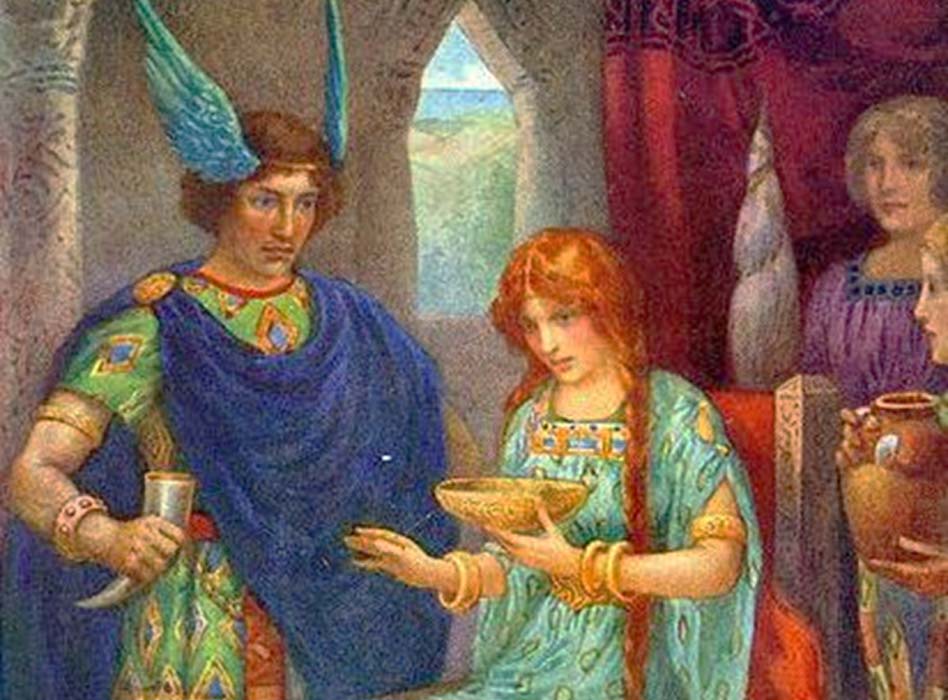
Image result for freyr gerd nine days marriage
Freyr and Gerd

Nine is an important number in Norse mythology because there are also nine worlds in Norse mythology and it represents magic and sacrifice, key themes of these pages. Other occurrences include sacrificial feasts lasting for nine days, involving nine sacrifices in Norse legends. The difference between the video and the book that I saw was how in the video, Gerd does not say yes to marrying Frey immediately and she only says yes to marriage to Frey after Skirnir had threatened to use magic against her. In contrast, in the novel Gerd is joyful when Skirnir approaches her with the news as the book states, "Gerd smiled, and her eyes shone with joy" (page 208). 

The group introduced the next story, "Hymir and Thor's Fishing Expedition" by briefly examining Thor's character. For example, he is the son of Odin, the god of thunder, lightning, storms, sacred trees, and strength. He is destined to kill and die fighting the deadly serpent Jormungandr. Therefore, Thor is destined to fight Jormungandr during Ragnarok. Reviewing the story of Hymir and Thor in the fishing expedition, Thor wants the giant, Aegir, to host a feast for the gods but this required a cauldron big enough to brew ale for all the gods. They travel to Hymir's house to obtain his cauldron but end up consuming the food that was meant to last them several days. 
They go fishing the next day for dinner and Thor rows to an area where Jormungandr lives. When Hymir cuts the fishing line and therefore, not defeating Jormungandr, Hymir comes up with the proposition that if Thor could break his favorite mug, he will give the cauldron. Eventually, Thor is successful to get the cauldron by breaking the mug on Hymir's head. 
Image result for aegir cauldron for feast
This illustration depicts Aegir, a giant who could live alongside the Aesir gods well. Aegir was the Lord of the Ocean and thus, highly respected by the Vikings. 

In the group discussion, I said that deception can be used as a means to the ends if no one is being harmed. However, Thor could've handled the situation differently by telling Hymir that he knew how the break the rock without killing the giants that chased him. Overall, Thor still attempted to face the Midgard Serpent because Thor has hubris, or excessive pride, as we discussed in previous lessons. He believed that he was able to take down any enemy despite how powerful they are. 

Reflection of the Day's Lesson: 
After discussing the two events, I learned that in the real world and in life, there are times when you must sacrifice something whether for personal gain or the greater good. Furthermore, I learned that you never know the true value of something until you no longer have it. For example, in the story of "The Story of Gerd and Frey," Frey gives away his sword to Skirnir to thank him for getting Gerd's hand in marriage. The consequences of his actions were negative as Ragnarok was coming and he didn't realize he needed the sword until "the sky splits asunder and the dark powers of Muspell march out on their war journey..." (page 209). It was also important for me to recognize that despite being faced with challenges, true bravery and consistency even though it comes from pride is a characteristic that Thor upheld and a lesson that as students, we can take away. This idea of perseverance despite adversity is crucial because as someone who is constantly learning, humans should constantly promote good morals and volunteer to benefit the world despite the tough obstacles that we encounter. Another reason why I learned that we should approach challenges with courage is to show that in Norse mythology, the gods resembled humans more than Greek mythology because although they were seen as ideal and respected as a higher power, these gods also faced difficulties when trying to achieve their goal such as Thor trying to get the cauldron. Still, he did not hesitate to stop fighting for the benefit of the other gods and for them to feast. As a result, he used his strength to tire and almost defeat Jormungandr. In Norse mythology, these gods exhibited human characteristics because they believed that the world would eventually end, focusing on gods they could relate to. Thus, as humans and Norse recognize similarily, there isn't necessarily a perfect world as they know the world will eventually end. I will use what I learned by applying these life lessons to experiences in the real world. For example, if I perform poorly on an exam, I will use this lesson to motivate me to study harder, review the information I may have missed, and adopt this new behavior to all future tests in school. Another example in which this lesson can be applied is despite wanting to stop running the immediate second I'm exhausted during training for a sport, I will persevere and finish the finish line with my goal to not give up in mind. Thus, perseverance taught me to develop the determination to succeed in any and all the challenges I come across in my life experiences. 

The Norse Gods
Norse Mythology consists of tales of various deities, beings, and heroes derived from the folk tradition, archaeological representations, and other numerous sources. 

Additional information about The Story of Gerd and Frey:
Additional information about Hymir and Thor's Fishing Expedition: https://www.youtube.com/watch?v=dk1FJSpnWZU
Additional information about the history of Viking culture, Norse Mythology, and Norse gods and goddesses such as Thor and Freya: 

Blog #44

Blog #44
Gordon Liang | Period 1
January 9, 2020

Today, Team 4 presented the lesson today focusing on the stories "Thor’s Journey to the Land of the Giants," and "The Apples of Immortality." Pages 155-197 of Neil Gaiman’s Norse Mythology


Aim: How is magic used to deceive nature and people in Norse Mythology?

"I am the giant Skrymir" (1902) by Elmer Boyd Smith.

Do Now: Think about a time you were good at something, but someone else proved that they were better at it. How do you think this applies to what we read?'

One said that he used to think he was really good at a video game, but later on he would lose to better players and soon realizes that he is actually not the best. Based on what we read, Thor, Loki, and Thialfi were challenged on what they do best. They thought no one could beat them, but in the end, no matter how hard they try, they lost the challenges. Many people would think they are the best at one thing, only to find someone better at it. This would usually result in people improving themselves to strive higher.

The Story of Thor
Thor's Fight with the Giants (1872)
by 
Mårten Eskil Winge.


• Thor is the Norse God of thunder, the sky, and agriculture. He is the son of Odin, the chief of the Gods.

• Thor is the defender of the Asgard, the realm of the Gods, and Midgard, the realm of the humans.

• Most depictions of Thor are of him slaying giants in order to protect those realms.

• Many of Thor's tales are of him fighting off the Midgard Serpent, Jörmungandr.

• Thor is doomed to die in Ragnarök to the poison of the serpent after he killed it with Mjollnir.


Thor's Journey to the Land of the Giants
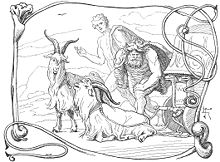
• The names of Thor's goats are Snarler and Grinder.

• Thor tells Thialfi and his family to not eat the bones of the goats

Thor notices that one of his goats has a lame leg in an illustration (1895)
by 
Lorenz Frølich

Pair-Share: Discuss why Thor told the family to not eat the goats' bones. Who ate the bone and why did they eat the bone?

Thor shares with the family the meat of his goats. As the god of mischeif, Loki will of course play tricks on others. In this case, Loki lied to Thailfi that if he ate the bone, he will become as strong as Thor. He sucks the marrow from a leg bone from one of the goats. When Thor resurrects the goats the next morning, he finds that one of the goats is lame in the leg. Eating the bones apparently would not give you powers, but instead would result in a limp leg when the goats are brought back to life.

Utgardaloki


   [The] Giant Skrymir and Thor (c. 1891)
by 
Louis Huard
 
• In Norse Mythology, Utgardaloki was the ruler of the castle of Útgarðar in Jötunheimr.

• His name literally means "Loki of the Outyards", distinguishing him from the Loki we know as Thor's companion.

• Along the journey. Thor and company have a hard time keeping up with this ruler, aka skymir, and the crew eventually settles down but is unable to retrieve their items from the giant's knapsack.

• Thor tries to deal damage to skymir with Mjollnir, but he is unfazed by any of Thor's strikes.

• Once again trickery and deception is used by Utgardaloki in challenges that the crew could not complete and our left standing in an open field instead of the castle where their feast was.

• The whole time Skymir was Utagardaloki utilizing the recurring theme of deception in Norse mythology once again.


VIDEO
The myth of Thor's journey to the land of giants - Scott A. Mellor


Discussion
1. What was the end result of all three challenges?

Even though they tried their hardest, Thor, Loki, and Thialfi were deafeated. However, they were able to impact the world and improve themselves and the world around them. 

2. Why were these the end challenges?

These were end challenges because it was impossible to beat. For example, in Thialfi's case, Thought will always be faster than action. These challenges were able explain certain phenomenons such as shifting tides when Thor was drinking the ocean and formations of valleys from Thor's blows

3. What lessons can be learned from this and how can they show the differences between Greek mythology?

Even if you lose, you can still have an impact. Similar to Greek mythology, hubris can be seen in the story. Thor, Loki, and Thialfi were so prideful and confident that they were the best in one talent. In Greek mythology, hubris will usually lead to downfall. However in this story, with hubris, the three were able to better themselves and be more humbled.

The Illusions of Their Journey
Loki's Eating Challenge:

• Loki claimed to be the world's fastest eater

• Although he consumed a lot of food, Loki was not able to beat his opponent, the King's servant.

• Loki's opponent was actually Wildfire

Thialfi's Race:

• The human could outrun anything in the wild.

• But he could not outrun the King's other servant

• His opponent was actually Thought


Thor's Three Challenges:

1. To drain a giant drinking horn with two attempts
        • The horn was filled with the ocean, Thor lowered the ocean levels

2. To pick up the King's giant cat
        • The cat was the Midgard serpent; moving the "cat's paw" is the moving of earth

3. To wrestle to old woman
        • The woman symbolizes old age (old age is supposed to weaken people till death, but Thor was not debilitated to a great extent

The giant they met along the way was actually the king in disguise, and the hammer blows created rifts and valleys.


Apples of Immortality

• Idunn, the goddess of spring or rejuvenation, is the wife of Bragi, the god of poetry.

• Idunn was the keeper of the magic apples of immortality

• Gods would eat the apples to preserve their youth

• One day, Loki passed by Idunn and told her that he needed one of her apple of immortality because he feels age upon him.

• When Idunn gives Loki a golden apple, Loki responds that he thought that Idunn would have better apples than that.
Iðunn is carried off by Þjazi in this artwork
by 
Harry George Theaker, 1920

• Normally gods talked about the perfection of flavor and how good it was to feel young again.

• Loki convinced Idunn that there was apples in the forest that were finer than her apples.

• As they walk into the forest to compare those finer apples with her own apples, Idunn realizes that there is only a tall pine tree with an eagle in it.

• It was no eagle, but rather the giant Thiazi in eagle shape to claim the beautiful Idunn. It soon seized Idunn and her box of apples.

• As the gods began to age, they forced Loki to retrieve Idunn back with her apples

• Thiazi chased after Loki after realizing that he had taken Idunn, but he flew into the flames prepared for him and Thor's hammer parted Thiazi from his life.

• Skadi went to Asgard to avenge her dead father. To which they compromised that first Skadki would be given a husband (Balder), second the gods would make her laugh again, and finally, the gods would make sure her father would never be forgotten.

                                                       
Group Discussion: Why did Loki trick Idunn to go into the forest to meet Thiazi? Do you think his reason justifies his actions?

Loki threw a spear at Thiazi, but while Loki was still clinging to the other end, Thiazi flew up into the sky bringing Loki with him. Loki begged the eagle to release him, but the eagle refused to do so until Loki swore an oath to bring him Idunn and her apples. Loki was not justified because he could have find a way to trick Thiazi or to ignore it. He brought this to himself and it is wrong to risk an innocent life for his own good. However, there was nothing Loki could really do about it because his life was at risk.

Connection to Real World
The Apples of Immortality:

• This myth can be connected to the religions of Christianity and the Celts as both have a somewhat similar representation of the apple.

• When Christ is portrayed holding the apple, he represents the Second Adam who brings life, It is similar to how the apples allow the gods to preserve their youthful appearance.

• During Allantis, people give polished Allan apples to their friends and family as tokens of good luck

• The Vikings formulated their views on the gods based on how they saw divinity (what specific things they do/have done, instead of how they are a god)

• They also have similar attributes to humans:
⤷ Hunger, pain, death
⤷ Physical weakness
⤷ Determination, Hubris, Humility
⤷ Deceit

Lessons Learned
Thor's Journey to the Land of the Giants:

☆ Nothing is as it seems
 Continue past the belief of defeat
 Fire destroys everything in its path
 Thought is always faster than action
 Old age weakens everyone eventually
 You should take a humble approach to everything
 Even gods have limitations
 Determination has its rewards

The Apples of Immortality:

 To not be too greedy
 Laughter is a better solution than anger and violence

Reflection

With the two stories we read, we were able to see how magic is used as a form of deception and that things are not always what they seem. In the first story, "Thor’s Journey to the Land of the Giants," the giant used magic to trick Thor and his companions to push themselves past their limit. The competitors were actually illusions Loki had actually competed against wildfire itself Thialfi had raced against thought , Thor had actually drank from the ocean and created tides. The cat that Thor attempted to lift was in actuality Jörmungand. The old woman was Old Age and there is no one that old age cannot bring down. In the second story, "The Apples of Immortality," with shape-shifting powers and Freya's magical robe, Loki was able to transform into a bird and Idunn was transformed into nut to deceive the giants and allow her to escape. The group presented very well. They elaborated a lot on the stories, especially on the lessons learned and themes rather then just reading on the slides. They went over about everything on both the stories and each member seemed to contributed a good portion. One mistake, however, was that Skadi never married Baldi, but she did marry Njord through the selection of the finest feet. The pacing was steady and they used their time very wisely. Overall, the presentation was straightfoward and really well put together.


Thursday, December 12, 2019

Zuting Chen 12/12/2019 Period 1 Blog #37


Aim: How does the story of Noah’s Ark symbolically serve humanity?

Do Now: What crimes are so heinous that God would require an Earth-wide purification?

We had a variety of responses, from rape to genocide. When murder was brought up,  it seems to occur in a lot of cases, yet we’re still shocked with each incident. It’s evident in news; if people were moved by such “heinous” acts, then that would suffice as a news story. On an even bigger scale are mass shootings or genocide, which are often carried out by prominent individuals, as with the case of the Holocaust.

Some others in the class added that God might have wanted to hit “reset” due to people being selfish, violent, or overall very corrupt, which contradicts the morals that God stands for.

But in it all, should an individual’s actions (or those of a small group) affect humanity altogether? Would the Holocaust warrant God to restart the entire Earth?

Ancient floods are floods sent by deities or the divine. It originated in Mesopotamia, but almost every culture has a flood myth. In many of those stories, it’s to cleanse or to punish.

The story of Noah’s Arc resulted from a similar flood sent by God to wipe out humanity. Noah, a worthy person, agreed to build and go on the Ark. He was to take seven pairs of clean animals and one pair of not clean animals. When it opened, two of each animal came, a male and female.

Humans, despite the self-centered position we often think of, weren’t given special consideration. The only thing that makes them distinct from the other animals is that they built the Ark.

But how does God’s control over nature (fire, water, earth, and air) in Judeo-Christianity compare to that of Greek Mythology?

Unlike many other cultures that have flood myths, Noah’s Ark revolves around one God. In Greek Mythology, many gods are each in control of certain elements or aspects. Those gods are subject to imperfections and flaws similar to humanity, making nature less predictable. God in Judeo-Christinaity, is the one sole being whose actions are wise and justified.

We watched this video about the Noah’s Ark replica in Kentucky, as covered by Fox News:

In this video, the news reporter spoke about the opening of the museum, the prospects it’ll bring, and what conflicts she presumed would occur (as a result of separation of church and state).

We ended on a dark note: Is humanity doomed?

Imperfections might suggest doom, but I don’t see it that way. Humans are imperfect, but in the few cases of perfection, it’s amazing.

Besides, the only one who’s perfect is God.

Reflection:
These are among some of the first few lessons I’ve had about stories in the Bible, which I’m not that familiar with (despite the numerous allusions in literature). I found it interesting how many cultures have references to a flood story. I distinctly remember the ones from the River-Valley civilizations (such as Mesopotamia), where it was suggested that a divine being wanted to destroy the civilization. Overall, this continues to establish God as a wise and omnipotent being; no human is as wise or perfect to fully understand God, as was with the ending of The Book of Job.

Blog #36

12/11/19
Jason Chen P1
Modern Myth 2020
The Book of Revelation

    In today’s class, we received a lesson from Mr. Misciagna on the Book of Revelation, breaking down the symbols and repetition in the book. The Book of Revelation was written by John the Apostle, the last living apostle. He wrote the book. The book was broken up into three sections described as “things which thou hast seen”, “things which are”, and “things which shall be hereafter”. These sections break up the book into the past, present, and the future.
    First, we were asked to name some of the things we read in the book, and then we dove into the symbols patterns that we saw with all the different items we listed. For example some of the patterns we saw were the number 7, the antichrist, destruction, and the four viewpoints. By looking at all the symbols on continues we begin to understand that the book of revelation is the same story, but told from 4 different points of views. The main timeline of the Book of Revelation can be broken down to Recompense, Ruin, Return, Righteousness, Restoration, and Rejoicing. 
Student Reflection:
Not having any previous experiences with the Book of Revelations, my eyes were opened up to how symbolize and repetition can come together to create a coherent story and theme. But at the Book of Revelations maintains an element of open endedness to the point where any reader can have their own interpretation of the meanings behind the symbolism. My interpretation of the cycle of Recompense, Ruin, Return, Righteousness, Restoration, and Rejoicing is that humanity will never be stagnant but instead between an equilibrium of chaos and order in the cycle of purging the world of the “Ruin” and “Return”. Although this is how I may view it I learned today that anyone can interpret the Book of Revelations anyway they want and their takeaway is personalized to their views.


Tuesday, November 26, 2019

Modern Mythology 2020

Victoria Pimenta Reyes
11/26/19
Ms. Peterson
Post #31

Aim: How does the paradox of blindness illuminate the Oedipus' tragic flaw of hubris

DN: Complete group work from yesterday
Irony Trumps Everything
Create a chart of irony in Oedipus
Oedipus saves Thebes from a plage by solving Sphinx's riddle -> He freed Thebes from a plague but he became the plague
Oedipus curses the murderer of Laius -> He is the murderer of Laius
Teiresias is blind -> but he sees the truth

Pair Share: Choose
  1. All truths, whether they hurt, destroy, unveil, or enlighten must be discovered
  2. Truth is a commodity which should be careful and tactful, used only when beneficial
  3. Write your own
I agree with option 2 because ignorance can be bliss. There's no need to unnecessarily expose things that don't need to be. Some lies can benefit both people, like complimenting a bad haircut. 
It sounds like a politician. 
There's a time and a place for truth because it can be offensive and tactless. 

People said option 1 because the truth should always be told. 

Option 3 some truths should be avoided if they benefit no one.


How do the characters fall into these options?
Oedipus falls into Option 1 because he wants to find out what Teiresias has to say, no matter the possible consequences
Teiresias falls into Option 2 because he believes Oedipus shouldn't know who the murderer is because it will make Oedipus and his family suffer

Paradox (n): A statement or proposition despite sound (or apparent reasoning from acceptable premises, leads to a conclusion that seems senses, logically unacceptable, or self-contradictory

Discussion: Why is it significant the play begins w a question?
The question is "Children, young sons and daughters of Cadmus, why do you sit here with your suppliant crowns?", asked by Oedipus
This is significant because it sets the tone of the play

Read Aloud pg 122- 131
Oedipus argues with Teiresias to tell him more about the murderer, but Teiresias refuses. When Teiresias gives in, revealing Oedipus is the murderer. Oedipus gets offended and threatens Teiresias for disrespecting the king, accusing him of treason. He believes that Creon, his brother in law, was conspiring with Teiresias to steal the throne. As he leaves, Teiresias reveals Oedipus is in an incestuous relationship with his own mother.

Pair Share 
  • What initial signs of rashness do we see in Oedipus?
  • Why does Teiresias argue so hard against telling Oedipus anything
  • What does this illustrate about his character?
Reflection:
The purpose of today's lesson was to examine the use of irony and paradox in Oedipus Rex, as well as begin to characterize Oedipus and Teiresias. It's ironic that Teiresias is the blind prophet, yet it is Oedipus who refuses to see the truth. In this tragedy, there are both literal and figurative cases of blindness. Oedipus is blind to the truth that Teiresias tells him because he is too prideful to accept that he is bringing plague to Thebes and that he killed the honorable King Laius, and instead turns his anger to Teiresias.

Friday, November 22, 2019

Modern Mythology 2020

Blog #29
Andrew Ou
11/22/19

Aim: What are the attributes of Greek Drama?
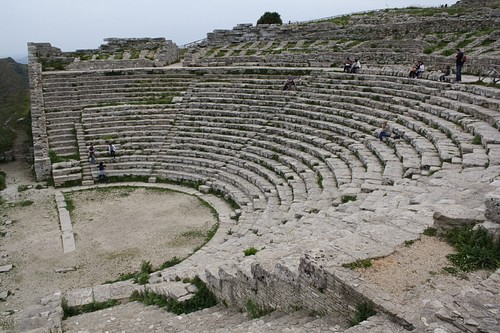
Today in class we talked about the attributes to Greek Drama. We started the class by talking about the Amphitheater. The Amphitheater was an open circular or oval building with a central space surrounded by tiers of seats for spectators, for the presentation of dramatic or sporting events.
After we discussed about Amphitheaters we talked about dramatic irony. Dramatic Irony is irony that is inherent in speeches or a situation of a drama and is understood by the audience but not grasped by the characters in the play.

The Chorus was a central feature of Greek Drama. The Chorus was composed of similarly costumed men on the orchestra, located beneath the stage. The chorus was in the orchestra for the duration of the performance to observe and comment on the action of the actors. Dialogue consisted of long, formal speeches in verse.
The Strophe was the first part of the choral ode. It was the movement of the Classical Greek chorus while turning from one side to the other side of the orchestra. The Antistrophe was the second part of the choral ode. It was a returning movement in Greek choral dance.  

Appositive
An appositive is a noun or noun phrase that renames another noun right beside it. The appositive can be a short or long combination of words. Examples of appositives are:
  • The insect, a cockroach, is crawling across the kitchen table.
  • The insect, a large cockroach, is crawling across the kitchen table.
  • The insect, a large cockroach with hairy legs, is crawling across the kitchen table.
  • The insect, a large, hairy-legged cockroach that has spied my bowl of oatmeal, is crawling across the kitchen table.
Reflection:
Today's lesson was important because modern drama/theatre is similar to Greek drama/theatre. Although Greek Drama was started a long time ago we still see it in our lives today. For example, the amphitheater is still designed used by many theaters. Modern theaters use the same design of a central space surrounded by seats for spectators but the main difference is most theaters are in doors, rather than outdoors. Greek Drama/theatre has been here a long time and it is important for everyone to understand where it came from because it will be a part of us forever. 

Thursday, November 21, 2019

Modern Mythology 2020

Jeslyn Mei                                                                                                   Modern Mythology Period 1
Ms. Peterson                                                                                                              November 21, 2019

Blog #28

Aim: What are the attributes of Greek Drama?

Lesson Notes:
Today in class, we discussed in our groups our decisions for four scenarios and whether that decision was based on emotions or reasoning. The first scenario was "A leader for whom you have the utmost respect is making a terrible decision. Telling him/her would cast you out of his/her graces; not telling him/her would lead to the failure and destruction of this leader." Our group discussed that we would tell the leader because the leader holds great responsibility for his/her people. Thus, not telling the leader of his/her mistake would affect the people negatively rather than simply just the leader. Furthermore, if the leader is a good person and has good intentions for his/her people, I would tell the leader of the bad decision they are making. My decision is based on reasoning because affecting the welfare and greater good of the people would have a more drastic effect than affecting my relationship with the leader. The second scenario was "You are a great leader, but your people are suffering through a plague. You can save your people, but it would cost you the reputation of your husband/wife and children; they would not be banished, but forced to walk with shame for the remainder of their lives." This scenario was similar to the first scenario because as my teammates and I discussed, we would rather save the lives of our people because as a leader, it is your duty to ensure that your people's needs are satisfied and to respond quickly during emergencies. The third scenario was "Someone has murdered your parent. To learn who would be at an even greater shock and devastation than what you are facing, but you have the power to learn that truth." My group and I came to the conclusion that we would want to know who that person is to have closure. However, since our decisions are based on emotions rather than reasoning for this scenario, other groups mentioned that they wouldn't want to know because they would want to get revenge. The fourth scenario was "Previously imperceptible, you recently learning that your spouse of many years, with whom you've had children, is a direct kin relation. Your spouse is oblivious to this fact." My classmates mentioned how they would tell the spouse and allow the future to unfold itself. I agreed with this response because morally, I believe the spouse has the right to know about this important detail. We discussed these scenarios because it relates to how people went to watch Greek Dramas to empathize with the characters and cry out at the dramatic irony. Dramatic irony is irony that is inherent in a situation of a drama and is understood by the audience but not grasped by the characters in the play. An important aspect of Greek Dramas is the fact that the audience must empathize with the characters such as the protagonist. This process is necessary for the audience to experience catharsis, the purging of emotions. 

Before learning about the background of Oedipus Rex, we solved the riddle: "What has four legs in the morning, two legs in the afternoon, and three legs in the evening?" The answer was a person because metaphorically, babies in the morning or childhood go about on all four legs. In the afternoon or during adulthood, humans will walk with two legs until the evening or old age when humans will require a cane to support himself. This explains why people will have three legs in the evening and introduces a riddle that Oedipus encounters when he visits the Sphinx. We were then introduced to Oedipus Rex and that it was written in 459 BC, "Rex" means "King," and the setting of the play begins where Oedipus is already the King of Thebes. It goes into detail on how Oedipus comes to his throne and eventually falls. 

We then learned about the essential characteristics of Greek Drama, according to Aristotle in Poetics. These characteristics are: 
  • It is mimetic (imitation, in particular. Representation or imitation of the real world in art and literature.)
  • It is serious
  • It tells a full story of an appropriate length
  • It contains rhythm and harmony
  • Rhythm and harmony occur in different combinations in different parts of the tragedy
  • It is performed rather than narrated
  • It arouses feelings of pity and fear and then pursues these feelings through catharsis
We discussed how a tragedy consists of six different parts which are (in the order of most important to least important): plot, character, thought, diction, melody, and spectacle. We elaborated on the attributes of Greek Drama by learning about how Catharsis is purification of emotions. The term was used by Aristotle to describe the effect on the audience of a tragedy acted out on a theater stage which relates back to the purpose we learned about people attending Greek Dramas in theaters. By watching these Dramas, audience members can release their tension and disturbing emotions as a result of (1) resolving to avoid conflicts of the main character or (2) transferring their own pity and fear to the main character. As a result, the audience members are able to release these negative emotions. We also learned that the overall effect of watching Greek Dramas is the feeling of tranquility and as an improved person intellectually, morally, or socially. I learned the definition of catharsis and how the term might apply to Greek Dramas because it relates back to why Greek Dramas were relevant and popular over 2,500 years ago. People were able to purge themselves of negative emotions whether that experience was real or imagined. This was a common belief shared by most people of the century and connected people of different backgrounds because they came together for a common purpose which was to become a better person socially, morally, and intellectually. The idea of catharsis is one example of an attribute in Greek Dramas and the role they play is the bringing of radical change in a person. People were able to discover more about themselves and release the negative aspects they did not favor about themselves through quality and dramatic Greek Dramas.

Reflection:
I learned about the distinct characteristics in Greek Dramas because I'm now able to recognize an example in works of literature such as books. Furthermore, Greek Dramas have contributed to the definition and importance of Dramatic Plays. Similar to dramatic plays we watch today, both Greek Dramas and current dramatic plays consist of performers that engage with the audience through the narration of their lines. I also learned from today's lesson that Greeks made the distinction between Greek Dramas and comedies because one characteristic of Greek Dramas was that they do not have comedic lines and are rather serious. However, today, we see the merging of dramas and comedies in shows and movies which represents a departure in the interests of people in regards to theater shows. I will use what I learned today by making connections between dramas I watch in the theater to Greek Dramas because Greek Dramas was one of the earliest forms of dramas we watch today. The characteristics of modern-day dramas derive from Greeks because most, if not all, dramatic plays have a sequential and coherent storyline. Another detail I learned today was the significance of taking notes and writing down the important facts because I'm able to refer back to the notes in the future and make better sense of the text by going over what I wrote down. I will use what I learned by being an active student and taking notes of the daily lessons so that I can pay attention to detail I may have missed while discussing the new information in class. In the future, I'm able to organize and prioritize the new information by deciding on what are the key ideas I'm reading and what are not necessary to note down in my notebook.

Overall, as a student in a Modern Mythology class, it is important to make the connection between modern drama and Greek Dramas. Some movies today continue to follow the format of these Greek Dramas such as a protagonist being defeated due to hamartia, a fatal flaw as discussed in previous lessons. By the end of the lesson, I was able to recognize the importance of Greek Dramas to today and to Greek citizens. Stories like Oedipus, such as one described in the novel Mythology by Edith Hamilton, provide insights into human nature and our desire to release disturbing emotions such as fear and pity by watching greek dramas being acted out on a theater stage.

Image result for greek dramas
This illustration is an amphitheater where Greek Dramas were performed and is one attribute of Greek dramas.

Image result for greek dramas plays
Greek tragedies often wore masks to express the emotions they wanted to portray and evoke specific emotions in their audiences such as feelings of pity and fear. 

Additional information about Greek dramas and its defining characteristics: https://www.metmuseum.org/toah/hd/thtr/hd_thtr.htm 

Tuesday, November 19, 2019

Blog #26

Blog #26
Gordon Liang | Period 1                               
November 19, 2019

Today we presented our projects for the Mythology Creation Project.

First to present is Team Ares.
They presented Taoism/Daoism using an illustrated piece and slides presentation.

TAOISM/DAOISM CREATION STORY
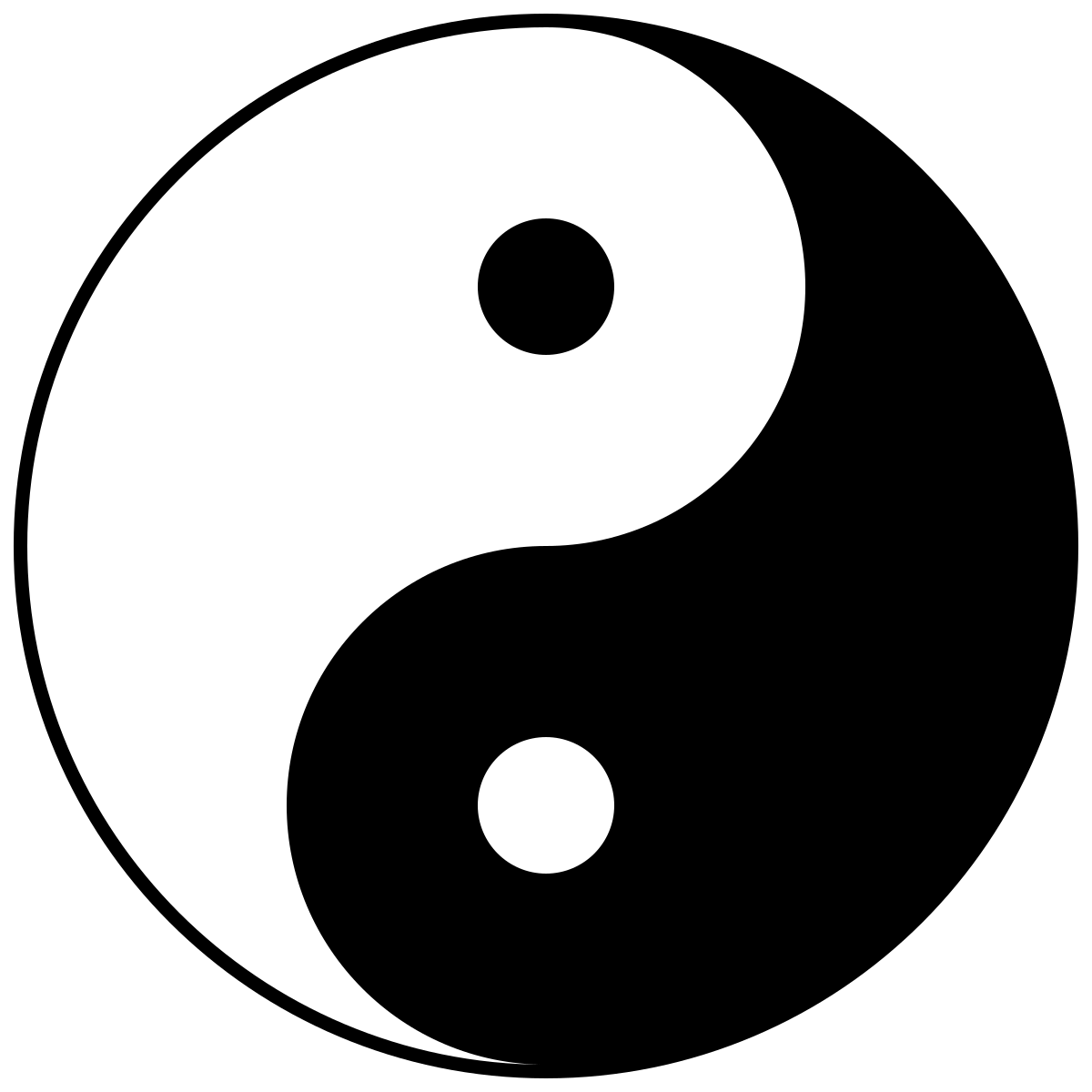
Image result for yin yang
Yin and Yang

Background

- originated in China around 4th or 3rd century BCE
- attributed to Lao Tzu
- official religion under Tang Dynasty
- Daoism is a complete philosophy of life reaching into religion, social actions, health

Yin Yang Symbol

- Yin = dark and shadows
- Yang = light, passion, growth

Major Gods

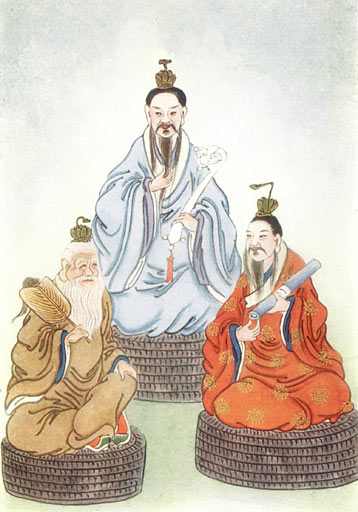
Three Pure Ones

- Three Pure Ones are highest gods in Taoist religion
- Tao produced one, one produced two, two produced three, and three produced all things

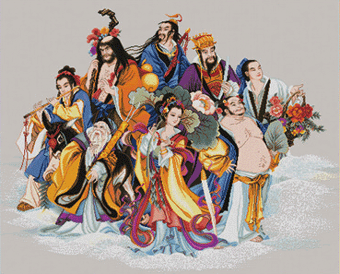
Eight Immortals

Eight Immortals

- They have the ability to transform into different creatures and objects, 
- controls people, animals, and objects through control of qi

How the Universe Came

- Similar to the Greek creation story, everything started with chaos, but the Chinese
further compared it to an egg
- Pan Gu was the first man to come from chaos (an egg) with two horns, two tusks, and a hairy body.

Important Concepts

- simplicity, patience, and compassion
- talks about daily problems mankind faces
- "when nothing is done,  nothing is left undone"

--------------------------------

Next to present is Team Zeus
They presented Hinduism using a sculpture of a god and a slides presentation

HINDUISM CREATION STORY
Team Zeus’ Creation

Background

- oldest religion, 4000+ years old
- no consistent structure- Vedas, Brahmans, Puranas
- nothing is fixed
- dharma- code of living that emphasizes morality
- henotheistic- worship single deity but recognizes other gods and goddess

Creation

- believed in periodic cycles of creation
- Hindu Trinity- creation and destruction of the world
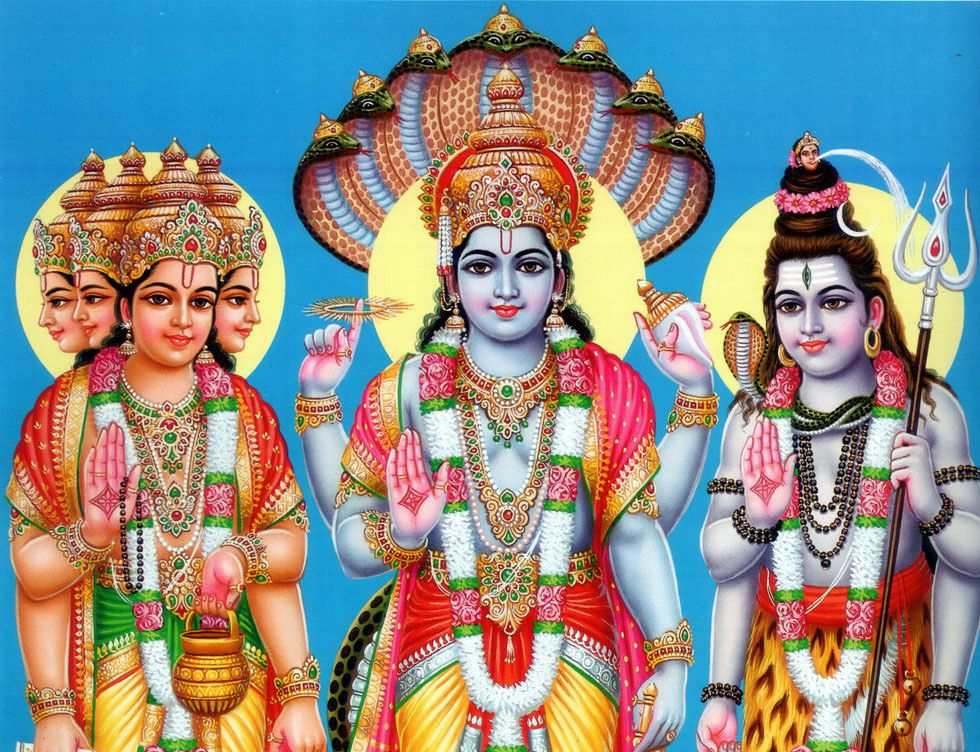
- Brahma: creator, Shiva: destroyer, Vishnu: sustainer
- Lotus Creation Story: lotus sprouted from Vishnu navel with Brahma seated in it
- Cosmic Egg Story: Brahman created seeds that transforms into golden egg which Brahma sprang

Deities

Brahma, Vishnu, Shiva
- Brahma
       - 4 heads recites four Vedas: rosary( meditation), Veda books (knowledge),
holy water (origins of the universe), lotus lower (nature and fertility of life)
- Vishnu
      - goal is to preserve and protect the universe
      - keep balance of good and evil
      - 4 arms holds conch (sound of creation), discus (mind), lotus (existence and freedom),
mace (physical and mental strength)
- Shiva 
      - goals was to destroy the world
      - 3 eyes third represents wisdom and insight
      - cobra necklace: power over over of the most dangerous creature
master of dance.  Tandav dance: cosmic dance of death
- Ganesha- remover of obstacles and new beginning
- Rama- often called before before death
- Hanuman- strength and energy
- Krishna- divine music

VS Modern Day

- Big bang- one cycle of any and before Brahma nothing and darkness, infinite cycle and prayala
- Multiverse theory- universe is one of many
- Twin paradox- Purana

---------------------------------

Reflection
The two groups presented excellently today and their projects were very creative and engaging. I learned a lot about two religions: Taoism and Hinduism. It was very interesting to learn about different people’s perspective on how the world came to be and similarities to today’s theories on the creation of the world. Team Ares did well on explaining the concepts and background of Taoism and Team Zeus did well on comparing Hinduism beliefs to modern day. It was really notable to have this project showcasing other religions and cultures.