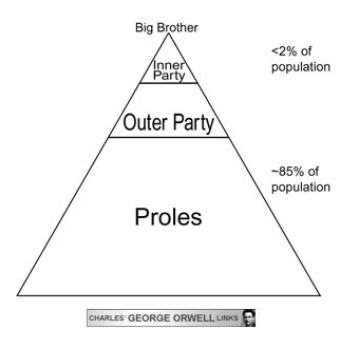
Tuesday, June 2, 2020

Blog #48- Annie Jiang- Period 2- 6/1/2020

Aim: How is the theme, “the importance of having knowledge about the past in order to understand the future” exemplified/elucidated through Winston’s time in the Prole District?

Do Now

  1. What are some of the “lies/stories” parents tell their children?

  • Storks deliver babies

  • It takes 7 years to digest gum

  1. Why do you believe they tell these stories, rather than the truth?

  • Parents tell their children that they came from storks because they don’t think the children are ready to know the truth since it can be a gruesome topic.

  • They’ll say things like gum takes a long time to swallow to prevent children from developing these potentially bad habits and to ultimately have control over their kids’ health.

  1. What might be a history “lie/story” a school has taught/told you?

  • In elementary school I was taught that Christopher Columbus “discovered” America and he was deemed a hero. In later years I learned that Columbus wasn’t as great as he seemed, and his “discovery” contributed to the death and torture of numerous Native Americans.


Group Discussion:

“In the end the Party would announce that two and two made five, and you would have to believe it.”


Analyze Winston’s statement above. How do you explain his example. What are your thoughts on the matter?

  • Winston’s example shows that the group with the most authority could change the way people think, ultimately brainwashing them. This is frustrating to me because the group in the power position is putting untrue ideas into people’s heads to fit their own agenda. 

What do you think the author’s intention or purpose is for the reader to have as a takeaway about the world you/we live in?

  • I think the author’s intention is to inform people that not everything the government tells you is true and to encourage people to not be afraid to question what the government does.


Group Work:

  • Winston is clearly on a quest for the truth from the past. He states, “If there’s hope, it lies in the proles.”

  • Work together to assess if Winston is correct. Consider the different age groups.

  • If he is/isn’t explain how things would unfold for success or failure to occur. Consider the government’s role in all of this as well.

  • Are there specific actions or events that need to occur to guarantee success/failure? If so, what?

Whether Winston is correct or not depends largely on the actions of the proles. They are the ones who aren’t brainwashed by the government and have the ability to to rebel, but if they don’t put those abilities to use nothing will change. The older age group might be more motivated to rebel because they remember the time before society was like this. A revolution would need to occur to guarantee success because it would expose the government therefore allowing people to see how messed up it is.


Whole Class Discussion:

What do you make of Winston (unconsciously) finding himself back at the very junk shop where he bought the diary?

  • It’s something important to him.

Why does he appear to be so drawn to the paperweight?

  • It gives him a connection to the past.

What are your opinions of the room, which has no telescreen?

  • It’s a sign of freedom seeing as how he’s not being watched.

Why do you suppose he decides he will continue to return to the shop, despite the risks? Foreshadowing?

  • I think he feels security in being in the shop. His constant returns might foreshadow that he will be found out and face serious consequences.


What is it like working from home?

Working from home has taken some stress out of my life when schools were open. For example, I don’t have to worry about missing the train every morning. But admittedly, remote learning has added a lot of other stress too. Sometimes I’m swamped with work and sometimes it’s hard to maintain my sleep schedule.

What are the updates around the work/community regarding the virus?

As of today, NYC is planned to reopen next week, the 8th. But with the #BlackLivesMatter protests going on, the virus could spread even more.

Your own personal feelings and thoughts about what is happening right now.

It’s saddening to see that people have to fight for their rights and that they didn’t really have them in the first place.  In these dire times, I hope everyone stays safe and gets the justice they deserve.

Reflection:

In this lesson, I learned that it is important to be aware of what the media says and to be able to discern truths and lies. In this day and age when we consume a lot of media every day, it’s easy for authorities to make us believe what they want. Therefore we have to see things for ourselves and determine if we want to believe in them or not. I will use what I learned in the future by reminding myself to find multiple sources about the same topic and develop my own opinion instead of following others. Also, this reminds me of the ongoing #BlackLivesMatter movement where people are fighting against police brutality and systemic racism which are so deeply rooted into our society. The media depicts protesters as rowdy and violent but the protesters post videos of themselves cleaning up the streets after the protests have happened. So, there are always different sides to a story, and not all of them are true.


Blog 43 Lisa Gerasimova, Period 3 5/20/2020


Aim: How and why does Winston manage to resist the manipulative power of language and mob mentality?
  1. What is it like working from home?
    1. Working from home is very different from going to school. It would seem that you have a lot of time to get work done, but the reality is that without waking up on a schedule and having an environment specifically dedicated to working, motivation dips and it becomes harder and harder to complete work. It also is saddening to only be able to communicate with people through a screen, it isn’t the same as having a discussion in a room with people who are able to really see your emotion and your point in the discussions. It is a challenge, but we are all doing our best.
  2. What did you learn in your online English class?
    1. In this class I learned about how quickly a person in charge can administer absolute power over people. We were having a discussion in which Ms. Peterson was asking us what we saw while secretly watching what people did behind their screens. When I told her that people were being suspicious and kept looking up at their screens and then down, as if watching people (because that is what they were doing) she pretended to deduct points from my team for saying something she claimed to disagree with. It taught us that even if you are correct, it does not mean that those thoughts will be accepted, and you may even be penalized for them.
  3. What are your thoughts regarding the reading? 
    1. I think the book in general is very interesting and brings to light many issues which we may not be privy to in real life. Throughout this reading mob mentality and the manipulative power of language were touched upon. The reading gave me a weirdly existentially chaotic feeling, most of the readings do, because some of the absurdities you witness in the book aren’t too far off from what we may experience in our real lives.

Student Reflection:
  1. I realized how easy it is for people in charge to use words to manipulate the world around us, to skew the views of the people below them in order to benefit themselves. I find it grounding and eye-opening to see the flaws of our society reflected in the society in the novel, and while originally you may think that their flaws are highly exaggerated versions of yours, as you read and think you come to see that the book is alarmingly similar to our reality.
  2. I learned this because it is important for everyone in our societies to be hyper aware of what goes on around them and how easy it would be for all of us to be taken advantage of. I learned this so that me and my classmates don’t become sheep, blindly following the rules of society without questioning their impact on our lives and our rights.
  3. I will use what I learned to be more aware of the world around me, to make sure that when something seems wrong I am able to use my voice to try and make things right. I will use this information to ensure that neither I nor anyone else is taken advantage of by people above us against our wills and basic human rights.

Blog #44 - Karen Khvan - Period 1 - 5/26/2020

Karen’s Khvan                                                                                                          #10
Period 1                              
Freshmen 2020
Aim: How does Homer further develop Odysseus’ characterization as a cunning hero in his exchange with both the suitors and his wife, Penelope?

Do Now: In the do now, we discussed how we would act if a family member or close friend of ours disappeared for twenty years. And although the answers seemed to vary, most people agreed that they would maintain hope that they would remain alive, but wold still try to conduct their life and go around their day as best they could.

We then read both “The suitors” and “Penelope” by homer. 

The Suitors summary:
In “The Suitors”, Odysseus arrives at his own home, still disguised as a beggar. There, he meets the suitors that have been living in his house ever since he left for Troy. He asked the “leader”, Antinous, for food and water; Antinous ridiculed and humiliated him. When Odysseus responded to the tauntings, Antinous struck him. Odyssues did his best to not allow his emotions overcome him in the moment in order to keep up his beggar facade; he simply shrugged it off. Shortly after, we meet Penelope, who scorns Antinous for his actions and proceeds to interrogate Odysseus. 

Penelope summary:
In “Penelope”, the passage starts off by showing the conversation between Penelope and the still disguised. Penelope reveals that she has been putting off marrying the suitors by creating a weave. She told the suitors that she would marry one of them when she finished weaving- however, at night, she would go and unweave what she had done the previous day. This bought her a lot of time, until one day she was discovered in the act. The suitors forced her to finish it, and she was slowly running out of time. Odysseus, still in his beggar form, tells her that he will come home, and that she should buy out as much time as she can.


Student reflection:
  • I learned that Odysseus has changed throughout the books. He is no longer this rash and impulsive leader, but a reserved and cautious hero.
  • I learned it through the two texts that we read, along with comparing it to previous passages and his actions before and after. 
  • I will use what I learned in things like future examinations/assignments and things of that nature.

Three blogging questions:
  1. I thought that this reading truly showed how much Odysseus has developed as a character. Instead of lashing out on Antonius like he would have earlier in the books, he knew that he had to be patient and remain calm, even though he was just physically attacked. He was calm and peaceful during the whole beginning part of the scheme, since he knew that his plan would not work if he started lashing out and acting rude. This shows a big change in his personality from the beginning of the books, since he used to be very rash and uncalculating.
  2. There are not many updates about the virus right now- however, we do know that when we go back to school, there is a chance that there are a lot of safety precautions that are going to be put in place; for instance, desks will have to be six feet apart, students will have to wear masks and gloves, and there will be staggered arrival/ dismissal times. Although I don’t know if its true, if it is then I am not looking forwards to going back to school.
  3. There is a lot in the world happening right now- one of them is the black lives matter movement. I feel that the media is not correctly covering it; they tend to show the destruction and make the protesters as antagonists, when in reality the police are the ones tear gassing peaceful protesters. The media does not cover everything, including the clean up of the protests and riots where people are coming together, or even the peaceful protests that are going on in places like New Jersey. Overall, the media is creating a very negative perspective on these people and this event, when it should be a symbol of change.

Monday, June 1, 2020

Blog #40 Holly Denig Period 2 5/19/202

Sophomore 2020

5/19, #40, Holly Denig, period 2 

Aim:Aim: How and why does Winston manage to resist the manipulative power of language and mob mentality?

First we kicked off the lesson with the Do Now, in which we had to observe 3 classmates and report what we saw to “Big Brother”. The points system was used to motivate us to “snitch” on our classmates. This was used to show us how the government system in 1984 was configured to make people snitch on each other. 

The next slide included a bulleted list summarizing the unfair qualities about 1984. Overall, the system manipulated people in order to control their thoughts. For example, fear, and limiting the words that people knew were used to regulate the public’s thoughts. People were manipulated to praise and obey big brother. 

After this, we reviewed Thoughtcrimes. Crime Think is essentially betraying the government by thinking something that you are not supposed to think. These are controlled by Newspeak, which was used to limit the availability of words. If you don’t have the word to express a thought, you can’t think that thought.

Then we analyzed double think, which is a contradictory statement, such as “war is peace.” We did a team activity where we had to create examples of double think as a motto for NYC. Max P shared the example of “rich city with poor people”, and Max M had said “poverty Is wealth.” Both of these exemplify double think because the statement contradicts itself.


Working at home does pose its challenges but I’m getting more and more used to it and falling into a routine. Although it can be difficult to stay motivated and focused, i'm doing my best to keep a good schedule and stay on top of my work with all subjects, especially with my upcoming Ap exam and certiport certification assessment, which are both factors of stress for me in this new system. Today we switched back to zoom from google meets, which was a difficult transition for some students. I didn’t really struggle much and personally, I prefer zoom and am happy to be using it again. 

As for my personal feelings about what’s happening right now, I’m worried about the city jumping the gun on opening back up. I’m seeing that some stores are opening again, and many people aren’t still social distancing. I still think that it is important to continue wearing masks and gloves, and for people to not go and see other people that they are not quarantined with. 

Reflection: 
Today I learned more about doublethink and was able to develop a deeper understanding of it by creating my own examples. I now understand how they can be used to manipulate people, by causing them to associate two things or think a different way, which I will apply to my readings of 1984. I also better understand Thoughtcrimes, and the motivation behind regulating thoughts. Everything I learned today will help me to grasp a fuller understanding of the novel, as well as the concept of big brother watching and controlling people, and how this is done. 

Blog #46 - Lucy Kwan - Period 3 - 06/01/2020

June 1st, 2020
Lucy Kwan
Sophomore English, Pd 3


Aim: How is the theme, “"the importance of having knowledge about the past in order to understand the future" exemplified/elucidated through Winston’s time in the Prole District?”


Do Now: 
  1. What are some of the “lies/stories” parents tell their children?
    1. We were given time to think about these questions on our own, then we discussed amongst the whole class. Individually, I thought of how parents often sugarcoat hard topics for children, like saying a parent went “to buy milk” when in reality, they would never come back. Some topics that were talked about in the whole-class discussion included the lie of carrots being good for eyesight and the existence of characters like Santa and the Tooth Fairy.
  2. Why do you believe they tell these stories, rather than the truth?
    1. Many of these lies are told to make children behave, as they incentivize good behavior in exchange for rewards. We also noticed how the stories of magical beings often can ignite a child’s imagination.
  3. What might be a history “lie/story” a school has taught/told you?
    1. Most notably, our history tends to favor the European colonists and glorify them, especially to little children. For example, children are taught that native Americans were friendly with the settlers, whereas the truth is that European colonists were often cruel to the native peoples.


The First Thanksgiving


We read about the lie that children are told regarding the first Thanksgiving. The Pilgrims are glorified in schools, but the truth is that rather than being friendly with the natives, they had caused a plague that wiped out a large percentage of the native tribes. Afterwards, when faced with cleanup, the Pilgrims would move to the next tribe and repeat the carnage, sometimes stealing supplies from weakened native settlements. In addition, Virginian settlers were cannibalizing the native people.


How is history manipulated in this story?
  • In the version we are told in school, the Pilgrims are said to be friends with the natives, and until you learn otherwise, it’s easy to accept that as fact. However, it is only due to this manipulation of history that we have holidays like Thanksgiving, because without this glorification we would not have reason to celebrate such horrible acts.
Group Discussion
“In the end the Party would announce that two and two made five, and you would have to believe it.”
  1. Analyze Winston’s statement above. How do you explain his example? What are your thoughts on the matter?
    1. Winston’s statement is a prime example of the extent of manipulation the Party has already accumulated. Since we know that 2 + 2 = 4 is an undeniable truth, the fact that the Party is able to manipulate even the things we have been taught since the very beginning suggests that the dangerous influence these people have is able to challenge the underlying stability and structure of all knowledge in existence. When <2% of the population is able to control everything, the possibilities are truly terrifying.
  2. What do you think the author’s intention or purpose is for the reader to have as a takeaway about the world you/we live in?
    1. Orwell’s tale of warning is trying to get us to acknowledge the power that the government holds over us and question it to the fullest extent. In Orwell’s time, fascist dictatorships like those in Nazi Germany already had methods to disrupt the flow of information, and the Party only seems to be a more intense recreation of those dictatorships. By bringing out the ugliest parts of Oceania, Orwell may have intended to show the audience that this information controlling is not only ineffective, as proven by the constant drop in rations, but detrimental, as many people, including Winston, face the threat of execution. 


Group Work
Winston is clearly on a quest for the truth from the past. He states, “If there’s hope, it lies in the proles” (Winston, pg. 69).
  1. Work together to assess if Winston is correct. Consider the different age groups.
    1. The proles are the largest part of society, meaning their strength lies in their numbers. In addition, the Party is not as tight with the proles, both because of their numbers and their innate discrimination against them. Combined with the knowledge that the elderly may have retained, the proles do seem to be Winston’s greatest chance of finding what the Party has hidden without getting caught.
  2. If he is/isn’t, explain how things would unfold for success or failure to occur. Consider the government’s role in all of this as well.
    1. For Winston to succeed, he would have to be careful to find proles with a similar mindset to him. For example, rather than rallying the youth which may already have been brainwashed by the Party, Winston would need to find the older generation that knows the truth from before the Party took over. 
  3. Are there specific actions or events that need to occur to guarantee success/failure? If so, what?
    1. Although it doesn’t seem like any specific actions must occur, it would be beneficial if Winston were able to lower his presence within the Party. As a part of the Outer Party, Winston is monitored constantly, and due to his ability to think freely, the Party may consider him a threat, especially if he starts acting suspiciously out of character.


Whole Class Discussion
  1. What do you make of Winston (unconsciously) finding himself back at the very junk shop where he bought the diary?
    1. By unconsciously returning to the junk shop, Winston seems to have internally accepted his desire for rebellion, as he finds more solace in the place that sparked his rebellious fit. It could also represent that Winston is back to his roots, even after spending some time living life as a “normal” party member, suggesting that in the end, no matter what he does, Winston will always end up rebelling.
  2. Why does he appear to be so drawn to the paperweight?
    1. The paperweight seems to represent safety to Winston, as the fragile coral is enveloped in a protective barrier of glass. 
  3. What are your opinions of the room, which has no telescreen?
    1. The fact that the room has no telescreen further provides safety to Winston, as ironically, the safest place for him is this old junk shop, despite him being a functional member of the Party. It also suggests that the Party is not as all-seeing as it seems, and possibly foreshadows the demise of the party as a result of the disproportionately weak surveillance in places that could spark rebellion the most, like the junk shop.
  4. Why do you suppose he decides he will continue to return to the shop, despite the risks? Foreshadowing?
    1. By returning to the shop, Winston is acknowledging that in his heart, he has betrayed the Party. Winston desires to know the truth, but ironically, even as a worker in the Ministry of Truth, he realizes that he can only find that truth elsewhere, specifically in that junk shop. In the future, Winston may end up completely giving himself in to this risk, abandoning the values of the Party forever.


Summary


In this lesson, we learned about how the government can change history to alter our opinions and skew our perspectives. In 1984, Winston finds that the place with the real truth of the past is not with the Ministry of Truth under the Party, but rather with the proles, where the censorship may be less strict, and the older generation may have the answers Winston looks for. This is especially important as a warning from Orwell, to distrust what we are told is true by those in power, especially in light of modern circumstances. The truth that has always been hidden by those in power will be found in the most oppressed, which in Oceania may be the proles, but in our modern-day America is the minorities. Currently, with the resurgence of the Black Lives Matter movement, we can see what Orwell warned us about, as the media often glosses over the brutalities committed by the government in lieu of damages from protesters, which are often responses to provocation. Especially in the modern age of accessible cameras and communication, we are able to see for ourselves just what the truth really is. However, this does not apply to the people in Oceania, and to find out the truth behind what the Party is hiding, Winston must risk his own life to search every nook and cranny under the Party’s control, similar to reporters who risk their lives to document and broadcast the protests around our nation. Orwell’s description of the Party’s reach is a warning to us, telling us not to let ourselves fall prey to the same evil that has permeated through Oceania, lest we lose the truth of our history and selves. As we continue to read 1984, I will use this information to continue questioning those in power, to see for myself what exactly the truth is, and how manipulating said truth may benefit others.


Blog Content


  1. What is it like working from home?
    1. Working from home allows me to more effectively organize my thoughts without any impending time limits, but I would still prefer working in-class due to how inefficient the distance learning has become. Although we are in a global pandemic, the organization of our education system has been pretty abysmal, and I think it could’ve been done much better if we had a universal protocol, rather than just vaguely following a cycle schedule. I do not fault our educators, however, but rather the management above. As one of my family members also works in the DOE, I know that the upper management has barely said anything regarding situations like returning to work, and though we do know that we won’t be returning to school, the way that distance learning has been handled is extremely messy, and in my opinion we should have been optimizing the experience over time rather than keeping the same rushed protocol for weeks with no change.
  2. What are you learning about your world/community based on the reactions?
    1. The coronavirus pandemic has brought to light many issues that I was too young to understand in the past. The economic effect of this pandemic has disproportionately affected ethnic communities, which only raised tensions that have been brewing for centuries. On the surface, we are only facing a disease, but in reality, this disease has been the perfect environment to expose the failures of our economic and political systems, resulting in outspoken outrage, and most recently, the “last straw” was pulled in the murder of George Floyd. As 1984 had warned, I realized that much of the information I had thought to be true was actually false, as the government had covered up many events and truths that would paint it in a negative light. However, this protest is different, as documentation now allows us to identify acts of brutality and cruelty from primary sources with less bias.
  3. Your own personal feelings and thoughts about what is happening right now.
    1. In my opinion, the response by the government to the coronavirus pandemic and the black lives matter protests have been awful and ineffective. It is shameful to see our doctors and nurses have to fight against a disease unpreparedly, with a leadership that believes in funding the military over providing basic resources for the frontline healthcare workers that are fighting a war on their own. Powerful images have been taken that show the difference between the “proles” of America and their oppressors; images that I would have never seen without looking for them myself. The stress caused by the pandemic is only the tip of the iceberg in a long-winded history of discrimination and oppression, and the response by the police to the protests only further supports the cause of the BLM movement. As children, we were taught that police exist to protect us, and those who were killed brutally or blinded by pepper spray and rubber bullets now know that is not true. As the protesters in Hong Kong had written before, “Who do you call when the police murders?”

Blog #26 - Peter Terranova - Period 3 - 04/27/2020

4/27/2019
Peter Terranova Period 3

Aim:  How does Orwell criticize society through Boxer and Benjamin?
Classwork
The do now was a heavy and complicated question, 2 in fact, “Agree/Disagree: ‘I can trust those in positions of authority to make decisions that are in my best interest.’” and, “If you had knowledge about a situation that could help someone else would you tell them, even though you might get in trouble? Explain”  Most of the class compromised and said that it depends on who has that position of authority.  It can also be said that it depends on your definition of “best interest”.   I took a more pessimistic stance claiming that you could only reach a position of authority if you were corrupted in some way.  As for the second question, we largely agreed that it is good to help.  There was a clear connection to Animal Farm with the recent actions of Benjamin sacrificing his unwritten oath to not meddle in these affairs to save a friend.  
After that we worked on an activity showing various real world organizational posters trying to get across a message, such as PETA and NYC Department of Health.  These posters had varying images and slogans that sent strong messages and we analyzed their intended audience, biases, and type of rhetoric (logos, ethos, pathos).  PETA’s “I’m ME not MEAT” we agreed to be pathos and the DoH’s “You’re drinking 85 pakets of sugar in just 4 sugary drinks a day” we agreed to be logos. 
We changed the subject to discuss the elements of a literary tragedy and discussed these relating definitions:
Hamartia - A tragic flaw that causes the downfall of a hero.
Hubris - Excessive pride and disrespect for natural order of things.  
Perepiteia - The reversal of fate that the hero experiences.  
Anagnorisis - A moment in time when hero makes an important discovery in the story.
Nemesis - A punishment that the protagonist cannot avoid, usually occurring as a result of his hubris.
Catharsis - Feelings of pity and fear felt by the audience, for the inevitable downfall of the hero.
We discussed the possibility that Boxer is a tragic hero, because he had good intentions with a flaw (loyalty to Napoleon) that ended up being killed, as we can imply when the slaughterhouse truck drives him off,  

Thoughts on Reading
I really like Animal Farm as I actually did read it on my own in middle school.  I like George Orwell’s writing in general (I also read 1984) even if it can be a bit dated.  I’ve always had my own ideas that I’ve been reframing to avoid spoilers but by Chapter 9 the message of the book is increasingly obvious.  Even though the humans may have left the farm, the bad spirits that made the farm such an unforgiving place to live never did.  Napoleon is obviously a very corrupt animal in that as the story progresses he and his pig acquaintances increasingly live in the luxuries of human life, at the cost of starving out the other animals.  It’s obvious to think that for this reason his rival, Snowball, would make a better leader.  However, it can be argued that the reason Snowball isn’t in power is because of his good spirits.  Many believe that there is no such thing as uncorrupt authority, that authority is always corrupt because you must be corrupt to secure such a position of authority.  But even Snowball isn’t without fault.  He was industrious and ambitious, but naive.  In truth the bad spirits can never leave the fam because the bad spirits are the farm.  Because of how a farm is run, it demands for a hierarchy and strict control of the animals from daily regime to rationing, because otherwise the crop would never be planted or harvested.  The farm is a communal effort, and strictly a communal effort.  Because of this, the farm destroys the possibility of individualism and the animals are seen less like individuals and more like cogs of a greater machine.  The only way the animals could truly be free, is if they left the farm altogether.  It is no secret that the book is a strong allegory of the Russian Revolution.  So what does this leaving the farm mean in terms of the Russian Revolution?  Abandoning the industrial revolution?  Nationhood?  Government?  Literally leaving farms?  Or is it hopeless because if the animals went their separate ways wild wolves and the like would eat them?  Or can the animals only be truly free in Sugarcandy Mountain?  That, I cannot answer.  

Current Events and My Own Thoughts
The virus is still ravaging the world.  There is recent news and suspicion on the health of the leader of North Korea, Kim Jong Un.  North Korean officials made an official press release saying Kim Jong Un is in good health and in a state resort.  Satellite imaging confirmed that his personal train is docked near the resort.  This is big news because if (although unlikely) he dies, North Korea will experience a succession crisis.  Kim Jong Un recently ordered the assasination of his uncle and there are currently no known plans of an heir.  Obviously this matters because of North Korea’s warring state against the United States (We’ve been at war since the 1950’s and we are in the longest lasting truce in modern history) and possible harboring of nuclear weapons.  There have also been greater suspicions that COVID-19 was created in a lab, suspicions shared by President Trump of the United States.  At this point in time it is hard to tell what is the case, but I don’t think it is in China’s best interest to purposely release the virus and ruin the world economy.  China’s export economy relies of western markets to buy its goods.  Now with this virus many of them are looking to implement protectionist economic policies in the future which will be bad for China.  That being said, it is possible that COVID-19 was created in a lab for other reasons and accidentally broke out.  At this point it is impossible to tell.  
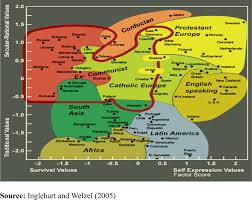
Honestly this entire situation I would have never expected to happen to me, but when it did I was never really shocked.  The process to reach this moment was so gradual in many ways that it doesn’t seem shocking.  That being said, I’d like to share a chart.  
This chart attempts to represent 2 dichotomies that ultimately separate the inherent values of different regions and cultures.  I will focus on one of them (survival/self expression).  It is of course not perfect as this isn’t exact science, but I think it is relevant to our current situation.  If certain commodities in a society are more scarce, for whatever reason including climate change, war, natural disaster or otherwise, then it is reasonable to assume that this society would take extra precautions in the future to continue survival, even at the cost of individualism.  This is strengthened by the fact that most of us suffer from a bias known as the availability heuristic.  We think that something is likely to happen again just because it happened in the recent past, even though it is in fact highly unlikely.  My favorite example is eastern European communist governments used to restrict its populace under the pretext that if not a fascist organization like the Nazis can rise again with similar force.  Because of this, more often than not a society can make temporary survival adjustments permanent.  If this pandemic is disastrous enough in the United States, we can expect a similar reversion into survival values over individualism and self expression.  That’s my thoughts on the situation.

Reflection

I learned the tools that organizations use in the real world to send their message.  I also learned about what a tragic hero is, and the various definitions used to describe a tragedy, as well as the flaws a tragic hero can have.  It was important to learn the tools organizations use especially in the Information Age as we get bombarded with information from all directions constantly, and it is important to know how to take a closer look and analyze it.  In the future I will use the system we practiced in class to analyze the various messages from organizations I come across.   Learning about tragedies and catharsis helped me realize that many times good people can “lose” because of a single flaw which is insane because most of us have more than one flaw.  This will help me as in the future I will not be as quick to judge others.