Aim: How can an exploration of writers’ choices, and the literary devices used, introduce
us to the concept of “voice” as it’s used in writing?
First, my class started with the Do Now, which is listed down below. After completing
the Do Now, we had a class discussion where we categorized different parts of a text
into the “Inferences about the speaker”, “Diction”, “Syntax”, “Imagery”, and “Tone”
categories. After the first class discussion, we were separatedinto breakout rooms where we continued working on the next 3 pieces of texts together.
Today’s Notes and Discussion
Do Now: Describe all that comes to mind when you think of pizza? Write a paragraph
describing pizza and showing your attitude toward it.
People came up with many ideas regarding their thoughts on pizza. Several of the
responses include:
The plethora of styles, types, and flavor combinations vividly paints the limitlessworld of imagination.
Like a child in a candy store, exploring pizza is an overwhelming.
Pizza is a comfort food and it definitely satisfies the consumer.
The many combinations that a pizza can become allows people to widen their palettes.
Pizza reminds me of birthday or school parties because these are common foods at these
However someone chooses to top their pizza, it doesn’t matter as long as they enjoy it.
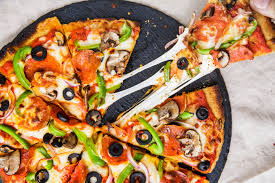

The students were really positive about their responses.
With pizza being so common around us and convenient to get,
the students knew what the others were talking about.
We were all able to relate to each others’ ideas in one way or another.
Like Ms. Peterson said, just thinking and talking about this lesson makes
you want to have pizza.
Terminology:
Diction:
A speaker’s (or author’s) word choice. This term may also refer to the general type or
character of language used in speech or in a work of literature. Diction is typically
divided into two components: vocabulary and syntax. By vocabulary, we mean the
degree of difficulty, complexity, abstractness, formality as well as the origin of words
chosen (native or foreign, Latinate or Germanic, and so forth).
Syntax:
Refers to the arrangement – the ordering, grouping and placement of words within a
sentence. The meaning of this term can also extend to encompass such things
as the degree of complexity
or fragmentation within these arrangements. Syntax is a component of grammar
but not a synonym for grammar. For example, the sentences, “I rode across the
meadow” and “Across the meadow I rode” exhibit different syntax but
identical vocabulary. To replace “meadow” with “sea of grass” is to alter the
vocabulary but not the syntax. To say “Rode I across the sea of grass” is to
use diction different from “I rode across the
meadow."The combination of unusual syntax and vocabulary in the first sentence as opposed to the
second is a feature that often differentiates poetic diction from that of prose.
Imagery:
A term used to refer to: 1) the actual language
that a writer uses to convey a visual picture or representation of a sensory
experience;and 2) the use of figures of speech, often to express abstract ideas in a vivid and
innovative way.
Imagery of this second type makes use of such devices as simile, personification,and metonymy among others. Imagery is a central component of almost all imaginative
literature and is often said to be the chief element in poetry. Two major types of
imagery exist – the literal and the figurative. Literal imagery is purely descriptive while
figurative may call to mind real things that can be perceived by the senses,
but it does so as a way of describing something else- often some abstract idea
that cannot be literally or directly described.
Whether literal or figurative, however, imagery is generally intended to make
whatever the author is describing concrete in the reader’s mind, to
give it some tangible or real
existence rather than a purely intellectual one. Imagery also provides the reader with
a sense of vividness and immediacy.
Tone:
The attitude of the author toward the reader or the subject matter of a literary work.
An author’s tone may be serious, playful, mocking, angry, commanding, apologetic
and so forth.
Class Discussion:
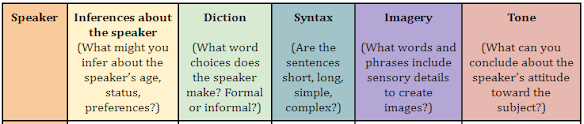
As a class, we read and discussed the text (shown below) for Speaker 1. We categorized
parts of the text into the different sections of the chart above.
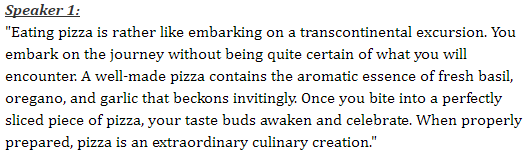
Inferences about the speaker (IS): The speaker is probably an adult because of the maturity of their writing.
Diction (D): The speaker uses formal language. He/she uses powerful words like “aromatic”
and “fresh”.
Syntax (S): The sentences are long and complex.
Imagery (I): The speaker uses alliterations to make the words flow.
Tone (T): The speaker is clearly passionate about pizza and uses very descriptive words
to explain the feelings and enjoyment brought from eating pizza.
Breakout Rooms:
In the breakout rooms, students were separated into groups of around 5 people and were
tasked to fill out the chart for the rest of the texts. The responses below are from the people
in my breakout room.
(IS): The speaker is probably a very young child around the age of 10 because he/she uses
very simple words to describe his attitude towards pizza.

(D): The speaker uses informal language because of certain words like “gooey” and “yummy”.
(S): The sentences are simple.
(I): Words and phrases that include sensory details to create images are “gooey”, “burn my tongue”,
and “eat it right up”.
(T): The speaker loves pizza as stated that he/she would eat it right away. The speaker
seems excited whenever there's pizza and doesn't seem to have a certain preference for pizza.
IS: The speaker is probably in his/her 20’s. The speaker is a vegetarian.

D: The speaker uses formal language.
S: The sentences are short and simple, but they’re also very descriptive.
I: Words and phrases that include sensory details to create images are “Gross disgusting animal
flesh”, “topped with”, and “satisfying”.
T: The speaker shows a strong dislike towards pizza that has meat. The speaker is also very picky
with the toppings that go on the pizza. The pizza has to meet very specific requirements.
IS: The speaker is in their late teens or early 20’s.
D: The speaker uses informal language. The speaker talks as if he/she is talking to a friend.
He/she uses slang like “dude” and jokes about pizza being one of the basic food groups.
S: The sentences are short and simple.
I: Words and phrases that include sensory details to create images are “covering the whole top”,
“hot steamy”, “dripping”, and “loaded with”.
T: The speaker loves pizza and enjoys all aspects of it. The speaker also likes to order it often.

Reflection
In today’s lesson, I learned about the concept of “voice” that is used in writing. Writers’ choices and the literary devices that they use are what introduces the concept of “voice”. We can divide this “voice” into Inferences about the speaker, Diction, Syntax, Imagery, and Tone. Inferences about the speaker is what we infer about the speaker’s details, like their age, status, and preferences. Diction is the speaker’s word choice. What words do they use and does it make their writing formal or informal? Syntax is whether the sentences are short, long, simple, or complex. Imagery is the usage words and phrases with sensory details that create images. Last but not least, Tone is the speaker’s attitude toward the subject. I learned this lesson in order to broaden my understanding of an author’s “voice”. An author may use many methods to convey their opinion on a certain matter. It is important to be able to point out which parts of the text contribute to that opinion and in what way it contributes. I will use what I learned in the future to better understand what an author is trying to express through their writing. I would be able to interpret the writing in the way the author had intended the readers to. It will also help me with my own writing because I will know what aspects I need to include in order to fully express myself. It can be descriptive and positive words to show my strong liking toward something, which falls into the Diction category. It can also be sensory words and phrases so that readers can picture what I’m picturing, which falls into the Imagery category.
