Tuesday, January 14, 2020

Modern Mythology 2020

Blog #46 by Andrew Ou

January 13th, 2020


Aim: How did the norse view love, hospitality, and attention to detail?
Today in class we had a presentation on pages 231-265 of Gaiman's Norse Mythology. 

Do Now: Have you ever been jealous of somebody else, and if you ever taken any actions against this person? Is taking action justified?
Many people answered the do now by saying that taking action against someone is not justified. They felt that you should not take actions against someone just because of jealously. 

After the do now the group presenting began telling summaries of each of the characters involved in their story.


Frigg:
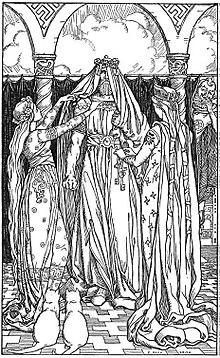
Image result for frigg norse mythology- Queen of Asgard and wife of Odin
- Mother of Balder and Hod
- A sorceress with a mysterious power of prophecy, she is associated with marriage, fertility, motherhood, and love
- Her name is old Norse for "beloved one"
- She is believed to be the origin of "Friday"

Loki:
- Infamous trickster of Norse Mythology
- Despite living in Asgard and having sworn brotherhood to Odin, Loki is not a good but a Jotun (giant or devourer)
- Mischievous and cunning
- Ability to shape-shift 
- Married to Sigyn, with two sons Narfi and Vali


Balder
- One of the Aesir gods, second son of Frigg and Odin, most beloved of all gods
- God of Light and Purity, having not only incredible beauty but also being wise, gracious, and fair
- Loyal husband to Nanna 


Image result for baldur death

The Death of Balder
- There were forces intent on harming Balder and that he would soon die from a dead seeress
- To ensure Balder's safety Frigg went around the world, having every plant, animal, element, and material pledge they would never harm Balder
- She did not get the pledge from the mistletoe
- Loki plots to kill Balder out of his jealousy
- He crafts a dart out of mistletoe, gives it to Hodr, then throws the dart which pierces Balder's Heart


How is Loki compared to a mistletoe?
A mistletoe is a parasitic plant. Within the gods, Loki is a parasite to them. Since he is a trouble maker and a trickster he causes many problems to the gods; acting like a parasite.

In the stories told in today's lesson there are important lessons to be learned that connects to modern day. One lesson learned is that people will go to extreme lengths to make sure some people don't have what they have. For example, Loki was jealous of Balder and in the end he plotted to kill him. In today's world, a lot of people could be jealous of what someone else has and might plan something that will go to extreme lengths to either get it or make sure that person doesn't have it.

Video Link - https://www.youtube.com/watch?v=VXPj_XDtrkc


Friday, January 10, 2020

Jeslyn Mei, 1/10/2020, Period 1, Modern Mythology 2020, Blog #45


Aim: How do we see the theme of sacrifice in Norse Mythology?

Notes For The Day: 
Today, we had team 5 presentations on pages 201-228 of Gaiman's Norse Mythology. We started our class discussion with our do now, which asked: "What are some other representations of sacrifice in other mythologies?" My group members and I said an example is how in Greek mythology, Antigone sacrifices herself in order to carry out a proper burial for her brother, Polyneices, despite knowing the possibility that Creon would punish her for this action by killing her. Another example that was mentioned in class was how Prometheus sacrifices himself to give humans the gift of fire. As a result, he was chained to a rock by Zeus as an eagle ate the Titan's liver. 
Image result for Prometheus chained to rock
Prometheus sacrifices himself for the benefit of human beings. This is similar to the story of "Hymir and Thor's Fishing Expedition" because Thor sacrifices himself when fighting the Midgard Serpent in order to bring the cauldron to host a feast for the gods. 

We proceeded the lesson by reviewing "The Story of Gerd and Frey" in the novel Norse Mythology by Neil Gaiman. Frey is the brother of Freya and is the god of prosperity, fair weather, and manhood. Furthermore, in the novel, Frey is depicted as the god with the best reputation among mortals and he will eventually die fighting Surtr, a fire giant with a flaming sword, in the events of Ragnarok, which we learned is a series of events that lead to the destruction of the cosmos and the creatures living in that world due to the lack of a weapon. We went over the events in the story of Gerd and Frey, in which we learned when Frey went to Odin's hall and sat at the Hlidskjalf, the observation point, and looked North to see Gerd, a giant and "the thing he was missing in his life." When he realized he couldn't obtain her hand for marriage because she was a giant and Frey was a god who belonged to the Vanir. However, after not being able to eat, drink, or sleep, Skirnir travels to Gerd and asks for her hand for marriage for him in exchange for a sword as payment for his duty. Immediately, Gerd agrees and states to Skirnir that Frey would have to wait nine days until they get married. We had a group discussion, asking was it reasonable for Frey to give up his sword in exchange for his marriage with Gerd? Why did Gerd make Frey wait for nine days? After watching a video, what are the key differences between the video and the book? After discussing with my group members, we said that it was not reasonable for Frey to give up his sword because, without the sword, he would be unable to hold off the ruler of Muspell, Surtr, which would cause other gods to be harmed. Gerd made Frey wait nine days because she wanted to get back at them for Skirnir threatening her to marry Frey and if not, he would use his magic on her and impose curses. 
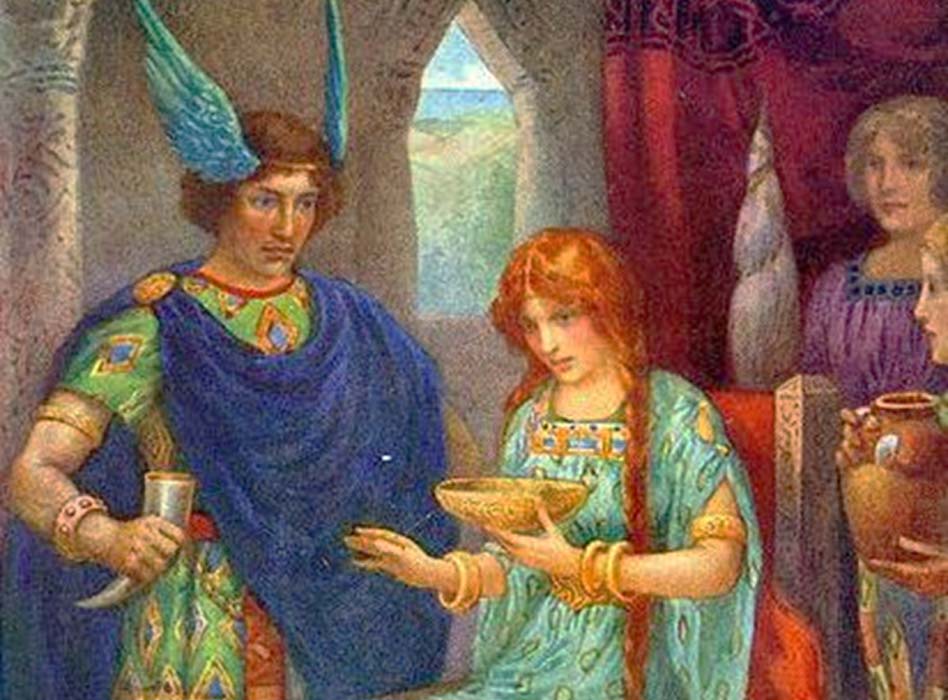
Image result for freyr gerd nine days marriage
Freyr and Gerd

Nine is an important number in Norse mythology because there are also nine worlds in Norse mythology and it represents magic and sacrifice, key themes of these pages. Other occurrences include sacrificial feasts lasting for nine days, involving nine sacrifices in Norse legends. The difference between the video and the book that I saw was how in the video, Gerd does not say yes to marrying Frey immediately and she only says yes to marriage to Frey after Skirnir had threatened to use magic against her. In contrast, in the novel Gerd is joyful when Skirnir approaches her with the news as the book states, "Gerd smiled, and her eyes shone with joy" (page 208). 

The group introduced the next story, "Hymir and Thor's Fishing Expedition" by briefly examining Thor's character. For example, he is the son of Odin, the god of thunder, lightning, storms, sacred trees, and strength. He is destined to kill and die fighting the deadly serpent Jormungandr. Therefore, Thor is destined to fight Jormungandr during Ragnarok. Reviewing the story of Hymir and Thor in the fishing expedition, Thor wants the giant, Aegir, to host a feast for the gods but this required a cauldron big enough to brew ale for all the gods. They travel to Hymir's house to obtain his cauldron but end up consuming the food that was meant to last them several days. 
They go fishing the next day for dinner and Thor rows to an area where Jormungandr lives. When Hymir cuts the fishing line and therefore, not defeating Jormungandr, Hymir comes up with the proposition that if Thor could break his favorite mug, he will give the cauldron. Eventually, Thor is successful to get the cauldron by breaking the mug on Hymir's head. 
Image result for aegir cauldron for feast
This illustration depicts Aegir, a giant who could live alongside the Aesir gods well. Aegir was the Lord of the Ocean and thus, highly respected by the Vikings. 

In the group discussion, I said that deception can be used as a means to the ends if no one is being harmed. However, Thor could've handled the situation differently by telling Hymir that he knew how the break the rock without killing the giants that chased him. Overall, Thor still attempted to face the Midgard Serpent because Thor has hubris, or excessive pride, as we discussed in previous lessons. He believed that he was able to take down any enemy despite how powerful they are. 

Reflection of the Day's Lesson: 
After discussing the two events, I learned that in the real world and in life, there are times when you must sacrifice something whether for personal gain or the greater good. Furthermore, I learned that you never know the true value of something until you no longer have it. For example, in the story of "The Story of Gerd and Frey," Frey gives away his sword to Skirnir to thank him for getting Gerd's hand in marriage. The consequences of his actions were negative as Ragnarok was coming and he didn't realize he needed the sword until "the sky splits asunder and the dark powers of Muspell march out on their war journey..." (page 209). It was also important for me to recognize that despite being faced with challenges, true bravery and consistency even though it comes from pride is a characteristic that Thor upheld and a lesson that as students, we can take away. This idea of perseverance despite adversity is crucial because as someone who is constantly learning, humans should constantly promote good morals and volunteer to benefit the world despite the tough obstacles that we encounter. Another reason why I learned that we should approach challenges with courage is to show that in Norse mythology, the gods resembled humans more than Greek mythology because although they were seen as ideal and respected as a higher power, these gods also faced difficulties when trying to achieve their goal such as Thor trying to get the cauldron. Still, he did not hesitate to stop fighting for the benefit of the other gods and for them to feast. As a result, he used his strength to tire and almost defeat Jormungandr. In Norse mythology, these gods exhibited human characteristics because they believed that the world would eventually end, focusing on gods they could relate to. Thus, as humans and Norse recognize similarily, there isn't necessarily a perfect world as they know the world will eventually end. I will use what I learned by applying these life lessons to experiences in the real world. For example, if I perform poorly on an exam, I will use this lesson to motivate me to study harder, review the information I may have missed, and adopt this new behavior to all future tests in school. Another example in which this lesson can be applied is despite wanting to stop running the immediate second I'm exhausted during training for a sport, I will persevere and finish the finish line with my goal to not give up in mind. Thus, perseverance taught me to develop the determination to succeed in any and all the challenges I come across in my life experiences. 

The Norse Gods
Norse Mythology consists of tales of various deities, beings, and heroes derived from the folk tradition, archaeological representations, and other numerous sources. 

Additional information about The Story of Gerd and Frey:
Additional information about Hymir and Thor's Fishing Expedition: https://www.youtube.com/watch?v=dk1FJSpnWZU
Additional information about the history of Viking culture, Norse Mythology, and Norse gods and goddesses such as Thor and Freya: 

Blog #44

Blog #44
Gordon Liang | Period 1
January 9, 2020

Today, Team 4 presented the lesson today focusing on the stories "Thor’s Journey to the Land of the Giants," and "The Apples of Immortality." Pages 155-197 of Neil Gaiman’s Norse Mythology


Aim: How is magic used to deceive nature and people in Norse Mythology?

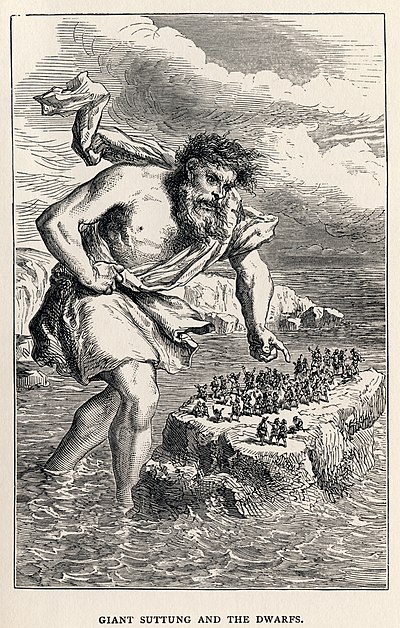
"I am the giant Skrymir" (1902) by Elmer Boyd Smith.

Do Now: Think about a time you were good at something, but someone else proved that they were better at it. How do you think this applies to what we read?'

One said that he used to think he was really good at a video game, but later on he would lose to better players and soon realizes that he is actually not the best. Based on what we read, Thor, Loki, and Thialfi were challenged on what they do best. They thought no one could beat them, but in the end, no matter how hard they try, they lost the challenges. Many people would think they are the best at one thing, only to find someone better at it. This would usually result in people improving themselves to strive higher.

The Story of Thor
Thor's Fight with the Giants (1872)
by 
Mårten Eskil Winge.


• Thor is the Norse God of thunder, the sky, and agriculture. He is the son of Odin, the chief of the Gods.

• Thor is the defender of the Asgard, the realm of the Gods, and Midgard, the realm of the humans.

• Most depictions of Thor are of him slaying giants in order to protect those realms.

• Many of Thor's tales are of him fighting off the Midgard Serpent, Jörmungandr.

• Thor is doomed to die in Ragnarök to the poison of the serpent after he killed it with Mjollnir.


Thor's Journey to the Land of the Giants
• The names of Thor's goats are Snarler and Grinder.

• Thor tells Thialfi and his family to not eat the bones of the goats

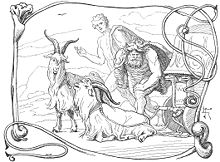
Thor notices that one of his goats has a lame leg in an illustration (1895)
by 
Lorenz Frølich

Pair-Share: Discuss why Thor told the family to not eat the goats' bones. Who ate the bone and why did they eat the bone?

Thor shares with the family the meat of his goats. As the god of mischeif, Loki will of course play tricks on others. In this case, Loki lied to Thailfi that if he ate the bone, he will become as strong as Thor. He sucks the marrow from a leg bone from one of the goats. When Thor resurrects the goats the next morning, he finds that one of the goats is lame in the leg. Eating the bones apparently would not give you powers, but instead would result in a limp leg when the goats are brought back to life.

Utgardaloki


   [The] Giant Skrymir and Thor (c. 1891)
by 
Louis Huard
 
• In Norse Mythology, Utgardaloki was the ruler of the castle of Útgarðar in Jötunheimr.

• His name literally means "Loki of the Outyards", distinguishing him from the Loki we know as Thor's companion.

• Along the journey. Thor and company have a hard time keeping up with this ruler, aka skymir, and the crew eventually settles down but is unable to retrieve their items from the giant's knapsack.

• Thor tries to deal damage to skymir with Mjollnir, but he is unfazed by any of Thor's strikes.

• Once again trickery and deception is used by Utgardaloki in challenges that the crew could not complete and our left standing in an open field instead of the castle where their feast was.

• The whole time Skymir was Utagardaloki utilizing the recurring theme of deception in Norse mythology once again.


VIDEO
The myth of Thor's journey to the land of giants - Scott A. Mellor


Discussion
1. What was the end result of all three challenges?

Even though they tried their hardest, Thor, Loki, and Thialfi were deafeated. However, they were able to impact the world and improve themselves and the world around them. 

2. Why were these the end challenges?

These were end challenges because it was impossible to beat. For example, in Thialfi's case, Thought will always be faster than action. These challenges were able explain certain phenomenons such as shifting tides when Thor was drinking the ocean and formations of valleys from Thor's blows

3. What lessons can be learned from this and how can they show the differences between Greek mythology?

Even if you lose, you can still have an impact. Similar to Greek mythology, hubris can be seen in the story. Thor, Loki, and Thialfi were so prideful and confident that they were the best in one talent. In Greek mythology, hubris will usually lead to downfall. However in this story, with hubris, the three were able to better themselves and be more humbled.

The Illusions of Their Journey
Loki's Eating Challenge:

• Loki claimed to be the world's fastest eater

• Although he consumed a lot of food, Loki was not able to beat his opponent, the King's servant.

• Loki's opponent was actually Wildfire

Thialfi's Race:

• The human could outrun anything in the wild.

• But he could not outrun the King's other servant

• His opponent was actually Thought


Thor's Three Challenges:

1. To drain a giant drinking horn with two attempts
        • The horn was filled with the ocean, Thor lowered the ocean levels

2. To pick up the King's giant cat
        • The cat was the Midgard serpent; moving the "cat's paw" is the moving of earth

3. To wrestle to old woman
        • The woman symbolizes old age (old age is supposed to weaken people till death, but Thor was not debilitated to a great extent

The giant they met along the way was actually the king in disguise, and the hammer blows created rifts and valleys.


Apples of Immortality

• Idunn, the goddess of spring or rejuvenation, is the wife of Bragi, the god of poetry.

• Idunn was the keeper of the magic apples of immortality

• Gods would eat the apples to preserve their youth

• One day, Loki passed by Idunn and told her that he needed one of her apple of immortality because he feels age upon him.

• When Idunn gives Loki a golden apple, Loki responds that he thought that Idunn would have better apples than that.
Iðunn is carried off by Þjazi in this artwork
by 
Harry George Theaker, 1920

• Normally gods talked about the perfection of flavor and how good it was to feel young again.

• Loki convinced Idunn that there was apples in the forest that were finer than her apples.

• As they walk into the forest to compare those finer apples with her own apples, Idunn realizes that there is only a tall pine tree with an eagle in it.

• It was no eagle, but rather the giant Thiazi in eagle shape to claim the beautiful Idunn. It soon seized Idunn and her box of apples.

• As the gods began to age, they forced Loki to retrieve Idunn back with her apples

• Thiazi chased after Loki after realizing that he had taken Idunn, but he flew into the flames prepared for him and Thor's hammer parted Thiazi from his life.

• Skadi went to Asgard to avenge her dead father. To which they compromised that first Skadki would be given a husband (Balder), second the gods would make her laugh again, and finally, the gods would make sure her father would never be forgotten.

                                                       
Group Discussion: Why did Loki trick Idunn to go into the forest to meet Thiazi? Do you think his reason justifies his actions?

Loki threw a spear at Thiazi, but while Loki was still clinging to the other end, Thiazi flew up into the sky bringing Loki with him. Loki begged the eagle to release him, but the eagle refused to do so until Loki swore an oath to bring him Idunn and her apples. Loki was not justified because he could have find a way to trick Thiazi or to ignore it. He brought this to himself and it is wrong to risk an innocent life for his own good. However, there was nothing Loki could really do about it because his life was at risk.

Connection to Real World
The Apples of Immortality:

• This myth can be connected to the religions of Christianity and the Celts as both have a somewhat similar representation of the apple.

• When Christ is portrayed holding the apple, he represents the Second Adam who brings life, It is similar to how the apples allow the gods to preserve their youthful appearance.

• During Allantis, people give polished Allan apples to their friends and family as tokens of good luck

• The Vikings formulated their views on the gods based on how they saw divinity (what specific things they do/have done, instead of how they are a god)

• They also have similar attributes to humans:
⤷ Hunger, pain, death
⤷ Physical weakness
⤷ Determination, Hubris, Humility
⤷ Deceit

Lessons Learned
Thor's Journey to the Land of the Giants:

☆ Nothing is as it seems
 Continue past the belief of defeat
 Fire destroys everything in its path
 Thought is always faster than action
 Old age weakens everyone eventually
 You should take a humble approach to everything
 Even gods have limitations
 Determination has its rewards

The Apples of Immortality:

 To not be too greedy
 Laughter is a better solution than anger and violence

Reflection

With the two stories we read, we were able to see how magic is used as a form of deception and that things are not always what they seem. In the first story, "Thor’s Journey to the Land of the Giants," the giant used magic to trick Thor and his companions to push themselves past their limit. The competitors were actually illusions Loki had actually competed against wildfire itself Thialfi had raced against thought , Thor had actually drank from the ocean and created tides. The cat that Thor attempted to lift was in actuality Jörmungand. The old woman was Old Age and there is no one that old age cannot bring down. In the second story, "The Apples of Immortality," with shape-shifting powers and Freya's magical robe, Loki was able to transform into a bird and Idunn was transformed into nut to deceive the giants and allow her to escape. The group presented very well. They elaborated a lot on the stories, especially on the lessons learned and themes rather then just reading on the slides. They went over about everything on both the stories and each member seemed to contributed a good portion. One mistake, however, was that Skadi never married Baldi, but she did marry Njord through the selection of the finest feet. The pacing was steady and they used their time very wisely. Overall, the presentation was straightfoward and really well put together.


Wednesday, January 8, 2020

Blog #43


01.08.2020
Serena Low Period 1
Blog #43

Today's lesson was taught by Team (3) Hammer Time on the story of The Mead of Poets as part of the intro to Norse Mythology project. Required reading: pgs 127-151

Aim: How does Norse Mythology use symbolism to highlight wisdom, envy, and the origin of poetry?

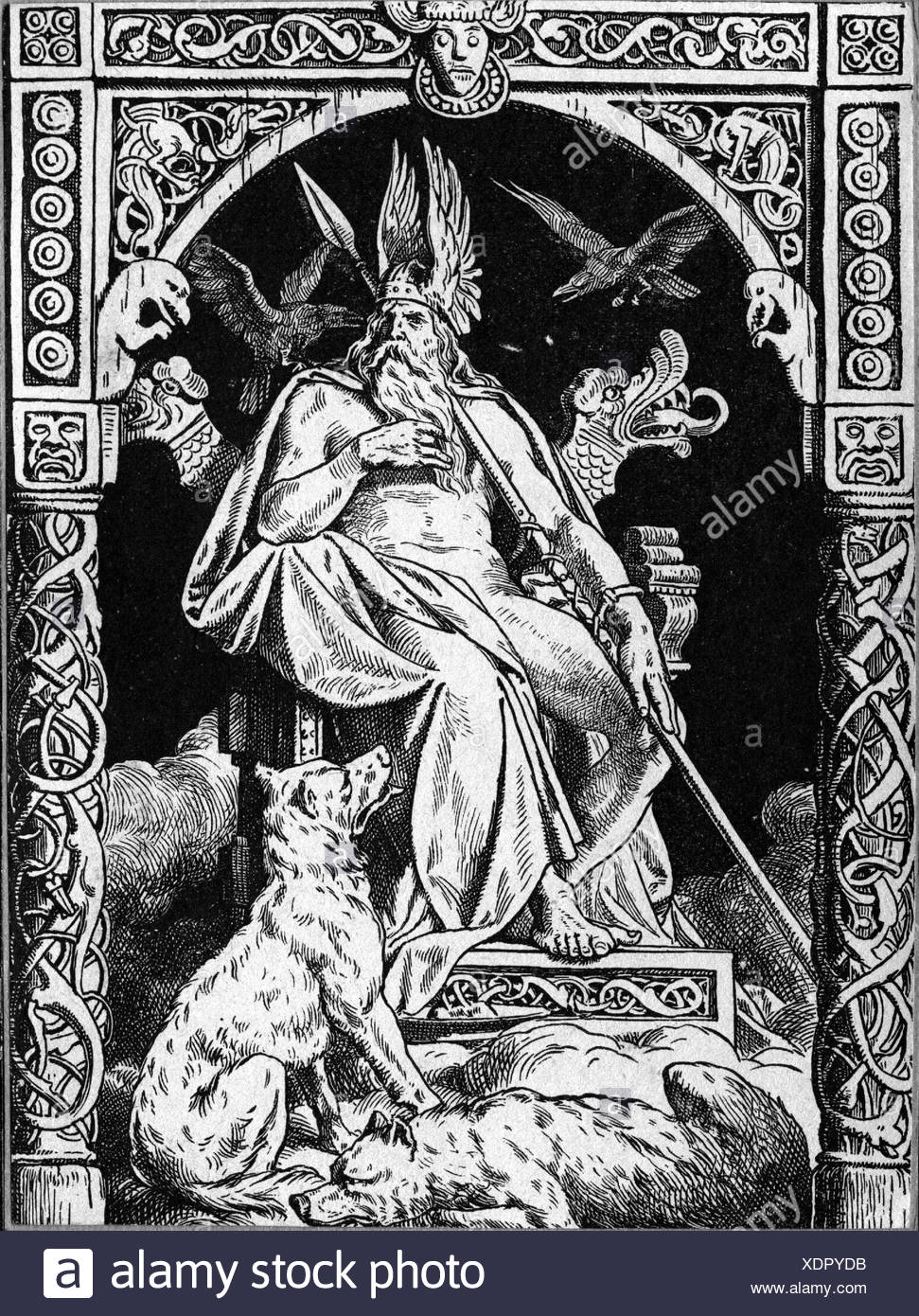
Image result for odin

Do Now: (Pair-Share) What characteristics separate good poetry from bad poetry? Why is poetry often used for rites of passage, such as marriage, maturity, and birth?

One student stated that there's no such thing as good or bad poetry; it's all just poetry. He stated that the reason why we thought it was part of the rite of passage was because in class, we learned that poetry is the type of literature that is preserved over many eras and poetry is like a song which can be memorized easily. There's a reason why poetry has been part of storytelling altogether and why it has lasted for so long. Poetry as meaning and substance behind it. All events in your life are special and so is poetry.
Another student stated that good versus bad poetry is subjective. While one may deem the piece trash, another might cherish it as treasure. The use of it during the rites of passage is only because the pieces of literature happen to encompass the events. These events are core events in most people's lives and that's why poetry with content about the events of love, development, and birth becomes more profound to the readers.


Whole Class Discussion: After watching the animation, how would you describe the ambiance of the video? How does it relate to Norse mythology's theme? How does it mimic the personalities of Norse Gods? (Odin, etc.)

The ambiance of the video was bleak, displaying events and characters in monochrome, which fits the theme of deception and darkness within the story. It demonstrated Odin's long plot to obtain the Mead of Poetry and how much care and effort he put into his plan, fitting of Odin's personality very well. The recurring theme in the Mead of Poetry is death and violence, where Odin kills a lot of people/giants to get what he wants. Once again, the black and white theme of this animation resembles the deceit, death, and darkness that the story is construed with.
In the Mead of Poetry, Odin is major character. Not only was his journey to obtain the mead central to the story, but the effect the mead in Odin's possession was central to an explanation of what makes poetry good or bad: the poetry coming from mead that Odin throws up is good poetry and those coming from his rear in a "wet fart" is bad. This outlines the power Odin has over poetry and overall wisdom.

The Beginnings of the Mead of Poetry

    Image result for mead of poetry
  • The Aesir (war-like gods of battle and conquest) and Varnir (sister gods and goddesses that made soil fertile and plants grow) were at war.
    • They came to a truce by each spitting into a vat, birthing Kvasir, the wisest of the gods
  • Kvasir left Asgard to explore the other nine worlds
    • While passing through villages and towns, he comes across two dwarves, Fjalar and Galar
      • Dwarves are obsessed with making things and these dwarves were eager to find something new to brew and make.
    • Fjalar and galar manipulate Kvasir and use his knowledge against him. 
      • They found out what to make next and killed him afterwards, mixing his blood with honey to create the Mead of Poetry.
    • Anyone who drank the Mead of Poetry would become a poet or scholar.

The Journey of the Mead of Poetry

Image result for mead of poetry sharpening scythe
  • One day, the dwarves were rowing in a boat with Gilling, a giant, but his weight was far too great for the boat so they threw him off
    • Gilling drowned and the dwarves went after his wife too (they killed her). 
  • The sons of Gilling came to avenge their parents, but spared the dwarves' lives for the mead
    • One of the sons, Suttung, took the mead and stowed it away in a mountain guarded by his daughter, Gunnlod
  • Odin eventually heard about this and began to set out for the mead
    • Leaves with a whetstone to sharpen blades with and the strongest drill (Rati)
  • Odin approaches Suttung's brother, Baugi.
    • In the fields, Odin sees Baugi's nine giant slaves, cutting grass for hay with a scythe of their own
      • Odin allowed the giants to sharpen their scythes with the whetstone and cutting grass became effortless for them
      • Because it was so effortless, the giants wanted the whetstone for future usage for themselves. Odin threw it up in the air and the giants jumped after it with the sharpened scythes in hand.
        • The sharpened scythes killed the giant adjacent, ending in a lot of dead giants

Discuss: Is Odin in the wrong for using trickery to obtain knowledge?

Some students in the class believed that Odin was wrong tricking people is wrong in general. While his intent was semi-understandable, trickery and deception is, nonetheless, wrong. In the story, he's basically indistinguishable from Loki, which is ironic given that he's supposed to be wise and all-knowing. He should know better than to leave a trail of enemies behind.
Having the mead in the giant's possession when it first belonged to the gods is a decent motive to try to obtain the knowledge. The giants were the fated enemies of the gods and the gods wouldn't want them to have an advantage.

Odin's Quest for Mead
    Image result for mead of poetry
  • Odin asks Baugi, who was unaware that he was the cause of his slaves' deaths, for lodging under the alias "Bolverkr," meaning "worker or terrible things"
    • Odin agrees to do the work of nine men in return for a taste of the mead
  • After his hard work, he is taken to Suttung who refuses to give Odin a taste
    • Baugi eventually takes him to a mountain and drills a tunnel through the side of the mountain
    • Odin transforms into a snake and slithers through the tunnel where Gunnlod and the mead reside
  • Odin uses his charisma and wise words to deceive Gunnlod disguised as a handsome man
    • He gains her trust only to break it
  • His "tastes" were not tastes
    • Drank all of the kettle Odrerir in his first drink
    • Drained the vat "Bodn"
    • Emptied the var "Son"
  • Odin transforms into an eagle and flies off
    • As Odin approached the hall, he spits a fountain of mead into the vats, providing the gift of poetry for everyone (good poetry)
    • Out of his rear, he releases a "wet fart" to evade his pursuers (bad poetry)
Significance of Poetry in Viking Culture
    Image result for norse poetry
  • Two types of Old Norse poetry
    • Eddaic poems: a collection from an unknown author and tells stories of Norse mythology
      • Poems could be about anything
      • The language is usually clear and relatively unadorned
    • Skaldic poems: performed by known poets and are in tribute of a hero or king
      • Uses kennings, a compound expression in Old English and Old Norse poetry with metaphorical meaning
  • Used to tell stories and for entertainment during the colder months
  • Skalds, or Viking's poets, became very prominent in Viking cultures as kings wanted their legacies to be remembered
    • Skalds wrote complex, compelling verse
    • Poetry was considered a gift of Odin and being a skald made a person part of the upper class in society

Why do you think food is a prominent feature in mythology? Discuss with your group.

In different situations and moods, you can eat food, whether it be at a funeral or a wedding. Food is used to survive and mythology is there to tell people that they can't live without food, water, or shelter, things that the gods have power over. Mythology is there to promote the dominance of the gods over our lives, associating them with a higher power. Food in itself has power as well. The extravagance of food and banquets and gatherings are recurrent in Norse mythology and other cultures. The celebrations and food has the power to bring all-powerful gods together.

Brainstorm/Share: The Mead of Poetry is the cornerstone of Norse mythological artistry. Are there other important objects or foods in other cultures?

In Christianity, Jesus turns water into wine. "Wine is my blood and bread is my flesh." In churches, on certain occasions, there's wine and bread distributed and eaten. It offers the opportunity to become one with god and to be rejuvenated with both physical strength and spiritual strength.

Connection to the Real World

  • Wisdom can come in many forms
    • ex: Odin gained wisdom when he consumed the Mead of Poetry
    • Required great effort and sacrifice
  • Drinking the mead not only gifted words and knowledge, but more importantly, the ability to inspire and arrange the words in a much more meaningful way to help others
    • ex: preventing Ragnarok
  • We gain new knowledge everyday, even if we might not be aware of it
    • May include information we coincidentally overheard
    • It's up to use to decide how to use the knowledge or if to use it at all

Reflection:


The story of the Mead of Poetry accentuates the power that knowledge has over all kinds of people, no matter how powerful that person may be, god or human. Knowledge had the power to make Odin, one of the wisest and most powerful gods, into a rampaging and impulsive being. The path to gain knowledge isn't pretty either. The dwarves first killed Kvasir and then they killed two other giants, only to be spared by the giants' sons. Then, Odin comes along and kills nine slave giants just for a taste of knowledge. Odin had to deceive so many people on his path to knowledge, betraying many people's trust. Knowledge has the power to make things ugly and violent. Sometimes, pursuing knowledge isn't the best choice. The group did a good job at explaining the themes and lessons to be learned within this story. They were cohesive with each other for the most part and most of them looked like they knew what they were talking about. They gave feedback to those who participated and responded to their prompts, which I thought was nice.


Mythology Blog #42


Blog #42                                                                                           1/07/20
Junhong Li                                                                                         Period 1Aim:
How does Norse Mythology illustrate the theme of vengeance?

Do Now:
What is vengeance and do you think it is justified?

Vengeance is when one takes matters into their own hands in an attempt to right what's wrong, by bringing harm to another. There was a general consensus amongst the class that excessive vengeance was definitely wrong, as "An eye for an eye only makes the world blind"(Mohandas Gandhi, Sid Meier's Civilization VI). This question was asked as to lead into the stories "The Children of Loki" and "Freya's Unusual Wedding," where characters of the stories eventually take revenge on those who wronged them.
Angrboða, Loki's mistress
Her name means "the bringer of grief," and she indeed lived up to her name. Her children with Loki would bring grief for all parties involved. The gods would kidnap these children from
 Angrboða, she would never see these children again. The wisest Odin, the mightiest Thor, and Tyr's right hand would be lost to these children, and Loki would not meet these children again until Ragnarok. We discussed for what reason he would have an affair and why would he love someone called "the bringer of grief," and we concluded that he was simply bored with his current life. It is also mentioned that Loki himself is a "bringer of grief" as a troublemaker, so he might sympathize with Angrboða.


Picture from "The Scary Children of Loki - Norse Mythology Stories - See U in History" by See U in History / Mythology. 
The Children of Loki
The children of Loki mentioned in the presentation were-
  • Hel, the ruler of Helheim and Niflheim
  • Jörmungandr, the ever-growing Midgard serpent
  • Fenrir, the big bad wolf
Jormungandr.jpg
Jörmungandr gets fished by an ox head, from a 17th-century Icelandic manuscript.

Jörmungandr
Jörmungandr was a snake who grew to enormous sizes. It was chucked into the ocean by Odin when the gods discovered that it was growing in size rapidly. Unfortunately, the snake didn't drown and grew to a large enough size to encircle the world Midgard. Thor meets it trice later and is killed by its poison on the third time, which was during Ragnarok. However, Thor gets the last laugh because he managed to kill the snake first.

"Loki's Brood" by Emil Doepler.
Hel
Hel was a maiden who grew to normal sizes. However, only half her body was beautiful, the other half was rotten and skeletal. She had the ability to kill people with a simple thought or touch, as well as revive them through the same method as well. She was quiet and well mannered, so Odin made her the ruler of Niflheim and Helheim. She would rule over those who died cowards or by sickness or old age.

"Fenrir and Odin" by Lorenz Frølich
Fenrir
Fenrir was a wolf who grew to enormous sizes. It was known to be cruel like its father, but unlike its father, it was a companion to the god of honor and justice, Tyr. However, Odin feared Fenrir due to a bad dream and decided that Fenrir needed to be bounded so that it will be harmless. So, in an attempt to trick the wolf, Odin and Co. asked it to display its strength. They chained it down multiple times, but he broke through every time. Finally, the gods asked the dwarves to make Gleipnir, a silk ribbon, persuaded Fenrir to be tied in it. Fenrir agreed, only on the condition that it would be released if it could not break the ribbon, and that its insurance would be the hand of a god. Tyr volunteered as tribute, and as expected, the gods did not release Fenrir. After chewing off Tyr's hand, Fenrir held a grudge against the gods, saying that it would've been a friend if they hadn't betrayed it. But then the gods stuck a sword in its mouth so it can't ever bite down. But then it would proceed to break out of its bonds during Ragnarok and swallow Odin.

Discussion
We discussed why Loki's children were a snake, a wolf, and a half-dead-half-living woman. We concluded that they represent his traits, as he is a snake, a wolf, and alive, but his death is prophetized and certain. He was also the outcast amongst his family and the gods, as the weakest giant, and as the annoying trickster.

We discussed Hel's duality and how she represented not only death but a cycle of life and death. She had the power to revive the dead and kill the living, and it was effortless to her. However, she was not evil nor good, like her father. Unlike her father, she kept to herself and didn't cause needless trouble. She was the neutral bystander, as justice is blind but death is Rated E for Everyone.

We discussed the materials used in the creation of the ribbon Gleipnir, which included:

  • The sound of the footsteps of a cat
  • The beard of a woman
  • The roots of a mountain
  • The sinews of a bear
  • The breath of a fish
  • The spittle of a bird
While there was a bit of confusion in the class on why these ingredients were chosen, my theory is that these items each had the perfect traits for an unbreakable bond, which included:

  • Lightness
  • Softness
  • Sturdiness
  • Toughness
  • Transparentness
  • Cohesiveness
Cats, with their padded feet, have soft steps. Women usually don't have long beards, but like all humans, they do have small soft hairs which grow from their face. These hairs are translucent and thinner than any other hair on the human body, and since women do not grow beards, these hairs are a lot more noticeable on women. The roots of a mountain can be understood as a mountain's foundation and mountains are known for their refusal to be moved by anything. They are sturdy. Bears are a symbol of strength. They are tough and hard to take down. The breath of a fish can be nothing other than water, the transparent liquid. The final one is the hardest one to understand. From searching up bird spittle, I found a species of birds that would build their nests with their spit, which hardened when exposed to air. Like glue, it worked very well to bind two things together. It is most likely what held the other ingredients together to form Gleipnir. Gleipnir's description of being a light and soft silk ribbon which would stretch without tearing or breaking when Fenrir tried to break it supports this theory as well.

We discussed if Odin was justified in chaining up Fenrir, and there was a group consensus of "No," as Fenrir himself claimed that he would've been a friend to the gods, had they not chained him up. This was led into a lesson on not judging others by a preconceived notion and to give everyone a chance at proving themselves. However, I think he was justified, but his actions of defiance against fate were useless. When he traded his eye for wisdom, he gained an ability to see visions of the future. When he saw Fenrir consume him in his dream, he should've known that fate was unavoidable. However, even so, chaining up Fenrir would've eased his mind at the time, so I think he is not to blame. After all, the whole idea of Norse mythology is that Ragnarok is unavoidable, but that won't stop the gods from trying their best to prolong it from happening.

Finally, we concluded this story with a video.
"Ah, what a lovely maid it is!" by Elmer Boyd Smith.

Freya's Unusual Wedding
In this story, Thor wakes up one day and his wife Sif isn't missing her hair. But his hammer was gone. So of course, he questions Loki first and finds out that it's actually not his fault this time. The king of the giants Þrymr had stolen the hammer while Thor was sleeping, the same hammer Thor keeps next to himself while he sleeps, in his room, in the land of the gods, where giants usually dare not tread unless they were Loki or offering to do the gods a favor. And then 
Þrymr even offers to return the hammer, the weapon of the mightest of gods, able to level mountains. He wasn't going to return the hammer for free though. He, like a certain other giant, wanted the hand of the most beautiful Freya in marriage in exchange for the hammer. Since Freya didn't want to marry some giant, Loki decided to get Thor to dress up as a bride and go to Þrymr to retrieve his hammer personally. So then he did. After showing up, Thor proceeded to eat excessively and lack manners, and Loki proceeded to get questioned by the giants about "Freya's" habits. After bluffing his way through, Loki managed to even get them to present the hammer to "Freya" and place the hammer on "Freya's" lap. The same hammer which couldn't be wielded without Járngreipr, a special pair of gloves. And then Thor proceeds to reveal himself, grab the hammer, and kill Þrymr and his servants.
This story was filled with plotholes, unexpected events, unexplained events, and had no moral. However, it was extremely entertaining. 10/10.

Connections with the Real World
Here, team 2 tried to connect these stories to the real world. They referred to the habits of Greek protagonists who tried to avoid fate, only to cause fate to occur when describing Odin's actions. They said that the moral of the story for the Children of Loki was "everybody deserves a chance." They said that the moral of the story for Freya's Unusual Wedding was "all the things in our world... are not as they seem." However, personally, I'm still not convinced the Freya's Unusual wedding had a lesson involved. While it is true that some stories in mythology are taught and passed down to teach a lesson, I believe there are exceptions that are only passed down as entertainment. The fact that Freya's Unusual Wedding was sung as a song even up until the 19th-century points to it being more for entertainment than having meaning.

Final Group Discussion
Finally, we answer the aim. Both stories ended in vengeance. 
Jörmungandr gets revenge on Odin by killing his son Thor. Fenrir gets revenge on Odin by swallowing him whole. Thor gets revenge on Þrymr by crashing his wedding with Freya. That is how vengeance plays a role in the stories of Loki's Children and Freya's Unusual Wedding.

Tuesday, January 7, 2020

Myth Blog 41 1/6/20

1/6/20
Modern Mythology 2020
Angel Li
PD 1

Aim: How does Norse mythology demonstrate lessons of promises and consequences through Loki's character?

Group 1: Zuting Chen, Junhong Li, Serena Low, Belinda Zhang, Benjamin Zhu, Andrew Ou

Do Now: Pair-Share
1. What is the role of the antagonist in a story? Why are they important?
2. To you, what excuses deception

Our group discussed that the role of the antagonist is to provide conflict and trouble to the main characters. They act as an obstacle that the protagonist has to try to overcome in some way or form. The antagonist builds the plot and is usually the one who everyone dislikes. They are important because they are the reason why the story exists and is entertaining. 
For the second question, deception can be excused if it is for the right reason. An example of this would be trying to hide the truth to prevent hurt feelings or trying to surprise a friend for their birthday. However, if deception is used in a negative way such as harming a person’s character, that is when deception can not be excused. 

After this Do Now, the presentation moved on to discuss Loki.

Discuss: What do you know about Loki? Why is he a “foreigner” in a way, among the gods?

Loki is the trickster among the gods. He defines himself as clever and stunning and always tries to find ways to stir up trouble. He technically was suppose to be a frost giant but was too weak to become one. As a result, he made an oath with Odin to become blood brothers. He often does not cooperate with the other gods, and that plays a part in his mischief. The origin of his name ‘luk’ means one who causes knots
He is known for being a prankster, cleverness, and ability to solve problems. Loki is not evil, but good as he works for his own benefits. Related by a blood oath between him and the all-father Odin.

The Treasures of the Gods is a myth that explains the origin of many items like that of Mjolnir, Thor’s Hammer.
The story went like this:
Thor loved everything about his wife, especially her long hair. One morning he woke up and saw that all her hair was missing and immediately blamed it on Loki. After threatening Loki to help solve the problem and put hair back onto Sif, Loki sought to the dwarves for help. He convinces Brokk and Eitri to take on 3 of Ivaldi in a test of skills - make 3 treasures better than them, and if they win the challenge, Brokk would get Loki’s head. Brokk and Eitri were convinced by this because of all the amusing inventions they could make with that head of Loki’s and agreed to the challenge. While crafting the treasures, Loki shapeshifts into a black fly to try to disrupt the two brothers to ensure that they don't lose the challenge. Tragically, the two brothers create magical weapons that grab the attention of the gods and were convinced. Specifically, Thor was introduced to his new unbreakable hammer. 
The 3 brothers of Ivaldi created 
  • Gungnir which is a spear carved with intricate runes, and will penetrate anything and will always find its mark. Oaths sworn on it are unbreakable
  • Golden Hair which is made of real gold and attaches itself to someone who needs it
  • Skíðblaðnir which was a silk scarf, if unfolded it will discover a ship, will always have a fair wind, biggest ship you can imagine will still fold up into a cloth
The 2 brothers Broke and Eitri created :
  • Draupnir where every 9th night, 8 gold arm-rings of equal beauty will drip from it. Odin can reward people with them to store them and his wealth will increase
  • Gullinbursti which is a huge boar with bristles made of gold. It will race across the sky and over the sea faster than the fastest hours, never tire and never fail
  • Mjollnir, a lightning maker, which will always be undamaged. If you throw the hammer, it will never miss, it will always return to your hand, and the hammer can change in size.

All three Gods were extremely impressed by the 2 brothers and choose them as the winner. And since they were the winner, they wanted to collect Loki’s head. However, through loopholes, he had made an oath with Odin that his neck would be protected. And there would be no way to get his head without cutting off his neck, and therefore Loki escapes losing once again.

 The second myth that was discussed in the class was The Master Builder

A video was shown that described what this “Master Builder” did.
Summary:
Thor left Asgard to fight against giants someplace else. Left unprotected, the gods decided they had to do something to protect themselves. Their conclusion - build a wall so thick and tall that no giant could break or cross. A mysterious explorer offers to build a wall for them in exchange for the god Freya’s hand, the sun, and the moon. At first, the gods were hesitant about going through with this and came to the consensus of the answer ‘no’. However, Loki convinces them all that this is an impossible feat to complete in one season, and the gods swear on their weapons that this unknown person would reap the rewards if he was successfully able to build the wall. They soon find out this mysterious person was a giant. The builder works alongside his stallion, Svadilfari and on the last day of the season, he was nearing the completion of the wall. Loki, being nervous about his death as punishment, turned into a beautiful chestnut mare and chased the stallion away. As a result, the builder was unable to finish the wall and was eventually killed by Thor as he returned.

The lessons and morals that could be taught by this story are:

  • You never try to deceive others otherwise you could potentially face extreme consequences. This was the case for Loki, and if it hadn’t been for the fact he made an oath with Odin, his head would be cut off right now.
  • Another lesson that can be learned from the two myths is to not make promises that you can’t keep. Time and time again, Loki makes promises that he can not fulfill. Once with the two brothers, Brokk and Eitri since he had made an oath with Odin, his neck could not be cut off, and therefore he could not have his head cut off. This is also seen when Loki promises that the builder was not going to be able to finish building the wall but gets proven wrong on the last day of its completion. In both cases, without Loki finding loopholes, he would have been dead.
  • Things aren’t always as they seem. The two dwarves were eager to finish their inventions even with Loki as a fly pestering them and trying to create havoc. The builder was actually a giant and the gods at Asgard despised giants
  • You must treat all with respect. While trying to build a wall that keeps all giants out, they unintentionally invite one in. 

Reflection:

After this amazing presentation given by fellow classmates, I learned how intricate Norse mythology is and its uniqueness compared to other mythologies. More specifically, I learned about the duality of mischief, and that it's not always good, but sometimes it is the necessary thing to do. This is seen twice by Loki's cleverness by manipulating others to work for him in his favor and to fix the mistakes he made. In the story of The Treasures, Loki had to fix his mistake of making Sif have no hair. He had no other option, other than having to trick the dwarves otherwise he would have to die for it. As a result, he manipulated dwarves to help him fix this problem. Another time his mischief was necessary to protect against frost giants from attacking Asgard when Thor wasn't in town. Although this wouldn't be the most moral way, it was something Loki had to do, and again showcases the duality of mischief. 

I learned all of this because there are clear morals and lessons to be learned from these stories. A general one would be to not deceive others otherwise there may be extreme consequences. It applies to everyday life, such as while talking to friends. Deceiving them to hide something would only create more trouble. Another one would be that not everything is as it seems. It has a direct connection to the modern-day because, with media and all, it is very easy to spread false information. Through such Norse mythologies, it teaches us to be careful when given information that may seem too good to be true.