Sunday, November 29, 2020

Blogger #15 - Chris Kim - Period 1 - 11/23/2020 - Day A - Freshmen 2021


Blogger #15 - Chris Kim - Period 1 - 11/23/2020 - Freshmen 2021


Aim: How does Edgar Allan Poe’s “The Bells” convey and reinforce the meaning of the life cycle through his choice of poetic sound devices?


Do Now: (Team Activity) (Timed)


We started off with the Do Now. For the Do Now, each team had to list different types of bells, and the team with the most won. My team came up with 10 different type of bells: Doorbell, Liberty Bell, Bicycle Bell, Church Bell, Alarm Clock, Dinner bell, Cow Bell, Jingle Bell, Wind Chime, and Traditional Chinese Bell.


After completing the Do Now, we were instructed to read the story “Oh Woe is Poe.”

Oh Woe is Poe! PDF

In this story, we read about Edgar Allan Poe’s life and his struggles and obstacles in life. We see how Poe uses poetry to express his feelings, after losing loved ones to tuberculosis, and people would later assume that Poe was crazy and had rabies,


Poetic Sound Devices...


Musical or sound devices: convey and reinforce meaning (or experience) through the use of sound


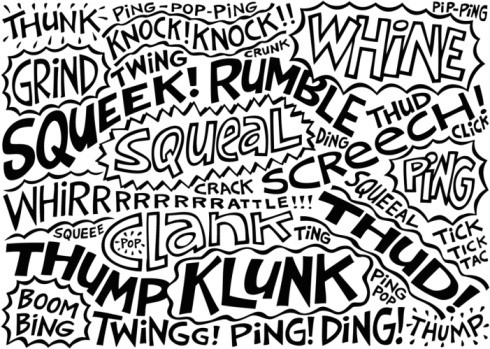
Cacophony: Cacophony comes from the Greek word meaning, “bad sound.” Or Involving or producing a harsh, discordant mixture of sounds. In other words, consider the noises you may hear on a crowded city street: cars honking, people yelling, dogs barking etc...


Explosive Consonants: (k, t, g, d, p, b, q, c, x, ch-, sh- etc...)


Hissing Sounds: (ch-, sh, and s)


Cacophony can be used to convey dark feelings/thoughts, harsh or loud noises, chaos, violence or fear.


Euphonious is when there are sounds that are soothing and pleasant to the ear. It’s quite the opposite of Cacophony.

It includes all the vowels

It has harmonious consonants, such as: (l, m, n, r and softer f and v, sounds).

Additionally, it uses soft consonants or semi-vowels such as: (w, s, y and th or wh) extensively to create more pleasant sounds.


Other Poetic Sound Devices:

Alliteration: A stylistic device in which consecutive words or words that occur close together in a series all begin with the same first consonant letter or sound.

https://www.youtube.com/watch?v=brQfY8VtmyA&ab_channel=TheRedRoomCompany


Onomatopoeia: A word which imitates the natural sound of a thing.

https://www.youtube.com/watch?v=0ST_SEOPcrk&ab_channel=TheRedRoomCompany


Repetition: Repeating words, phrases, lines, or stanzas. Repetition is used to emphasize a feeling or idea, create rhythm, and/or develop a sense of urgency

Rhyme: a repetition of similar sounds in two or more words (especially common at the ends of words). Rhyme is pleasing the ear and also lends a sense of rhythm and order to the language.

Perfect rhyme occurs when stressed syllables of the words, along with all subsequent syllables, share identical sounds (ex: pencil" and "stencil”)

Imperfect rhyme or “slant rhyme” involves the repetition of similar sounds that are not quite as precise as perfect rhyme (ex: “uptown” and “frown”)


https://www.youtube.com/watch?v=URuMb15CWJs&ab_channel=TED-Ed


Team group work (breakout rooms)


Analyze the first two stanzas. How do they compare, in terms of similarity?


The first two stanzas compare in terms of similarity the mood they convey. Both bells in both stanzas are described positively, both the silver and gold bells are described by the depiction of Euphonious wordplay.


Now, compare the bells in stanzas 1 and 2 with the bells in stanzas 3 and 4. How does Poe” mood shift in his poem?


Poe’s mood shifts from positive to negative during stanza 1 and 2 to stanzas 3 and 4. In the first two stanzas, the bells are described as “rhyming and tinkling” while the next two stanzas describe the bells as groaning and clangor.


4) How does Poe use sound devices to imitate the sound of bells?


Compile a list of the devices you believe he used.


Poe uses the sound of bells, people’s groans, and their screams to imitate the sound of the bells. He uses onomatopoeia, such as “tinkling, jingling,” and as I have mentioned before, “moaning and groaning.”


5) This poem is as much about sound as it is about meaning.


Why do you think Poe places a heavy emphasis on sound in this poem?


What message does it help to express?


How is this poem symbolically a metaphor for life?


I think Poe placed a heavy emphasis on sound because out of sound, we can describe the mood of events. Sound helps deliver a message, physical or negative, and fuel the emotions. This poem is a symbolic metaphor for life, bells bringing the memory of joy or sadness.


Reflection:

In this lesson, I learned about the wide range of literary devices used to make poetry more interesting. We also had a small sneak peek into Poe’s life, which had a large influence on his style of writing. We got to analyze the poem and identify poetic devices, such as: Cacophony, Euphonious, Alliteration, Onomatopoeia, Repetition and Rhyme. By analyzing Poe’s life and his poem, we can grow in knowledge and gain a deeper understanding of classical poems, and the influence of literary devices on the poem and how the reader reads it.


Blogger #13 - Oriana Huang - Period 1 - 11/23/2020 - Day A - Freshmen 2021


Blogger #13- Oriana Huang- Period 1- 11/23/20- Day A- Freshman 2021


Freshman Lit 2021


Aim: How does Edgar Allan Poe’s, “The Bells” convey and reinforce the meaning of the life cycle through his choice of poetic sound devices?


Do now: TEAM CHALLENGE

In the beginning of the class, we went into breakout rooms and we were challenged to name all the bells we knew. Then, we would all come back together and the team that had the most bells named would win. I was in Team 4 and we came up with 6 bells that included school bells, a doorbell, church bells, liberty bells, cow bells, Christmas bells.


Oh Woe is Poe! PDF


In class, we spirit read this story and concluded that Edgar Allen Poe had lost many of his loved ones due to tuberculosis. Because of this curse on him, he decided to write poems about his life which became popular but didn’t pay him well due to the absence of copyright laws during that time. He moved all over the place and became a drunk addict which then led to people avoiding him. He disappeared for a while but came back to a bar in Baltimore crazy. Edgar was brought to the hospital still supposedly acting drunk. They waited 4 days but he was still the same. He was then declared dead with possible causes including rabies. After discussing what we have concluded about this story, we all compared this story and connected it to pictures. These are just some of the pictures we discussed below.


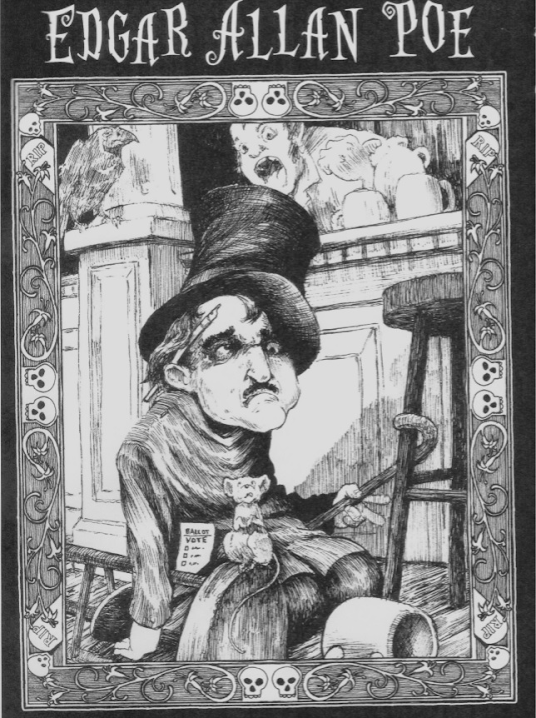
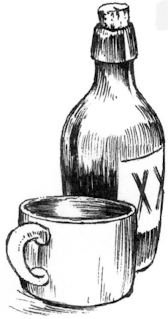
The first picture represented the people that were close with Edgar dying from tuberculosis. The second picture with the bottle of an unknown liquid and a cup was assumed as alcohol and that connected to Edgar having an alcohol addiction. The third picture correlates to the death of Edgar Allen Poe. Edgar was suspected to die from rabies and rabies can come from racoons. Therefore, the third picture of the racoon would be connected to the death of Edgar Allen Poe.


Poetic Sound Devices:

Musical or sound devices: convey and reinforce meaning (or experience) through the use of sound


  • Cacophony: Cacophony comes from the Greek word meaning, “bad sound.” Or Involving or producing a harsh, discordant mixture of sounds. In other words, consider the noises you may hear on a crowded city street: cars honking, people yelling, dogs barking etc…
    • Explosive Consonants: (k, t, g, d, p, b, q, c, x, ch-, sh- etc...) 
    • Hissing Sounds: (ch-, sh, and s)
      • Example: He is a rotten, dirty, terrible, trudging, stupid dude!
    • Cacophony can be used to convey dark feelings/thoughts, harsh or loud noises, chaos, violence or fear.

Think/Pair/Share: Highlight or underline words that are cacophonous, in the following examples.


1) “Beware the Jabberwock, my son! The jaws that bite, the claws that catch!” (“The Jabberwocky” by Lewis Carroll)


2) “I gave him a description of cannons, culverins, muskets, carabines, pistols, bullets, powder, swords, bayonets, battles, sieges, retreats, attacks, undermines, countermines, bombardments…”

(Gulliver’s Travels by Jonathan Swift)


  • Euphonious: involving sounds that are soothing or pleasant to the ear. It is the opposite of cacophony.
    • It includes all the vowels
    • It has harmonious consonants, such as: (l, m, n, r and softer f and v, sounds).
    • Additionally, it uses soft consonants or semi-vowels such as: (w, s, y and th or wh) extensively to create more pleasant sounds.
      • Example: “While the stars that oversprinkle all the heavens seem to twinkle” -Edgar Allen Poe
    • Euphony is used to make language sound beautiful and melodic. If a writer is describing something they want to make seem attractive, pleasant, or beautiful, one of the best ways of achieving this is to make the language itself sound harmonious.

Think/Pair/Share: Highlight or underline words that are euphonious, in the following examples.


1) “Season of mists and mellow fruitfulness” (“Ode to Autumn” by John Keats)


“While the stars that oversprinkle/All the heavens seem to twinkle” (“The Bells” by Edgar Allen Poe)


  • Alliteration: A stylistic device in which consecutive words or words that occur close together in a series all begin with the same first consonant letter or sound
    • Example: Jackrabbits jump and jiggle jauntily.

While discussing what alliterations were, we watched a video along with it for better understanding. This is the link to the video: Red Room Poetry Object Poetic Device #1: Alliteration [2:00]


  • Onomatopoeia: A word which imitates the natural sound of a thing.
    • Example: The buzzing bee flew by
    • Example: The rustling leaves kept me awake.

This is the link to a video about onomatopoeias: Red Room Poetry Object Poetic Device #4: Onomatopoeia [2:36]


  • Repetition: Repeating words, phrases, lines, or stanzas. Repetition is used to emphasize a feeling or idea, create rhythm, and/or develop a sense of urgency
    • Example: Let it snow, let it snow, let it snow.

  • Rhyme: a repetition of similar sounds in two or more words (especially common at the ends of words). Rhyme is pleasing the ear and also lends a sense of rhythm and order to the language.
    • Perfect rhyme occurs when stressed syllables of the words, along with all subsequent syllables, share identical sounds (ex: pencil" and "stencil”) 
    • Imperfect rhyme or “slant rhyme” involves the repetition of similar sounds that are not quite as precise as perfect rhyme (ex: “uptown” and “frown”)

As we discuss and dive in deeper to a further understanding of poetic sound devices, we watch a video about poetic pattern. This is the link to the video: The pleasure of poetic pattern - David Silverstein [4:46. The video talks about repetition and how it can bring positive aspects and negative aspects to your poem. Having repetition in your poem allows the reader to further understand the concepts and ideas of your poem but having too much repetition lacks the needs of a real poem. The video then goes over what we had discussed in class before such as alliteration.


After we had discussed all these poetic sound devices, we read “The Bells” by Edgar Allan Poe and put our knowledge of poetic sound devices to use. We then went into breakout rooms to complete the following chart and questions.

Link to “The Bells” by Edgar Allan Poe: https://poets.org/poem/bells

Link to Audio for “The Bells” by Edgar Allan Poe: “The Bells” By Edgar Allan Poe (YouTube)


ANALYSIS OF POETRY


TEAM GROUP WORK


1. Analyze the first two stanzas. How do they compare, in terms of similarity?

The first two stanzas are similar since they both convey feelings of happiness. They both have positive feelings since they both use euphonious words.


2. Now, compare the bells in stanzas 1 and 2 with the bells in stanzas 3 and 4. How does Poe's mood shift in his poem?

Like said from before, stanzas 1 and 2 describes the bells with positive and euphonious words. However, both stanzas 3 and 4 convey negative feelings and use cacophonous words. This was the mood shift in his poem.


3. How does Poe use sound devices to imitate the sound of bells?
    a. Compile a list of the devices you believe he used.

Poe uses sound devices to imitate the sound of bells with repetition, rhyme, and onomatopoeia. For example, he uses descriptive words such as, “How they ring out their delight.”


4. This poem is as much about sound as it is about meaning.

    a. Why do you think Poe places a heavy emphasis on sound in this poem?

    b. What message does it help to express?

    c. How is this poem symbolically a metaphor for life?


Poe places a heavy emphasis on sound in this poem because he wants the reader to understand and picture the feelings these bells carry with them. The message it helps spread is that there are many different feelings in life. This poem is symbolically a metaphor for life because these bells represent each stage in life. For instance, the silver bells and the golden bells represent your youth because of the happiness it brings and the brazen and iron bells represent your adultery which then leads to death. This is connected to feelings of fear and misery.


REFLECTION

During this lesson, I was able to learn about many different poetic devices and have the opportunity to be able to read a story about Edgar Allen Poe and one of his poems. At first, I learned different bells that I never knew about during the Do Now thanks to my group mates. I learned about Edgar Allen Poe’s life story and how every person he was close with died from tuberculosis. I learned how due to all of these mishaps, Edgar went to poetry. I learned many poetic devices that consisted of alliterations, onomatopoeias, repetition, rhyme, cacophony, and euphony. This is because I would need these poetic devices to better understand the poem “The Bells” by Edgar Allen Poe. Lastly, I learned deeper meanings and ideas of “The Bells” due to the help of poetic devices. For example, I was able to realize that these bells can represent stages in your life. The silver and golden bells can represent your youth and childhood while the brazen and iron bells represent the adultery and death in life. They have different feelings and meanings to them. I will use what I learned in this lesson to help with future lessons. My knowledge on poetic sound devices are extremely useful when reading other poems in the future and finding out deeper meanings. Thus, this lesson will help develop my understanding of poems.

Blogger #16- Stanley Khaskelzon - Period 9 - 11/25/2020 - Day C - Freshmen Lit 2021

Wednesday: November 25, 2020 (No live zoom meeting - work done asynchronously)


Blogger #16- Stanley Khaskelzon - Period 9 - 11/25/2020 - Day C - Freshmen Lit 2021


Aim: How does Edgar Allan Poe’s “The Bells” convey and reinforce the meaning of the life cycle through his choice of poetic sound devices?


Do Now Question:

Create a list of ALL the kinds/types of bells you’ve ever heard.  The Team to create a list with the most amount WINS the points!!! You have only 2 Minutes!


The class was given a couple of minutes to think about the types of bells they have heard before with their teams. The team who got the most bells would win points. In the video, Team 1 got 10 bells, team 2 got 8, team 3 got around 13-14, team 4 got 10 bells, team 5 got 15, and team 6 got 8. Some examples of answers were doorbells, cowbells, jingle bells, bicycle bells, music bells, minecraft bell, school bell, and more.


Slide 2: After reading the poem together, the class had a discussion about the pictures on slide 2. The class compared the raccoon to Edgar Allan Poe to maybe having died from rabies and the alcohol comparing him to being drunk and connecting to voter fraud which was another one of the images. The tombstone compares to the poet because in his life, Edgar Allan Poe experienced a lot of death from his family. I thought it was interesting that all these images were indirectly explaining Edgar Allan poe’s life. All the images are showing important events and aspects of his life.


The class had a discussion about slide 3 which explained cacophony and poetic sound devices. The discussion helped me get a better understanding of the word cacophony by comparing it to unpleasant sounds and explosive sounds.

Cacophony: comes from the Greek word meaning “bad sound”. Involving or producing a harsh discordant mixture of sounds. Most of the cacophonous sounds are consonants such as c, and q which are very harsh and explosive


Euphonious is the opposite of cacophony, meaning sounds that are pleasant to hear such as vowels and consonants such as l and m, n. 


Summary: Cacophony = unpleasant… Euphonious = pleasant


Slide 5 discussed other poetic devices such as:

  1. Alliteration- A stylistic device in which consecutive words or words that occur close together in a series all begin with the same first consonant letter or sound

  2. Onomatopoeia: A word which imitates the natural sound of a thing.

  3. Repetition: Repeating words, phrases, lines, or stanzas. Repetition is used to emphasize a feeling or idea, create rhythm, and/or develop a sense of urgency

  4. Rhyme: a repetition of similar sounds in two or more words (especially common at the ends of words).  Rhyme is pleasing the ear and also lends a sense of rhythm and order to the language.

  5. Perfect rhyme occurs when stressed syllables of the words, along with all subsequent syllables, share identical sounds

  6. Imperfect rhyme or “slant rhyme” involves the repetition of similar sounds that are not quite as precise as perfect rhyme 

The examples helped the class and me understand how each device can be used in poems and how each device actually affects the writing.


The class then watched a short video about all the devics explaining how and why they are used.


The videos were very helpful because they applied the different poetic devices in actual poems that helped the classmates get a better understanding of their purposes.


After watching all the videos on the different poetic devices, the class listened to a reading of “The Bells” by Edgar Allan Poe while reading along on the text version. Then the class had to answer the questions on the next few slides


The 12th slide had the class fill in a table that analyzed the 4 stanzas of the poem. We had to identify the poetic devices and then explain the effects of the devices used.

Slide 13 and 14 had us answer 4 questions about the poem in our breakout rooms with our team.


Reflection:


After reading the slides and watching the lesson video I think that this lesson was very useful to my understanding of poetry. I learned about some of the different sound and poetic devices that are used by poets such as Edgar Allan Poe. We heard a reading of a few different poems that helped us have a better understanding of how to apply different devices in poems and their effect on the writing and the reader. “The Bells” also helped us know how to apply different poetic devices. We got a better understanding of how different sound devices have an effect on poems and how our understanding of the writing changes.


Saturday, November 28, 2020

Blogger #14 - Joshua John - Period 1 - 11/23/2020 - Day A - Freshmen 2021


Blogger 14, Joshua John, Period 1, 11/23/20, Day A


Freshman 2021


Monday, November 23rd, 2020


Aim: How does Edgar Allan Poe’s, “The Bells” convey and reinforce the meaning of the life cycle through his choice of poetic sound devices?


Do Now: (Team Activity)(TIMED activity)

We started the discussion with the Do Now. The Do Now was a team activity where each team listed different types of bells and the team with most kinds of bells won. Our team came up with 10 different types of bells: doorbell, Liberty Bell, bicycle bell, church bell, alarm clock, dinner bell, jingle bell, cow bell, traditional Chinese bell, and a wind chime.


Oh Woe is Poe! PDF

After the Do Now, we read the story, “Oh Woe is Poe” by using Spirit Reading. We read about Edgar Allen Poe’s life and how he used poetry to express his feelings. Furthermore, he had lost close people and family members to tuberculosis. However, Edgar Allen Poe was crazy and people assumed he had rabies. We discussed how the images on slide 2 correlated to parts of Edgar Allen Poe life and how some of these assumptions weren’t correct at the time.


Poetic Sound Devices:

Musical or sound devices: convey and reinforce meaning (or experience) through the use of sound


Cacophony: comes from the Greek word meaning, “bad sound.” Or Involving or producing a harsh, discordant mixture of sounds. In other words, consider the noises you may hear on a crowded city street: cars honking, people yelling, dogs barking etc...


Explosive Consonants: (k, t, g, d, p, b, q, c, x, ch-, sh- etc...)


Hissing Sounds: (ch-, sh, and s)


Example: He is a rotten, dirty, terrible, trudging, stupid dude!


Cacophony can be used to convey dark feelings/thoughts, harsh or loud noises, chaos, violence or fear.


Think/Pair/Share: Highlight or underline words that are cacophonous, in the following examples:


“Beware the Jabberwock, my son! The jaws that bite, the claws that catch!” (“The Jabberwocky” by Lewis Carroll


“I gave him a description of cannons, culverins, muskets, carabines, pistols, bullets, powder, swords, bayonets, battles, sieges, retreats, attacks, undermines, countermines, bombardments…”

(Gulliver’s Travels by Jonathan Swift)

In this activity, we had to underline the cacophonous words in the example. All the cacophonous words are highlighted.

Euphonious: involving sounds that are soothing or pleasant to the ear. It is the opposite of cacophony.


It includes all the vowels


It has harmonious consonants, such as: (l, m, n, r and softer f and v, sounds).


Additionally, it uses soft consonants or semi-vowels such as: (w, s, y and th or wh) extensively to create more pleasant sounds.


Example: “While the stars that oversprinkle all the heavens seem to twinkle” -Edgar Allen Poe

Euphony is used to make language sound beautiful and melodic. If a writer is describing something they want to make seem attractive, pleasant, or beautiful, one of the best ways of achieving this is to make the language itself sound harmonious.

Think/Pair/Share: Highlight or underline words that are euphonious, in the following examples.


“Season of mists and mellow fruitfulness” (“Ode to Autumn” by John Keats)


“While the stars that oversprinkle/All the heavens seem to twinkle” (“The Bells” by Edgar Allen Poe)

In this activity, we had to underline the euphonious words in the example. All the euphonious words are highlighted.


More Poetic Sound Devices


Alliteration: A stylistic device in which consecutive words or words that occur close together in a series all begin with the same first consonant letter or sound

Example: Jackrabbits jump and jiggle jauntily.


We used this video to better our understanding and use of alliteration as a poetic device in poetry: Red Room Poetry Object Poetic Device #1: Alliteration [2:00]

This video talks about how alliteration is used in poems about many different topics. The video talks about how alliteration is used to create and support the mood of a story by using sounds.


Onomatopoeia: A word which imitates the natural sound of a thing.

Example: The buzzing bee flew by

Example: The rustling leaves kept me awake.


This video helped explain the use of onomatopoeia as a poetic device in poems.

Red Room Poetry Object Poetic Device #4: Onomatopoeia [2:36]

This video talks about how onomatopoeia uses words to imitate different sounds. It adds an atmosphere and environment to a poem. It can also be used to add to rhythm in a poem. It helps connect the reader to the poem and vividly visualize the poem.


Repetition: Repeating words, phrases, lines, or stanzas. Repetition is used to emphasize a feeling or idea, create rhythm, and/or develop a sense of urgency

Example: Let it snow, let it snow, let it snow.


Rhyme: a repetition of similar sounds in two or more words (especially common at the ends of words). Rhyme is pleasing the ear and also lends a sense of rhythm and order to the language.


Perfect rhyme occurs when stressed syllables of the words, along with all subsequent syllables, share identical sounds (ex: pencil" and "stencil”)


Imperfect rhyme or “slant rhyme” involves the repetition of similar sounds that are not quite as precise as perfect rhyme (ex: “uptown” and “frown”)


The pleasure of poetic pattern - David Silverstein [4:46

In this video, we explore the poetic pattern of rhythm and repetition. The rhythm can diversify ideas in a poem and make it easier to imagine. However it can have its downsides too if a poem is too repetitive. This video sums up most of the concepts our class talked about in the previous lessons.


Note: Spirit Reading is the process in which students freely read any portion of text they want to and ending whenever they want. Students in the classroom are expected to continue the text or read the remainder of a text after the previous reader finished.)


“The Bells” By Edgar Allan Poe (YouTube)

We listened to this video while reading the poem. We also were required to annotate the poem and identify literary devices in the poem.


I.

Hear the sledges with the bells—

Silver bells!

What a world of merriment their melody foretells!

How they tinkle, tinkle, tinkle,

In the icy air of night!

While the stars that oversprinkle

All the heavens, seem to twinkle

With a crystalline delight;

Keeping time, time, time,

In a sort of Runic rhyme,

To the tintinnabulation that so musically wells

From the bells, bells, bells, bells,

Bells, bells, bells—

From the jingling and the tinkling of the bells.

II.

Hear the mellow wedding bells,

Golden bells!

What a world of happiness their harmony foretells!

Through the balmy air of night

How they ring out their delight!

From the molten-golden notes,

And all in tune,

What a liquid ditty floats

To the turtle-dove that listens, while she gloats

On the moon!

Oh, from out the sounding cells,

What a gush of euphony voluminously wells!

How it swells!

How it dwells

On the Future! how it tells

Of the rapture that impels

To the swinging and the ringing

Of the bells, bells, bells,

Of the bells, bells, bells,bells,

Bells, bells, bells-

To the rhyming and the chiming of the bells!


III.

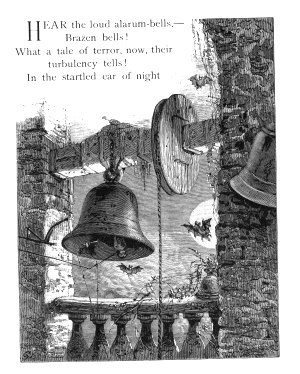
Hear the loud alarum bells—

Brazen bells!

What a tale of terror, now, their turbulency tells!

In the startled ear of night

How they scream out their affright!

Too much horrified to speak,

They can only shriek, shriek,

Out of tune,

In a clamorous appealing to the mercy of the fire,

In a mad expostulation with the deaf and frantic fire,

Leaping higher, higher, higher,

With a desperate desire,

And a resolute endeavor,

Now- now to sit or never,

By the side of the pale-faced moon.

Oh, the bells, bells, bells!

What a tale their terror tells

Of Despair!

III.--Cont’d

How they clang, and clash, and roar!

What a horror they outpour

On the bosom of the palpitating air!

Yet the ear it fully knows,

By the twanging,

And the clanging,

How the danger ebbs and flows:

Yet the ear distinctly tells,

In the jangling,

And the wrangling,

How the danger sinks and swells,

By the sinking or the swelling in the anger of the bells-

Of the bells-

Of the bells, bells, bells, bells,

Bells, bells, bells-

In the clamor and the clangor of the bells!


IV.

Hear the tolling of the bells—

Iron Bells!

What a world of solemn thought their monody compels!

In the silence of the night,

How we shiver with affright

At the melancholy menace of their tone!

For every sound that floats

From the rust within their throats

Is a groan.

And the people- ah, the people-

They that dwell up in the steeple,

All Alone

And who, tolling, tolling, tolling,

In that muffled monotone,

Feel a glory in so rolling

On the human heart a stone—

They are neither man nor woman-

They are neither brute nor human-

They are Ghouls:

And their king it is who tolls;

And he rolls, rolls, rolls,

Rolls


IV.--Cont’d

A pæan from the bells!

And his merry bosom swells

With the paean of the bells!

And he dances, and he yells;

Keeping time, time, time,

In a sort of Runic rhyme,

To the paean of the bells—

Of the bells:

Keeping time, time, time,

In a sort of Runic rhyme,

To the throbbing of the bells—

Of the bells, bells, bells—

To the sobbing of the bells;

Keeping time, time, time,

As he knells, knells, knells,

In a happy Runic rhyme,

To the rolling of the bells—

Of the bells, bells, bells:

To the tolling of the bells,

Of the bells, bells, bells, bells—

Bells, bells, bells—

To the moaning and the groaning of the bells.


TEAM GROUP WORK:

After reading the poem, we were sent into breakrooms where we were supposed to complete the table and questions pertaining to the poem, “The Bells.”

ANALYSIS OF POETRY
1.


2. Analyze the first two stanzas. How do they compare, in terms of similarity?

The first two stanzas they compare, in terms of similarity, because they both share a harmonious connotation but also both use euphonious words to express different meanings. Some words such as crystalline and “merriment” in “Silver Bells'', as well as “mellow” and “molten-golden” depict the euphonious wordplay in the stanzas.


3. Now, compare the bells in stanzas 1 and 2 with the bells in stanzas 3 and 4. How does Poe's mood shift in his poem?


The bells in stanzas 1 and 2 express a euphonious meaning while the bells in stanzas 3 and 4 display a cacophonous meaning. Poe’s mood shifts throughout the progression of the poem since he talked about the feelings merriment and silverbells gave him in the first two stanzas compared to when he talked where his feelings were brazen and aggressive in the last two stanzas.


4. How does Poe use sound devices to imitate the sound of bells?


Compile a list of the devices you believe he used.


Poe uses sound devices to imitate the sound of bells by describing some of the emotions he got from the experience and by using onomatopoeia to create these sounds. Some examples of this is, “twinkling, jingling, harmony, chiming, moaning and groaning.” These words were some of the sounds devices Poe used to describe the sound of bells.


5. This poem is as much about sound as it is about meaning.


Why do you think Poe places a heavy emphasis on sound in this poem?


What message does it help to express?


How is this poem symbolically a metaphor for life?


Poe places a heavy emphasis on sound in this poem because sounds help direct the story and let readers visualize the story while they understand the author’s feelings. The message it helps to express is that the author feels different emotions while addressing the sounds of the bells. For example he addresses the bells with a positive connotation such as “twinkling” but addresses the bells with a negative connotation with words like “moaning.” This poem symbolically is a metaphor for life because it expresses the stages of life. It expresses your childhood as the silver bells, golden bells as youth, the brazen bells as adulthood, and iron bells as death. Furthermore, it also addresses the obstacles and challenges that you face along your life.


Reflection:

In this lesson, I learned about Edgar Allen Poe’s life and his style of writing. I also learned about the variety of literary devices that are used in poetry to make the writing more vivid and interesting for the reader. Furthermore, I learned about how Edgar Allen Poe’s life influenced his writing style and also how literary devices can affect how a poem is emphasized to the reader. For example, onomatopoeia makes a poem feel more realistic by adding words that convey sounds. I learned this because it is an essential part of understanding poetry and these literary devices can help convey more feelings and create a more in-depth understanding for the reader. In addition, using literary devices is key to making your poem more intricate and more relatable to the reader and his/her environment. I will use what I learned by incorporating these literary devices into the poems I write in later years of my high school career and even college. This lesson taught me information that I will use to further enhance my poetry skills as wells as my overall understanding of poetry.

Friday, November 27, 2020

Blogger #14 - Benjamin Li - Period 2 - 11/23/20 - Day A

 Aim: How does Edgar Allan Poe’s, “The Bells” convey and reinforce the meaning of the life cycle through his choice of poetic sound devices? 

Do Now: TIMED ACTIVITY! 

TEAM CHALLENGE ...


Cow bells, liberty bells, church bells, carillon bells, standing bells, Japanese peace bell, cow bells, alarm bells, door bells


Our do now was to list the different types of bells we knew. After getting placed in our breakout rooms we were able to name different bells that some of us never heard of. Our group was able to come up with 14 different bells which were more than all the other groups. Students from different groups listed the number of bells they knew.


After discussing the Do Now we moved on to the next slide where we spirit read about Edgar Allan Poe’s life.

Oh Woe is Poe! PDF

We read that:

  • We read that:

    Edgar’s dad divorces his mother and left him with her and 3 children.

  • After watching his mother die of tuberculosis, he was orphaned and raised by foster parents.

  • His first girlfriend died of tuberculosis and his stepmother followed

  • After his brother died of tuberculosis he moved out and met his first cousin who he fell in love with, but died of tuberculosis.

  • He became a poet, but he made little money causing him to turn to drink alcohol. 

  • He was involved in a voting fraud where you change clothes and vote multiple times for free alcohol.


He died presumably of alcohol poisoning, but recently doctors think that he was bit by a rabid animal giving him rabies.


FRAUD???

Overall he was unlucky and had an unfortunate life. We then made connections from his life to the pictures in slide 2


In slide 3-5 we read about poetic sound devices. 

We learned of:

  • Cacophony: a harsh, discordant mixture of sounds.

Cacophony include 

  • Explosive Consonants:  (k, t, g, d, p, b, q, c, x, ch-, sh- etc...) 

  • Hissing Sounds: (ch-, sh,  and s)

        Cacophony can be used to convey dark feelings/thoughts,  harsh or loud noises, chaos, violence, or fear.


  • Euphonious:  sounds that are soothing or pleasant to the ear.

  • It is the opposite of cacophony
  • Euphony include
  • all the vowels

  • harmonious consonants, such as: (l, m, n, r and softer f and v, sounds).

  • soft consonants or semi-vowels such as: (w, s, y and th or wh)

         Euphony is used to make the language sound beautiful and melodic.   

  •  Alliteration: consecutive words that start with the same letter or sound.
Example: Jackrabbits jump and jiggle jauntily.
We also watched a short video explaining alliteration.\
(https://www.youtube.com/watch?v=brQfY8VtmyA&ab_channel=TheRedRoomCompany)
  • Onomatopoeia: the word that imitates sounds 
Example: The buzzing bee flew by
This video helps to explain onomatopoeia (https://www.youtube.com/watch?v=0ST_SEOPcrk&ab_channel=TheRedRoomCompany
  • Repetition:  Repeating words sound of phrases that create rhythm and emphasizes feelings.
Example: Let it snow, let it snow, let it snow.

  •      Rhyme: words that have similar sounds at the end of the words.

    There are 2 different types of Rhyme

  • Perfect rhyme: Rhyme that has almost identical sounds and syllables. 
  • Imperfect rhyme: Rhyme that has similar sounds but is not as exact as Perfect Rhymes
The following link will take more in-depth about repetition and rhyme.   (https://www.youtube.com/watch?v=URuMb15CWJs&ab_channel=TED-Ed)


After reading the poem, we were taken to our breakout rooms to complete the chart below to analyze the poem.

ANALYSIS OF POETRY


TEAM GROUP WORK


  1. Analyze the first two stanzas. How do they compare, in terms of similarity?

  2. Now, compare the bells in stanzas 1 and 2 with the bells in stanzas 3 and 4. How does Poe” mood shift in his poem?\

  3. How does Poe use sound devices to imitate the sound of bells?

    1. Compile a list of the devices you believe he used.


  1. This poem is as much about sound as it is about meaning.

  1. Why do you think Poe places a heavy emphasis on sound in this poem? 

  2. What message does it help to express?

  3. How is this poem symbolically a metaphor for life?


Unfortunately, we ran out of time but we were able to briefly talk about the meaning and theme of the poem. The poem uses a variety of cacophony repetition imagery euphony and repetition. It starts out happy with euphony and ends in misery with cacophony. There was a repetition of the word bells which created a rhythm to connect all 4 parts of the poem. The theme that I wrote was that the bells represent a certain part of our lives. We start as silver bells, innocent and happy. Then we grow up and become golden bells which represent maturity and youth. However, as we get older, we can never hide from death and iron bells symbolize the death that will fall upon all of us.


Reflection: 


What did I learn?

In this lesson, I learned about Edgar Allan Poe’s unfortunate life and his poem “The Bells.” We also talked about poetic devices commonly used in poems: Cacophony, Euphonious, Alliteration, Onomatopoeia, Repetition, and Rhyme. We got to analyze the poem and identify poetic devices used in the poem.

Why did I learn it?

I learn this so we can analyze poems better and how this poem relates to the unfortunate life of Edgar Allan Poe. Also by analyzing this poem we reach a deeper understanding and knowledge of classical poems.

How will I use what I learned?

I can use what I learn to analyze more classical poems and use this knowledge to gain more information about the structure of other classical poems that are hard to understand.