Note: This is a three in one lesson, the responses and answers to the questions will be in blue. In addition, to open some of these PDFs and documents, please be signed into your SITHS google account.
Homework: Consists of: The Odyssey Plot Sum I-VIII (Book 8) & The Odyssey Book X (Book 10). Please use the accompanying slides as a guide for understanding, as well as for questions to consider while reading.
Please open up the slides attached below to complete your homework. You can work with your group mates!
The Odyssey Books 1-8: https://docs.google.com/presentation/d/1RPh-wqjVmtz59phEyDIA0VJF_U-8Ysw6C63d2qcVoeY/edit
The Odyssey Book X:
https://docs.google.com/presentation/d/1dkAmyAaseNbTNU6y4VNmvj6jwKNLE6CM7wIdB_U4vzM/edit
Lesson 9: The Odyssey: Land of the Dead
Aim: How does the episode of "The Land of the Dead" further our understanding of Odysseus as the epic hero?
We start off the class with a Do Now like always:
Do Now: Class Discussion
➢ What are some of the cultural traditions we use to honor the dead?
➢ Consider your culture and/or religion - what do you and your family do in order to mourn the passing of a
loved one?
○ How might these traditions be observed in order to honor fallen warriors & soldiers?
Response #1: Host a funeral and burn a special type of paper to honor them.
Response #2: Father burns sticks (incense) everyday to honor the dead one.
Response #3: Burn gold paper, small cars and houses (not real ones!).
Enrichment: Tomb of the Unknown Soldier [http://www.arlingtoncemetery.mil/Explore/Tomb-of-the-Unknown-Soldier]
After the Do-Now, the class spirit read and watched a video about “Death and the Underworld.”
● The Greeks believed that that after death, the soul went on a journey to the Underworld
● The Underworld was deep beneath the Earth and was ruled by Hades and his wife Persephone
● In the afterlife, the soul would either receive punishment or a state of bliss depending on choices made during life
● At the end of this journey, they would be brought to three judges who would decide their fate:
● Would they go onwards to Elysium (a comfortable place where the sun always shone), or would they be punished and sent to Tartarus?
Video
The Underworld: The Kingdom of Hades - Greek Mythology Curiosities - See U in History: https://youtu.be/5VEbWU3izcE

Following, we read about Honoring and Remembering the Dead

The Greeks held elaborate burial rituals
○ A proper burial was necessary, omission of burial rites was seen as an insult to human dignity .
○ If the body was not given a proper burial according to Greek ritual, the soul would remain trapped between the worlds of the living and the underworld.
In ancient Greece the continued existence of the dead depended on their constant remembrance by the living
○ If one forgot to honor and remember the dead one was considered impious and, while this particular breach of social conduct was not punished as severely as Socrates' breach, it was certainly frowned upon severely.
Adapted from:
https://www.ancient.eu/article/29/the-after-life-in-ancient-greece/
Moving on, the class read “Land of the Dead” and answered questions.
Land of the Dead: https://drive.google.com/file/d/1B2UC-VafUK7i1TJ8CxlqN6K3Q0yTRD6B/view?usp=drivesdk

Questions to go along with the reading:
1. As Odysseus prepares to meet the dead he says, “Then I addressed the blurred and breathless dead, / vowing to slaughter my best heifer (cow) for them...” (line 555-556). What can be inferred about ancient Greek beliefs concerning death and the afterlife from these lines?
The Greeks like to make sacrifices to the gods in the hopes of the gods helping the dead with their passage to the underworld.
2. Discuss Elpenor's request to Odysseus (lines 598-608).
a. What details does he want Odysseus to remember about his burial?
He wanted his corpse to be burned, for there to be a monument of him, and a oar on his ships so he won’t be forgotten.
b. How does this reflect the Greek ritual of death?
The Greeks really respect the dead and there is a very specific process because they believe that for souls to travel through the underworld is not an easy task.
3. How does Odysseus react to seeing Elpenor (Lines 580-585)?
a. How does he react to Anticlea (his mother) (Lines 614-619)?
b. What characteristics of Odysseus do we see displayed in this scene?
Odysseus did not expect Elpenor’s soul to be in the underworld so quickly. Odysseus was also upset upon seeing his mother because she was still alive when he left home to fight in the Trojan war. However, seeing his mother’s soul, Odysseus now knows that his mother was treated properly after death.
4. Although not a god, Tiresias has been endowed with the power of prophecy. Consider the following advice Tiresias gives to Odysseus regarding the remainder of his journey home: “One narrow strait may take you through his blows: denial of yourself, restraint of your shipmates.”
a. What leadership advice is Tiresias giving to Odysseus?
b. In addition, what instructions does Tiresias give Odysseus in order to quell Poseidon’s rage?
Tiresias wants Odysseus to trust himself and his teammates because traveling through the sea will not be an easy task now that Poseidon is angered by Odysseus. Tiresias wants Odysseus to make a sacrifice to Poseidon (a bull) because Odysseus has angered Poseidon by blinding Polyphemus.
Vocabulary:
Ignoble (adj) - dishonorable, shameful
Assuage (verb) - to calm, to mollify, to lessen
Foil:
In literature, a foil is a character that shows qualities that are in contrast with the qualities of another character. The objective is to highlight the traits of the other character. The term foil, though generally being applied to a contrasting character, may also be used for any comparison that is drawn to portray a difference between two things.
What we observe in literature very often is that a foil is a secondary character who contrasts with the major character to enhance the importance of the major character. The etymology of the term foil testifies the aforementioned assertion as the word is taken from the practice of backing gems with foil (tool), so that they shine more brightly.
Enrichments:
The “Funeral Practices”. Feel free to annotate for clarification.
“The Ancient Greek Burial Rites” questions for guidance, in case you were confused. They are NOT to be submitted!
https://youtu.be/peJy-xmPOFM
After completing Lesson 9, the class jumped straight into Lesson 10.
Lesson 10: The Odysseus: The Sirens
Aim: How does Odysseus' strategic leadership further characterize him as an epic hero in "The Sirens" episode of Homer's Odyssey?
Starting off with the Do Now:
FLATTERY:
How would you define the term “flattery”? Review the “3” Morals of Aesop’s Fable. What do you believe the morals advise?
● Flattery is a dangerous weapon in the hands of the enemy.
● Flattery is not proof of admiration.
● He who listens to flattery is not wise, for it has no good purpose.
Response: Flattery is to make someone happy by complimenting them, even though it might not be what you really think. It is often done when you want to get something from others.
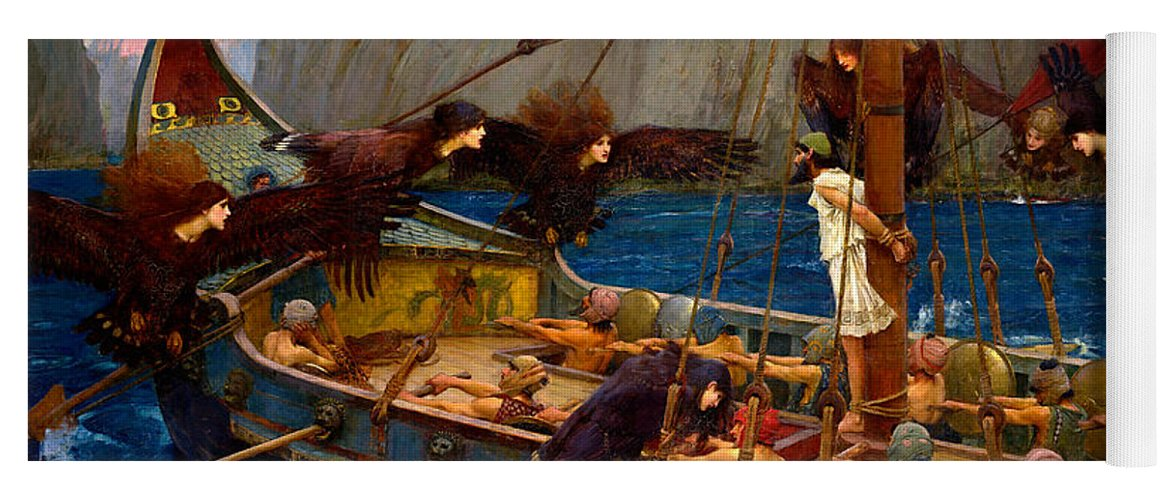
After the Do Now, we start the lesson by learning a bit about the sirens and watching a short video:
Time to spirit read some notes!
Odysseus and the Sirens
❖ The sirens are seductive creatures that lure sailors to their death with their song.
❖ Upon hearing the song, sailors are led to the Wandering Rocks where their ship
crashes and sinks.
❖ Sirens are often depicted as half-bird/half-woman (they have also been used in
many modern examples as mermaid-type creatures).

Odysseus and his men return to Circe’s island where they give Elpenor proper burial rites and burn his body. Before they leave, Circe gives Odysseus some important advice for the next portion of his journey. She warns him of the sirens he will encounter. With their songs, the sirens lure sailors to their destruction at the Wandering Rocks. She tells Odysseus to put beeswax in his men’s ears so that they will not hear the song.
The Sirens sing of desire, and promise wisdom and knowledge.
Legend has it that no mortal has ever heard the song and lived to tell the tale, but if Odysseus insists on hearing the song himself, then he should have himself tied to the mast of the ship.
Quick Video:
Sirens: The Seductive Creatures of Greek Mythology: https://youtu.be/hJpzse2qYlU

Next, we read “The Sirens” from The Odyssey
https://drive.google.com/file/d/1d7t7Yoj6bW7TG4i62Ge6W-wMIZV1TVTV/view?usp=drivesdk
Here are the questions for the main reading of the lesson:
Lines 685 – 698
1. Why does Odysseus address his men “sore at heart”?
Odysseus addresses his men as sore at heart because he is sad to have to tell his men they are traveling to a place where only one group of people has ever made it out alive.
2. Why does Odysseus decide to tell his men about Circe’s forecast?
a. What does Odysseus reveal about his character by sharing this information with his men?
b. Circe insists that Odysseus “alone should listen to their song.” He directs his crew to “tie me up...lashed to the mast, and if I shout and beg to be untied, take more turns of the rope to muffle me. ” What leadership qualities does Odysseus demonstrate here?
c. What character traits are revealed in Odysseus’ desire to hear the Sirens’ song? “I carved a massive cake of beeswax into bits / and rolled them in my hands until they softened ... Going forward / I carried the wax down the line, and laid it / thick on their ears..”
d. Consider this action along with their successful escape and assess the leadership qualities revealed by Odysseus.
Odysseus decides to tell his men about Circe’s forecast because his men would know what to expect and be prepared for the danger. The leadership qualities Odysseus demonstrates is faithfulness in his teammates and selflessness to put only himself in harm. Odysseus reveals curiosity when he wants to listen to the Sirens’ song.
3. Read the “Siren’s Song ” below. Analyze the strategy sirens use to lure the men. What are they appealing to; in an effort to lure the men in?
a. How do the sirens use flattery to lure the soldiers?
b. What examples would appeal to the crew and to the epic hero?
The sirens’ song appeals to desire and wisdom in an effort to lure men in. The sirens use flattery to lure the soldiers by making them lose concentration and think about glory/ opportunities. Examples of what would appeal to the crew and the epic hero would be praise for participating in war and having to go through such difficulties to get back home.
This way, oh turn your bows
1Achaea’s glory,
As all the world allows-
Moor and be merry.
Sweet coupled airs we sing.
No lonely seafarer
Holds clear of entering
Our green mirror.
Pleased by each purling note
Like honey twining
From her throat and my throat.
Who lies a-pining?
Sea rovers here take joy
Voyaging onward.
As from our song of Troy
Grey beard and rower boy
Goeth more learned.
All feats on the great field
In the long warfare,
Dark days the bright gods willed,
Wounds you bore there.
2Argos’ old soldiery
On Troy beach teeming
Charmed out of time we see.
No life on earth can be
Hid from our dreaming.
1Achaea- Greek Mythology Link. Achaea has been called a region in southern Thessaly, and also the northern coast of the Peloponnesus. Those who marched against Troy were called Achaeans, and sometimes Argives for living in Argolis.
2Argos’ - The beach is full of Argos' soldiers; 'Troy beach' is, of course, the beaches outside of Troy where they camped out for years, trying to defeat the Trojans.
5. What does an analysis of the Siren Song suggest about the idea of human flattery?
a. Why are we, as humans, susceptible to a figurative “Siren’s Call?”
b. How can the sirens represent both desire and distraction?
An analysis of the Siren song suggests that the idea of human flattery is often viewed negatively. Humans are susceptible to a figurature “Siren’s Call” because maybe we aren’t getting praise for our work and it would feel good when someone finally compliments you. The sirens represent both desire and distraction because they lure you in by telling you about your desire, what you desire to become. They also distract you from who you really are and what is happening around you.
Enrichment:
The Odyssey by Homer — Book 12 Summary & Analysis: https://youtu.be/gJBGlIL5O6Q
Pirates of the Caribbean Mermaid Scene: https://youtu.be/hC8gpeDgZG8


Questions for the Pirates of the Caribbean Mermaid Scene:
● How are the sirens depicted in the film?
In the film, the sirens are depicted as mermaid-like creatures who use their singing to lure in sailors.
● How do the sailors behave upon hearing the sirens’ song?
The sailors get stunned upon hearing the sirens’ songs. They want to get closer to the sirens.
CHECK ANSWERS, fill in answers, AND INSERT IMAGE!!!
Finally, it’s time for the last lesson of the day!
Lesson 11: The Odyssey: Scylla and Charybdis
Aim: How can we evaluate Odysseus’ leadership through his decision-making in his encounter with “Scylla and Charybdis” in Homer’s Odyssey?
Do Now: Would you sacrifice one person in order to save five other people?
➢ What would influence your decision if you had to make a choice according to “The Trolley Problem?”
Responses: I would sacrifice one person in order to save five other people. The biggest thing that would influence my decision if I had to make a choice according to “The Trolley Problem” is if I know the person, and what I need to do to save the people. In the problem, I would kill the one person on the other track to save the other five, but I would not push the person down the bridge to stop the train. This is because the people on the train tracks were already put in a situation to die and the train could have killed any one of them. However, the person on the bridge was already safe to begin with so it’s not right to push them down the bridge.
Now, the class read about Scylla and Charybdis.
Scylla:
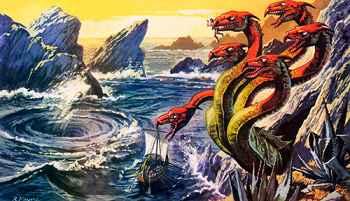
In Greek mythology, there was a sea monster who lived underneath a dangerous rock, opposite the whirlpool Charybdis. She threatened passing ships.
Scylla was a nymph, daughter of Phorcys.
The fisherman-turned-sea-god, Glaucus, fell madly in love with her, but she fled from him onto the land where he could not follow. Despair filled his heart. He went to the sorceress Circe to ask for a love potion to melt Scylla's heart. As he told his tale of love to Circe, she herself fell in love with him. She wooed him with her sweetest words and looks, but the sea-god would have none of her.
Circe was furiously angry, but with Scylla and not with Glaucus. She prepared a vial of very powerful poison and poured it in the pool where Scylla bathed. As soon as the nymph entered the water, she was transformed into a frightful monster with twelve feet and six heads, each with three rows of teeth. Below the waist her body was made up of hideous monsters, like dogs, who barked unceasingly. This description of Scylla is probably derived from the imagery of words associated with her name--namely, "hermit-crab" (Greek skyllaros), "dog" and "dog-shark" (skylax) , and "to rend" (skyllô).
She stood there in utter misery, unable to move, loathing and destroying everything that came into her reach, a peril to all sailors who passed near her. Whenever a ship passed, each of her heads would seize one of the crew.
Charybdis:
A female monster represented in the form of a whirlpool.
She was once a nymph-daughter of Poseidon and Gaia who flooded lands for her father's underwater kingdom; however, her life was changed after she stole Hercules' cattle.
As punishment, Zeus turned her into a monster. Three times a day, Charybdis sucks water in and vomits it out. This is believed to be how the Ancient Greeks imagined the changing of the tides throughout the day.
The Greeks had a verb “ekcha rubdizô” which meant to swallow like Charybdis. This verb was invented in order to describe those who were gluttonous.
She lived in a cave at one side of the Strait of Messina, opposite the monster Scylla, the two of them forming a dangerous threat to passing ships.
Next, we read “Scylla & Charybdis” from The Odyssey
*Keep in mind while we read “Scylla & Charybdis”
Odysseus is faced with the challenge of bringing his men through two dangerous places.
➢ Why does he choose one over the other?
Scylla & Charybdis:
https://drive.google.com/file/d/1OH77TtDun-Lkp1Oyq_BLisyQTIKKasr0/view?usp=drivesdk
Important note in reading — Circe’s Advice:
Just as she offered advice with the Sirens, Circe also gives Odysseus information about two other sea monsters he will encounter: Scylla and Charybdis. Only one ship (Argo) has ever managed to pass in between these monsters without losing any lives. Circe tells Odysseus that he should pass Scylla and sacrifice six of his men; rather than risk the entire crew to Charybdis. Odysseus asks if he can escape Charybdis and then fight off Scylla to save the lives of all of his men. Circe reprimands his stubbornness and informs him that Scylla is immortal.
After the Reading, there will a quick lesson on Allusions:
[Insert Image!]
People allude to this story when they are talking about the idea of "being caught between a rock and a hard place".
What do you think “between a rock and a hard place” means? Or the idiom “to choose the lesser of two evils”?
Here is a PowerPoint on Allusions:
https://drive.google.com/file/d/1rypIGn1SveoU8vc31cFJzJUKG0Ks4TnS/view?usp=sharing
Moving onto the classwork of today’s lesson:
Point of View
1. Imagine you are one of Odysseus' men when he leads his crew to Scylla.
a. How do you feel about his decision to take you closer to Scylla?
b. Do you support his decision or not?
I would feel safe and nervous about his decision to take me closer to Scylla because it was Circe’s advice. However, some of the people will die so that’s why I’m nervous. I support his decision because I don’t want all of my crew or me to die and I might even have a chance to survive otherwise.
2. Also, Odysseus decides it would be best to not tell his men which route they are taking. But as I sent them on toward Scylla, I told them nothing, as they could do nothing. Assess Odysseus’ decision.
a. Would you have wanted to know which route Odysseus was leading you?
i. Why or why not?
b. If you were the leader, do you think you would have made the same decision?
c. Why might Odysseus have opted to withhold this information from his men?
I would not want to have known which route Odysseus was leading me because if I don’t know what to expect, I would feel more confident. I would perform better because I won’t be as nervous. If I am the leader, I would have made the same decision because it will put less pressure on my crew to not know the danger and prevent them from messing up, which may bring us more harm. Odysseus might have opted to withhold this information from his men because both routes taken will lead to deaths and the crew doesn’t know which route is which. Thus, they can be prepared for the worse and things can only get better from there.
3. How does the story of Scylla & Charybdis correlate to the “Trolly Problem” we encountered in the Do Now?
The story of Scylla & Charybdis correlate to the “Trolly Problem” in the Do Now because Odysseus has to make a decision between killing off some of his crew or all of his crew. It would be unfair to those who died if he took the route to Scylla, but it would be unfair to those who didn’t need to die if he sailed towards Charybdis instead.
Enrichments:
Scylla: The Story Behind Greek Mythology’s Deadliest Sea Monster - (Greek Mythology Explained):
https://youtu.be/xF3gVMM8RZI
Charybdis: The Gigantic Whirlpool Monster of Greek Mythology - (Greek Mythology Explained):
https://youtu.be/EIRTWxQOiLs
Reflections:
Today, I learned more about the Greek culture and Odysseus’ traits as a leader. The Greeks respect the dead and believe in a proper burial for the soul to travel to the underworld. I was able to see Odysseus demonstrate selflessness (putting beeswax not into his ears, but his crews’ ears), vulnerability (when he was upset to see his mother’s soul in the underworld), and trust (he ordered his teammates to tie him to the ship and not let him go on all accounts). Furthermore, I was exposed to tons of new Greek monsters like Scylla and Charybdis. Also, I have always known about the mermaid version of sirens, but I didn’t learn they used to be birds and came from the Greek culture. Learning more about the monsters that used to be humans taught me that the Greeks must have had high ethics because they are afraid of consequences from the gods.
I learned what I did so I can apply my knowledge to other classes and to stories I will read in the future. In World History, I learn about Greece too and knowing more about the Greek culture can help me in my writings. In addition, today’s lesson helps me build Odysseus’ character and better understand why he does what he does and what his mindset is when having to choose. It is important to understand the stories of the past as well as the present. Not only seeing how literature has changed, we can see how people’s beliefs have changed. Do people still belief in the same gods? Have the funeral rituals changed? These are all considerations I take in while learning and it helps me make connections across time periods.
I can use what I learned in my daily life. Odysseus’ characteristic doesn’t just apply to him, it applies to everyone. Through learning about Odysseus, I become more observant of the people around me and their traits. I notice that when people make mistakes, they often make up for it in some way. Moreover, I can use what I learned while watching movies. I can see how the heroes of their own stories relate to one another. I can compare their qualities to Odysseus’ and see how stories have evolved. I can also use my knowledge of the Greeks, their beliefs, and monsters to write stories of my own. Lastly, learning techniques authors use like allusions gets me to learn how literature is connected to one another and make me more aware while reading. For example, while reading the book When yesterday night, I found an allusion. “I was stuck between a rock and a hard place, and feeling like the life was getting squished right out of me.”