Friday, February 26, 2021

Blogger #6 - Lixiang Chen - Period 7 - 2/25/2021 - Day C

Aim: How can active reading be applied to interpret writers' choices that create a narrative voice?


Do now:

We started off the lesson by having a class discussion on what the phrase “to come of age” means to us. The class expressed similar ideas along the line of it being a milestone where you mature and become more responsible. As said by Ms. Peterson, the phrase “to come of age” is like a rite of passage where you transition from childhood to adulthood. 


The  Double-Entry Journal:

After that, we were introduced to what a double-entry journal is. A double-entry journal is a way to take notes while actively reading. It resembles a T-Chart where on the left side is the direct quote from the text, and the right side you write down your thoughts and analysis on that particular quote. As shown below, these are some prompts to use on the right side of the chart to

express your opinion. 


Narrative Voice

We then moved on to the main part of the lesson, narrative voice. The class watched a short youtube video that reviewed what first person, second person and third person point of views are and pronouns associated with them. Here is the video.


Spirit Reading:

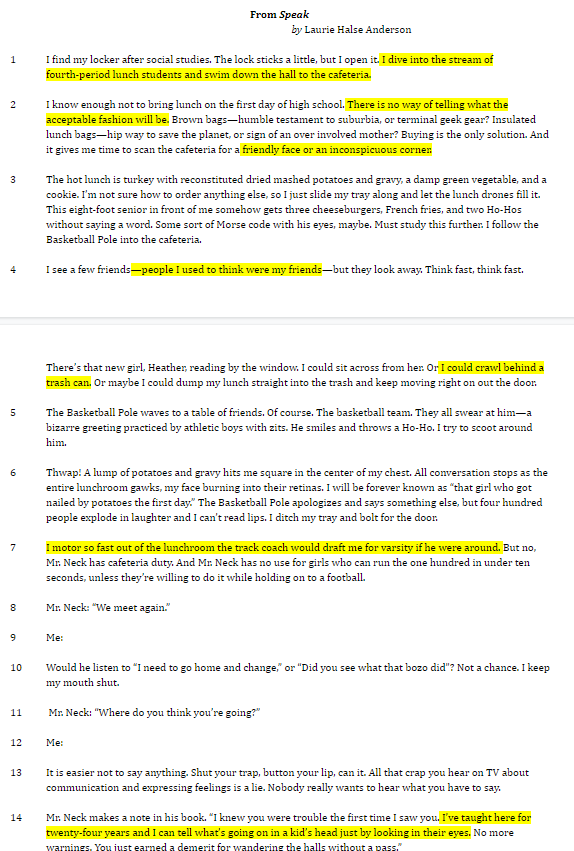
Afterwards, we moved on to spirit reading a passage from the book Speak by Laurie Halse Anderson. As we spirit read, we were annotating the passage for signs of diction, imagery and syntax. This is for our upcoming group work which incorporates the double-entry journal. Here is the passage we read:

Think/Pair/Share Breakout Rooms:

After completing our spirit read, we moved on to our group activity where we were put into breakout rooms of our own teams. The activity was to pick 4 annotations and use the double-entry journal to respond to them. Then we will share our own document with our partner of choice and they will respond to your annotation and comments in the double-entry journal. 

In my group, we had an odd number of people so we agreed on sharing our documents through a rotation. I chose 4 annotations that stood out to me and used the prompts to fill out the double-entry journal. Afterwards, I shared my document to my partner and opened up the document for me to comment on. Here is my filled out double-entry journal:

The group activity took about 20 minutes and we concluded with going back to the main room to discuss our findings. We discussed as a class about whether or not we shared the same ideas as our partner. Some of us did and some of us wrote the same thing or had completely different takes on the quote. 


Individual Activity:

To conclude the lesson, we participated in an individual activity where we pick 3 quotes that we think sounds like a teen’s voice. Then, we answer two follow up questions. One of them is “Does Melinda’s sarcastic interior monologue seem authentic? Why or why not?” and the other one being “What inferences can students draw based on her voice? From her voicelessness?”. Here are my takes on the activity. 


Reflection:

From today’s lesson, there were things introduced as a review and things introduced as a completely new concept to me. To summarize, we reviewed diction, imagery and syntax and learned about double-entry journals, different perspectives, narrative voice as well as how to put them into action. Knowing and identifying diction, imagery and syntax is important because it helps you break down a piece of writing to better understand and analyze the text. In addition to analyzing the text, the new note-taking strategy, double-entry journals, was a big help in understanding and analyzing the passage from Speak. I was able to use double-entry journals to actively read, reflect and express my thoughts to get a better sense of how Laurie Halse Anderson put her narrative voice into play. The main part of our lesson, the narrative voice, is such an important aspect of writing because it conveys the author’s tone and what the author wants you to feel while reading. Knowing how to incorporate narrative voice in your writing through diction, imagery and syntax is very important because you need to know how to manipulate your readers into thinking or feeling the way you want them to. That way you can successfully deliver your message across. Just like how Laurie Halse Anderson put on the persona of Melinda, a high school student, to make you think it is a student who is experiencing all these situations.


Blogger #4 Ethan Cadotte 2/25/2021 Day C

First, in class we started with the Do Now: What does it mean to you when you hear the phrase: "to come of age"? During this discussion, many ideas were presented on this phrase, many thought of it as a sign of maturity. This was a great part of the class because we got to experience how are classmates think about certain topics, and it would be an important tool in the upcoming parts of the lesson. 


After the Do Now, we reviewed a “Double Entry Journal”, which is a note taking strategy for the active reading of a text. You can connect your experiences to the experiences in the characters of the text. This allows us as readers to relate to the character and better understand the plot and character development.


After watching a video about narrative voice, in which the perspectives of a story (first/second/third person) were reviewed, we practiced the “Double Entry Journal”by reading through a text. This story was an excerpt of “Speak”, by Laurie Halse Anderson.

We paid close attention to diction, imagery, and syntax while highlighting what stood out to use.

It was a rather interesting story, about a girl in high school wandering through the cafeteria, thinking about where she should sit, except they went into great detail about her situation.

After reading the text and noting what stood out to us, we partnered up with people that were in our assigned groups, in which we would write our thoughts about the story based on quotes that stood out to us, and our partner would comment on what we wrote. It was interesting to see what our partners had to say about our comments, whether they agreed, disagreed, or even offered a deeper point that we weren’t quite getting to. This criticism brought out the thinking and deeply encouraged us as readers to dig deeper.


To finish off the lesson, we were given an independent activity. This activity consisted of 3 quotes that we found to be particularly authentic to the general idea of a teen’s voice.  These quotes would lead us to answer these 2 questions: 

  • Does Melinda’s sarcastic interior monologue seem authentic? Why or why not? 

  • What inferences can students draw based on her voice? From her voicelessness?


These questions dug deeper into the story as we were able to closely relate to how our first day at high school might feel to come back. It asks us if we see this character as having an authentic voice of your average high school student, an authentic experience being the first day at high school.


In conclusion, the lesson was planned to make us, as readers, dive deep into the meaning of the text provided for us, to make us more efficient readers. This is where the lesson ends, reminding students that they can use their own self reflection to see further into how the character is feeling in their situation, and how the character will develop throughout the story.


Blogger #5- Joanne Chen- Period 7- 2/25/21- Day C

Aim: How can active reading be applied to interpret writers' choices that create a narrative voice?


Do Now: WHOLE CLASS DISCUSSION

What does it mean to you when you hear the phrase: "to come of age"? 


Our class had a short discussion for this Do Now. The responses from each student varied, but shared the same general idea. We concluded that “to come of age” meant a transition from adolescence to adulthood. To add on, different religions and cultures might have something that marks this transition. For example, in Judaism, bar mitzvah and bat mitzvah ceremonies are held when a boy or girl turns 13. In addition, many American teens celebrate a Sweet Sixteen on their 16th birthday. There is also a similar hispanic celebration called a QuinceaƱera, which celebrates a girl’s 15th birthday. 


My peers had more specifically stated -

  • (Oscar) When you reach the age of 18, you become an adult. It is the milestone you reach when you become an adult.

  • (Lapyan) To come of age means to mature into a more responsible person.

  • (Isabella) To come of age means growing up to a point where you're more responsible, respected more, and when people start looking up to you.

  • (Sahil) When a person “comes of age,” they mature and develop into an older, more refined person.


The Double-Entry Journal

A double-entry journal is a note-taking strategy for actively reading a text. In your journal, you can connect your own experiences to those of the characters, share your opinions about what is happening, trace the development of the characters, and comment on the writer’s choices that create the voice of the narrator.


“Text”

(The book says...)

Analysis / Question / Opinion

( I say… )


If you are having trouble thinking of what to write, try using these stems: 

I really like / dislike this part because… 

I wonder why… ? 

The diction / imagery creates a tone of… 

This quote shows the narrator's / character’s voice by… 

I predict that… 

This reminds me of the time when I… 

If it was me, I would…

Wow! I can’t believe...


After reviewing how to take notes using the Double-Entry Journal strategy, our class watched a video on NARRATIVE VOICE to gain a better understanding of the three types of narrative voice.


Link: https://www.youtube.com/watch?v=CHl7mDZzfDw&ab_channel=mistersato411


Main points gathered from the video -

  • The writer creates the narrative voice.

  • The narrator can be a character in the story, or tell the story as an observer. 

  • When the narrator is a character in the story, they speak directly to the reader in first person. In first person, we get the thoughts and feelings of the narrator. 

  • The writer can choose to make the narrator tell the story from a distance as an observer, using third person. Sometimes in third person, the narrator focuses on the thoughts and feelings of only 1 character, which can help us understand the character more closely. 


Narrative voice can be determined through pronouns used in the text.


QUESTION 

What narrative voice is the following text written in?


He waited and tried to maintain his calm. “I will stay calm,” he told himself.

They pushed and shoved in the line: elbows and bags; everyone too close.


We determined the narrative voice used in this text was from a third person perspective. The narrator uses the third person pronoun “he” to refer to the central character, and quotations to show the character’s inner voice speaking.


After learning about narrative voice, we practiced the double-entry journaling strategy while actively reading an excerpt from Speak, by Laurie Halse Anderson. In this scene, the narrator, Melinda, is dealing with a new experience: the first day of high school.


Students took turns spirit reading. As we read along, we were tasked to highlight quotes in the text that made us think, while paying particular attention to diction, imagery, and syntax.


REVIEW 

Diction - What word choices does the speaker make? Formal or informal?

Imagery - What words and phrases include sensory details to create images?

Syntax - Are the sentences short, long, simple, complex?


THINK / PAIR / SHARE GROUP WORK

  1. Choose four of your highlighted quotes, making sure you choose a variety of types, and record and react to them in your graphic organizer. 

  2. Then exchange, and write responses to each other’s comments, explaining your own reaction to the trigger text or how you feel about your partner’s response. 

Did you see things the same way or differently? Why?

My graphic organizer is shown below, my partner was Carmen. 

“The book says…”

I say…

Comments from your partner

Partner’s Name:  Carmen Zeng

“Think fast, think fast.”


First person POV. The story is  narrated through Melinda’s thoughts. I relate to this quote because I also tell myself to “think fast” when I’m in a nervous situation. 

The story is told from first person and it is being told through Melinda’s perspective. It shows her thinking process and her thoughts while going through these certain situations.

“The hot lunch is turkey with reconstituted dried mashed potatoes and gravy, a damp green vegetable, and a 

Cookie.”


The diction and imagery creates a tone of disgust and dissatisfaction towards the food served at lunch. 

The word choices and details of the food elaborate on the disgusting lunch food that had been given out.

“...the entire lunchroom gawks, my face burning into their retinas.”


I like this part because it creates strong imagery through the diction. I can picture in my head what Melinda is currently experiencing. If I were in the same situation, I’d probably want to disappear.

It shows her perspective of what is happening when lunch gets on her. It gives exact details of what was occurring in her POV at the specific time. 

“Of course. The basketball team.”


Syntax; the short sentences. It sounds like the narrator is not very fond of the baseball team and has a negative outlook on them. 


Some sentences were complex and longer, however, these two sentences are examples of the shorter and simpler sentences that had been written in the text. 


When we returned from our breakout rooms, we had a brief class discussion on what we noticed about our responses in comparison to our peers. We noticed that some of us had the same quotes, or similar responses and feelings towards the same quotes. 

However, the type of response each person gave may have differed. Some responses were more personal, focusing more on connections and opinions, while others focused more on diction, imagery, and syntax. 


INDIVIDUAL ACTIVITY

Anderson was 38 years old when Speak was published, yet she captures a teen girl’s voice through her diction, syntax, and imagery. To explore how, choose three quotes you think sound particularly authentic to a teen's voice and respond to the following:

  • Does Melinda’s sarcastic interior monologue seem authentic? Why or why not? 

  • What inferences can students draw based on her voice? From her voicelessness?


“There is no way of telling what the acceptable fashion will be.”

“And it gives me time to scan the cafeteria for a friendly face or an inconspicuous corner.”

“Shut your trap, button your lip, can it. All that crap you hear on TV about communication and expressing feelings is a lie. Nobody really wants to hear what you have to say.”


Melinda’s sarcastic interior monologue does seem authentic. Many high school teens are focused on fitting in and Anderson captures that desire to “fit in” perfectly. Through her thoughts we learn that Melinda wants to fit into the “acceptable fashion,” and she also tries to find a place to sit at lunch so she doesn’t stand out.  In addition, like many teens, Melinda doesn’t like expressing her feelings, and would rather bottle all her emotions up. She tells herself to “Shut your trap, button your lip, can it.” when she is confronted by Mr. Neck. Melinda’s internal monologue also reveals her opinion towards expressing her feelings, “All that crap you hear on TV about communication and expressing feelings is a lie. Nobody really wants to hear what you have to say.” From Melinda’s voicelessness, we can infer that she is a quiet student, and that she tries to fit in so she doesn’t stand out. Melinda chooses to keep quiet, even in a situation where it would have benefitted her if she spoke up. She doesn’t stand up for herself, causing Mr. Neck to misunderstand the situation. Melinda chooses to stay quiet, as it would be easier to give up, than even attempting to correct the misunderstanding. 


Reflection

What did I learn?

Why did I learn it?

How will I use what I learned?

From this lesson I learned a new strategy for note-taking while actively reading; the Double-Entry Journal strategy. This is a useful method to jot down your reactions and ideas when actively reading and engaging in a story. If I ever need a quick and efficient way to get my thoughts down on paper, I will be sure to use this strategy in the future. 

This lesson’s topic was narrative voice and the choices a writer makes in their story to create a narrative voice. Narrative voice is an essential element in writing that affects other literary elements such as mood and tone. The three types of narrative voice was mostly a review for me, since I had touched on the topic in the past. However, I learned that the narrator’s voice in a story can help us characterize the central character.  In Speak, Anderson uses a variety of techniques to capture a teen girl’s voice through the character, Melinda. While following along and reading the excerpt from Speak, it had not occurred to me that Melinda’s voice had been created when Anderson was 38 year old. Upon further investigation, I started to understand how Anderson was able to capture the voice of a teenage girl so seamlessly. Through choices in diction, syntax, and imagery, writers can capture the speech, actions, and thoughts of a character. One element Anderson focused on to create the voice of Melinda was diction, or word choice. Anderson’s choice of informal slang words reflect that of an actual teenager’s speech. In a story, the choices of the writer creates a narrative voice. By recognizing the specific choices the writer makes, we can better characterize and understand future characters through a narrative voice.

Thursday, February 25, 2021

Blogger #4 - Chloe Chen- Period 2 - 2/23/2021 - Day A

Blogger #4 - Chloe Chen- Period 2 - 2/23/2021 - Day A


Aim: How can active reading be applied to interpret writers' choices that 

create a narrative voice?


Do Now: (class discussion)       

What does it mean to you when you hear the phrase: "to come of age"


As a class, we discussed that “coming of age” reminds us of development and being able to reach a certain maturity. (Ayah) To come of age would be somewhat of a metaphor because we are earning maturity and learning to voice our opinions. We gain experience and knowledge to make our own decisions and have a certain point of self-awareness. It is like “a new stage” with more freedom and additional realization. 

Typically, the phrase “coming of age” is used to describe different teen movies because it is where we, as people transform. In our teenage years, we tend to face situations that we have never seen before. It is when we transition into adulthood and experience the real world. We start to take on new perspectives and meet people who are completely different compared to us. It’s special because although we may not have it all figured out yet, we learned more about ourselves than we have before. 


The double-entry journal:

The double-entry journal is used in high school and college-level courses to help understand the materials that you encounter. It is a note-taking strategy and connecting experiences between the characters and ourselves. It is in the format of a T chart,  where we put in text analysis, reflection, questions, and opinions. We may include various commentary and personal opinions. Down below is how the entry journal is supposed to look like:


“Text”

(The book says...)

Analysis/Question/Opinion

(I say...)


If you are having trouble thinking of what to write, try using these stems: 

I really like / dislike this part because… 

I wonder why… ? 

The diction / imagery creates a tone of… 

This quote shows the narrator's / character’s voice by… 

I predict that… 

This reminds me of the time when I… 

If it was me, I would…

Wow! I can’t believe...


Narrative voice

A narrative voice is a narrator created by the writer. Depending on the angle the audience is reading the story from, there are different types of narrative voice.

There are three types of narrative voice:

First Person:

  • When the narrator speaks directly to the audience
  • Uses I, me, we, mine...


Second Person:

  • When the audience is implied as the narrator or the writer address you as a character
  • Uses you, yours...


Third Person:

  • When the narrator tells the story from a distance
  • Uses he, she, they, them...
  • The writer may focus us on one character’s thoughts and feelings to understand them better


Additional sources to understand narrative voice:

First person vs. Second person vs. Third person - Rebekah Bergman

Writing in the Third Person From the First Person


Spirit Reading: 

The class read through a scene from Speak, the narrator is Melinda and she is dealing with her first day at school. We followed the directions below to annotate the scene:

“DIRECTIONS: As you read, highlight quotes in the text that make you think; try to pay particular attention to diction (What word choices does the speaker make? Formal or informal?), imagery, (What words and phrases include sensory details to create images?) and syntax (Are the sentences short, long, simple, complex?). Then, use the chart to write a variety of responses to the text.”

From Speak

by Laurie Halse Anderson


1       I found my locker after social studies. The lock sticks a little, but I open it. I dive into the stream of 

fourth-period lunch students and swim down the hall to the cafeteria.


2       I know enough not to bring lunch on the first day of high school. There is no way of telling what the 

acceptable fashion will be. Brown bags—humble testament to suburbia, or terminal geek gear? Insulated lunch bags—hip way to save the planet, or sign of an over involved mother? Buying is the only solution. And it gives me time to scan the cafeteria for a friendly face or an inconspicuous corner.


3       The hot lunch is turkey with reconstituted dried mashed potatoes and gravy, a damp green vegetable, and a 

cookie. I’m not sure how to order anything else, so I just slide my tray along and let the lunch drones fill it. This eight-foot senior in front of me somehow gets three cheeseburgers, French fries, and two Ho-Hos without saying a word. Some sort of Morse code with his eyes, maybe. Must study this further. I follow the Basketball Pole into the cafeteria.


4       I see a few friends—people I used to think were my friends—but they look away. Think fast, think fast. 

There’s that new girl, Heather, reading by the window. I could sit across from her. Or I could crawl behind a trash can. Or maybe I could dump my lunch straight into the trash and keep moving right on out the door.


5       The Basketball Pole waves to a table of friends. Of course. The basketball team. They all swear at him—a 

bizarre greeting practiced by athletic boys with zits. He smiles and throws a Ho-Ho. I try to scoot around him.


6       Thwap! A lump of potatoes and gravy hits me square in the center of my chest. All conversation stops as the 

entire lunchroom gawks, my face burning into their retinas. I will be forever known as “that girl who got nailed by potatoes the first day.” The Basketball Pole apologizes and says something else, but four hundred people explode in laughter and I can’t read lips. I ditch my tray and bolt for the door.


7       I motor so fast out of the lunchroom the track coach would draft me for varsity if he were around. But no, 

Mr. Neck has cafeteria duty. And Mr. Neck has no use for girls who can run the one hundred in under ten seconds, unless they’re willing to do it while holding onto a football.


8       Mr. Neck: “We meet again.”


9       Me:


10     Would he listen to “I need to go home and change,” or “Did you see what that bozo did”? Not a chance. I keep 

my mouth shut.


11     Mr. Neck: “Where do you think you’re going?”


12     Me:


13     It is easier not to say anything. Shut your trap, button your lip, can it. All that crap you hear on TV about 

communication and expressing feelings is a lie. Nobody really wants to hear what you have to say.


14     Mr. Neck makes a note in his book. “I knew you were trouble the first time I saw you. I’ve taught here for 

twenty-four years and I can tell what’s going on in a kid’s head just by looking in their eyes. No more warnings. You just earned a demerit for wandering the halls without a pass.”


Think, Pair, Share:


In our groups, we chose four of our highlighted quotes and reacted to them in our graphic organizers/double-entry journal. We made sure that each quote played a part in the story's diction, syntax, and imagery.


First, we copied and pasted the quotes from the scene into box 1 with quotation marks.

(If you are inserting a section and it is too long, you can use ellipses to shorten the quote)

For example: “The hot lunch is turkey with reconstituted...and a cookie.”


Then, we commented about how we felt about that certain scene in box 2. Why did this scene stand out? How did you react? How does it affect the story's diction, imagery, or syntax?


Finally, we shared our doc with our partner and they reflected on our commentary in the last box. We reflected on their commentary on their doc. Did they agree or disagree? Why? What did you think of the scene?


The book says… (box 1)

I say… (box 2)

Comments from your partner:


When we shared out our opinions as a class, we realized that many people had different takes on the same scene. Some people had similar views and it’s all about perspective and personal experiences. 


One scene that stood out to me was “Shut your trap, button your lip, can it. All that crap you hear on TV about communication and expressing feelings is a lie.” This sentence makes the passage seem informal because she used words that are not necessarily professional. For example, the word, “Shut your trap...crap” This phrase sounds like we know her very well and that’s why she isn't so formal. We are inside of her head and understanding how she feels. 


Individual work 

Anderson was 38 years old when Speak was published, yet she captures a teen girl’s voice through her diction, syntax, and imagery. To explore how, choose three “quotes” you think sound particularly authentic to a teen's voice and respond to the following “2” bullets:

  • Does Melinda’s sarcastic interior monologue seem authentic? Why or why not? 
  • What inferences can students draw based on her voice? From her voicelessness?
  1.  
  2.  
  3.  


Respond to the 2 Bullets:

  1.  
  2.  


We responded to the box individually, allowing us to reflect on how the writer brings out her inner teenage self through monologues. Responding to the first bullet, I think that Melinda's sarcastic interior monologue seems somewhat authentic because although regular teens don’t use vocabulary words like she does, most of her emotions like anger and embarrassment make her more like a teenager. It shows how her emotions affected the way she acted and teenagers run on emotions. They act based on how they feel at the moment, purely on impulse.  It makes the story so much more relatable and brings out the inner teenager within the narrator. 


Reflection:

Throughout today’s lesson, I learned to use the double-entry journal effectively. I practiced how to use it as a way to reflect on my thoughts and comments. I also learned that working together has a big impact on perspective because there can be so many views on a single scene of a story. The narrative voice has a big impact on the way we tell and receive stories, it affects the audience’s connection with the characters. I learned to use narrative voice because then I can manipulate the way I want my audience to receive my story. Using different perspectives and learning to use the double-entry journal, I can connect with different characters and try to understand them.