Wednesday, February 5, 2020

Blog #2 - Laiba Ali - Period 9 - 2/5/2020

February 5th, 2020
Laiba Ali
Period 9

Aim: Why is “The Declaration of Independence” symbolized as a valuable document for our society?

Do Now: 1) How would you explain what your rights are as an individual living in the United States? Why? 
   2) Why do you believe an individual’s rights are so important to society?

To begin class, teams first discussed what they believe their rights are as an individual living in the United States. My team and I agreed that some of our basic, but important rights include freedom of speech and the freedom to do as we please as long as we don’t hurt anyone else. Then, we debated the second question, recognizing that without rights, there would be no individuality and no sense of freedom. 
Then, the class discussion began. Mainly, we discussed how important the national laws are, especially freedom of speech. Without freedom of speech, people would be scared to speak up for what they believe in and would be suppressed. 

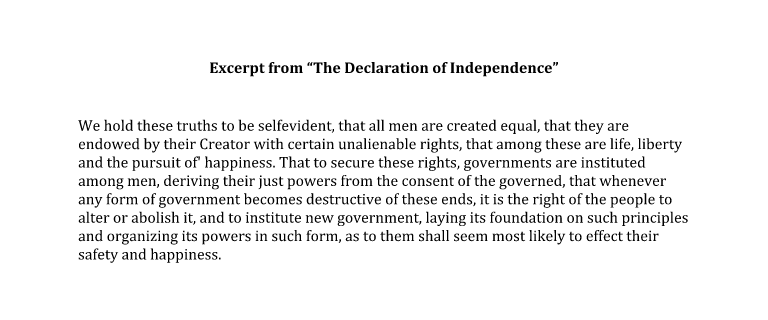
Then, using this excerpt from The Declaration of Independence;
we discussed the following 5 questions in our groups, then as a class:
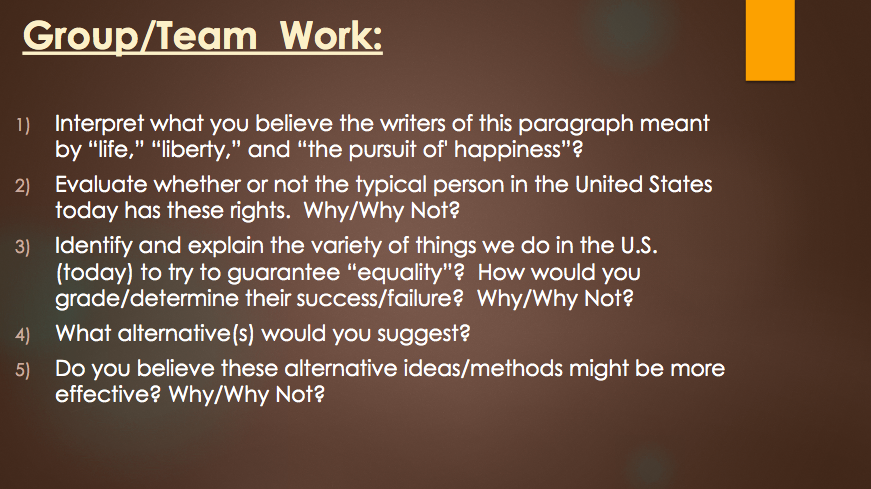
    We began the discussion by talking about “life,” “liberty,” and “the pursuit of happiness,” agreeing that the pursuit of happiness is our right to try and seek fulfillment and joy within our lives. It includes the right to opportunities and the right to be happy. “Life” means the right to live as a person, nothing less, and the promise to be treated as such. Lastly, we agreed that “liberty” includes freedom, such as freedom of speech and expression. Then, we carried the conversation into a slightly darker tone, discussing whether or not we believe the typical person in the United States has these rights. My group and the class brought up good points, such as that not everyone has the means to pursue these rights, although they may have them. An example brought up in my group would be a diabetic citizen. Although they have the right to life, they’d be unable to fulfill that life if they cannot afford their insulin for months on end because of lack of good, affordable healthcare. I had added on in our group that homeless people, for example, have been belittled and discriminated against since the beginning of times. With no help available to them and spikes being installed where they’d normally sleep at night, are they being given the opportunities and aid they are promised by their rights? The conversation was then led into what the United States already does to try to guarantee “equality.” Some examples brought up by Ms. Peterson and the class include scholarships (and the excessive costs of college) and the use of different SAT score cutoffs based on ethnicity. When it was brought up that college is excessively expensive and should be free up to a certain point in order for students to exercise their right to education, scholarships were brought up. Scholarships are a great way for already excelling students to be rewarded for their hard work. However, we agreed that they can be unfair when lack of opportunity comes into play. For example, Ms. Peterson’s foster daughter. Although she was a good student and deserving of an equal chance, she was not given the chance to learn to read until eleven years old. This meant she was so behind everyone else her age that she had to work twice as hard to catch up. As Ms. Peterson said, she’d never be able to achieve as high of a score as a student in this school, not because she wasn’t as smart, but simply because of lack of opportunity. If she had been given the same treatment as any other child, maybe she would have been rewarded with a scholarship. Another example of unfair ways the US has tried to fill in these guarantees would be increasing or decreasing the SAT score cutoff depending on ethnicity. One student called it discriminating against students based on where their parents were born and the class agreed. On the other hand, another student pointed out that our ability to simply say “we don’t have rights anymore” is a right in itself. In other countries, one can be prosecuted for saying such things. It was implied that we have more rights than what meets the eye and we must be more grateful for them. Throughout our discussion, great real-life examples were introduced and refuting points were made about whether or not we believe the typical person in the United States has the rights discussed in the excerpt from The Declaration of Independence. 


Reflection:
    Today I learned about the rights the United States has promised the American people and the importance of it in our society. By reading the Declaration of Independence and then applying its effects on society to the average American life, I was able to tell how much the Declaration really executed what it promised. Although I do acknowledge that I live a privileged, righteous life, where I have a roof over my head and education under my belt, I also recognize the lack of aid the Declaration provides for people less fortunate than me, who miss opportunities they may have deserved. I think I learned this because in the last few days we have been diving into the idea of equality in our country, and going back to the roots of the country in the Declaration of Independence allows me to finally realize how equal this country really is. I also think I learned this as a way for me to recognize how truly privileged I am to live the life i do, even if sometimes I may not think of it that way. This was truly an eye opener for me. I will use this lesson to be even more grateful for what I have and to recognize the importance of the Declaration of Independence. 

Blog #2 - Fiona Chen - Period 1- 2/5/2020

February 5, 2020
Fiona Chen
Period 1

Aim: How can active reading be applied to interpret writers' choices that create a narrative voice?

Do Now: What does it mean to you when you hear the phrase to: "come of age"?

  • A common response about "coming of age" was that it meant to not only grow older physically, but mentally. Many times, we associate this term with both aging and maturing. As we get closer to reaching adult status and becoming more established, the way we think and act is more sensible.

___________________________________________________________________________

Double- Entry Journaling
A double-entry journal is a note-taking strategy for actively reading a text. You can connect  your own experiences to those of the characters, share your opinions about what is happening, trace the development of the characters, and comment on the writer’s choices that create the voice of the narrator.

  • Consisting of 2 columns, the left side is where you cite your text, while on the right, you jot anything that you want to comment on, whether it's your opinion, writer's choice, or even any questions.
  • Using sentence stems may help with your analysis, examples below:


    Following this discussion about using double-entry journals and what you can include in your analysis of the text, we read an excerpt passage from Speak, where our narrator Melinda experiences her first day of high school.

    As we [spirit] read this passage together as a class, we highlighted quotes, focusing on the writer's diction, imagery, and syntax.
    ____________________________________________________________________________________________________________________
    From Speak
    by Laurie Halse Anderson
    1       I find my locker after social studies. The lock sticks a little, but I open it. I dive into the stream of
    fourth-period lunch students and swim down the hall to the cafeteria.

    2       I know enough not to bring lunch on the first day of high school. There is no way of telling what the
    acceptable fashion will be. Brown bags—humble testament to suburbia, or terminal geek gear? Insulated lunch bags—hip way to save the planet, or sign of an over involved mother? Buying is the only solution. And it gives me time to scan the cafeteria for a friendly face or an inconspicuous corner.

    3       The hot lunch is turkey with reconstituted dried mashed potatoes and gravy, a damp green vegetable, and a
    cookie. I’m not sure how to order anything else, so I just slide my tray along and let the lunch drones fill it. This eight-foot senior in front of me somehow gets three cheeseburgers, French fries, and two Ho-Hos without saying a word. Some sort of Morse code with his eyes, maybe. Must study this further. I follow the Basketball Pole into the cafeteria.

    4       I see a few friends—people I used to think were my friends—but they look away. Think fast, think fast.
    There’s that new girl, Heather, reading by the window. I could sit across from her. Or I could crawl behind a trash can. Or maybe I could dump my lunch straight into the trash and keep moving right on out the door.

    5       The Basketball Pole waves to a table of friends. Of course. The basketball team. They all swear at him—a
    bizarre greeting practiced by athletic boys with zits. He smiles and throws a Ho-Ho. I try to scoot around him.

    6       Thwap! A lump of potatoes and gravy hits me square in the center of my chest. All conversation stops as the
    entire lunchroom gawks, my face burning into their retinas. I will be forever known as “that girl who got nailed by potatoes the first day.” The Basketball Pole apologizes and says something else, but four hundred people explode in laughter and I can’t read lips. I ditch my tray and bolt for the door.

    7       I motor so fast out of the lunchroom the track coach would draft me for varsity if he were around. But no,
    Mr. Neck has cafeteria duty. And Mr. Neck has no use for girls who can run the one hundred in under ten seconds, unless they’re willing to do it while holding on to a football.

    8       Mr. Neck: “We meet again.”

    9       Me:

    10     Would he listen to “I need to go home and change,” or “Did you see what that bozo did”? Not a chance. I keep
    my mouth shut.

    11    Mr. Neck: “Where do you think you’re going?”

    12     Me:

    13     It is easier not to say anything. Shut your trap, button your lip, can it. All that crap you hear on TV about
    communication and expressing feelings is a lie. Nobody really wants to hear what you have to say.

    14     Mr. Neck makes a note in his book. “I knew you were trouble the first time I saw you. I’ve taught here for
    twenty-four years and I can tell what’s going on in a kid’s head just by looking in their eyes. No more warnings. You just earned a demerit for wandering the halls without a pass.”
    __________________________________________________________________________________________________________________

    Using the provided chart, we recorded four of our annotations/responses in a graphic organizer, noting things we saw about narrator's choice of words.
    As we did this, we also exchanged with our partners to write about their reaction to our comments/annotations.


    ___________________________________________________________________________________________________________________

    Reflection:
  • Today I learned how to identify different parts of the text to analyze the writer's choice. With different pieces of evidence from the text to support our analysis of the author's diction/word choice, syntax, and portraying imagery. Through the use of a double entry journal, I recorded text evidence and an opinion/question about it. Using graphic organizers and this way of note taking helped me better focus on not just what the story is about but also how it is written, specifically the writer's style and choice of words to better fit the character's experience. With this, I can analyze texts, recording down any connections with my own experiences to better understand the text and engage in it.

Blog #2- Daniel Briskman- Period 2- Sophomores 2020

Aim: Why is “The Declaration of Independence” symbolized as a valuable document for our
society?
Do Now: 1) How would you explain what your rights are as an individual living in the United
States? Why? 2) Why do you believe an individual’s rights are so important to society?

Our team discussed the significance of freedom of speech and liberty to the United States.
These rights are important because they allow the working class to not be oppressed like it was
during the rule of the American colonies by Great Britain. Unlike other countries that took away
the rights of peasants under serfdom, the U.S. valued the rights of the working class. After all, it
was the peasants who allowed us to achieve freedom. As a result, the common citizen should
be given a voice and independence, as it was these values that led to the creation of our
country.

Notes: After the Do Now, our teams read this passage from the Declaration of Independence.
Afterwards, we discussed and answered the following questions.
Interpret what you believe the writers of this paragraph meant by “life,” “liberty,” and “the pursuit
of happiness”?

“Life” and “liberty” mean that Americans’ choices will not be bound by or controlled by another
country, like Great Britain. “Pursuit of happiness” means that Americans will have unlimited
opportunities in life. They can work hard and achieve their dreams.

Evaluate whether or not the typical person in the United States today has these rights.
Why/Why Not?

The typical person in the United States today does not always have these because there are
many xenophobic people who deny people of certain cultures, religions, sexualities, or genders
the same opportunities as everyone else. These biases infringe on the citizens’ right to
“equality” as well as “pursuit of happiness,” as it would be more difficult to find work.

Identify and explain the variety of things we do in the U.S. (today) to try to guarantee “equality”?
How would you grade/determine their success/failure? Why/Why Not?
What alternative(s) would you suggest?

Now there is a large emphasis on diversity in America. This is evident in the large numbers of
ethnicities portrayed in media such as movies. However, this is not a complete success because
some people may be prioritized more than others based on their ethnicity to maintain a good
appearance. Also, greater efforts are being produced to diversify schools, but this causes a
similar problem as with the media, as in some cases students may not be chosen purely on their
hard work. In addition, the U.S. enforces equality with police, but this is not foolproof, as the
system only works when people are brave enough to come forward and report cases. Lastly,
can offer classes to prepare students for the adult world, but, oftentimes, the low weight of these
classes leads to low effort in students. Overall, these actions to give American people equality
are steps forward, but they are not a complete success. Some alternatives may be to provide
more opportunities to have an education. Rather than picking a select few, education can be put
under greater emphasis in order to provide a means to a valuable education for all people.
Secondly, we can change the curriculum for career development classes to make them more
beneficial for our youth and make them have more value in our averages so students
understand their importance.

Do you believe these alternative ideas/methods might be more effective? Why/Why Not?
Of course, there is no perfect solution. If education is to be given top priority, taxes would have
to be increased. This would anger American citizens and cause strikes or revolts. Also, raising
the credits that career development classes provide would cause dissatisfaction in students who
believe that the class should not have that much influence on their average, as it is not a
traditional class.

Class Discussion & Address the Aim:

The Declaration of Independence is symbolized as a valuable document because it represents
the birth of our nation and the mission of the colonists—to give American citizens new rights.
However, we discovered in our groups and in class that by trying to make everybody equal, we
are actually being unfair by bringing extra attention to certain groups. Yesterday we applied this
idea to giving extra points to people who want their average to be slightly higher, and today
applied it to our country. Although we realized there is no perfect answer as to how we can fix
such issues, the Declaration of Independence remains a reminder of our founders’ visions for
this country. Though their ideals may have been distorted or imperfect, they represent the fight
of Americans to keep searching and fighting to reach a better answer, just as the colonists
fought for America.
Reflection:
     Over the past few days in class, we explored the idea that the equality of our country is not
the “ideal” total equality that many wish for. We also realized that total equality is not the answer
after all. Today, we expanded on those ideas by analyzing the significance of our rights and how
we can guarantee them, if at all possible. We dove into the origins of our country by reading a
passage from the Declaration of Independence. After describing the meanings of the rights
written in the document, we questioned the intent of the writers. Although the rights were written
to include “all men”, they excluded women and, in reality, the rights only applied to wealthy,
white men. Now, we—as a society—are trying to reinterpret the document with our modern
morals, but have we achieved our goals? To answer this question, we worked within our teams
and then discussed it as a class. Together, we realized that the efforts of the U.S. have not
been a complete success. Not only is it difficult for the police to enforce our rights without
reports from people, but by placing special importance upon the inclusion of all types of people
in schools and the media, we have somewhat reversed the circumstances at the writing of the
Declaration of Independence, so that external factors are still exerting too much influence rather
than the internal factors (character, abilities, work-ethic) that matter most, but with minorities
having the advantage. This is especially evident in the college admissions process, which
sometimes results in ethnicity determining the outcome. Through our discussion, we found that
equality is more of a loaded word and an ideal rather than an achievable state. As we
deliberated about how we can guarantee equality, we gained a new perspective on the workings
of a society. We learned that society is so fragile, that equality is broken as someone tries to
create it! As we progress through our sophomore year curriculum, we will apply this insight to
analyze how dystopian literature portrays societies that attempt to achieve equality but do so in
harmful, oppressive, and corrupt ways. Perhaps we will identify trends that are similar to what
we discussed in class.

Tuesday, February 4, 2020

Blog #1- Malak Abdelhakim- Period 2- 2/4/20

Malak Abdelhakim Pd 2
2/4/20
Sophomores 2020
Blog #1


Aim: Why are the terms, “equality”, “rights” and “alike” important to society?


Do Now: 
Class Discussion #1

Why do you believe that “equality” has been the “hot topic” of discussion in society? Why do you believe that society is so concerned with the equality of people?

  • Equality is a hot topic because it gives people a false sense of belonging.
  • The same people who advocate for equality are the ones fighting for it; it’s also possible that they just feel they’re on top of others.
  • Many are hypocrites; some just want it because they just think it’s the right thing to do, or maybe they’ll just get something out of it.
  • Panacea - something that can be used as a cure or a solution.

Group Questions

Agree/Disagree: Life in the USA would be perfect if everyone were totally equal. Why?

  • Total equality might have different outcomes; there will always be those who want more, or those who work harder than others, but get the same outcome, which will eventually lead to disorder in a society.

You are designing a society in which everyone is equal. What are the laws?

  • An equal society: everyone has equal opportunity as long as they deserve it or work for it.
  • It’s almost impossible to create an equal society, because everyone has so many different needs; equal society doesn’t equal the best society.

What would you do to help people who were less capable mentally,physically, or socially to “catch up”?

  • The public is provided resources, even if only the minority needs it, so it wouldn’t seem like special treatment.

What problems can you foresee that might arise in a society with enforced “equality for all”?

  • Without a leader, society would decline fast, because people have a natural instinct of following others or getting influenced by them.
  • It can’t be a complete anarchy because there are too many decisions to be made in government that it would just be too difficult for just people as a whole to control it on their own.

How would you handle those problems?

  • A system of artificial intelligence can be created that sort of acts like a rubric for a person, grading them based on how they work, and paying them an amount that corresponds to that. 

Do you believe that total equality is possible, or would human nature assure that some people would eventually dominate others?

  • Total equality is not very possible, because there will always be power-hungry people
wanting more, or maybe some that work harder than others, yet get the same amount
back. This eventually leads to disorder and chaos in a society, because protests and riots rise up, giving way for rise of power.

Class Discussion #2
 `
  • Everyone is the same means communism; Everyone has rights, but you are still different from others. 
  • You need a higher person in power to control the total equality; this will lead to sharp division of class, which will lead to more chaos; someone being put in charge ruins the emphasis on equality that the society was built off of.
  • Laws for society: no social classes; everyone is born in where they are, whether it be the poor farm families or the wealthy middle class, but they can’t interact with one another; merit pay
  • If you give people one thing, you have to give the same to others, so everyone can get the same treatment. However, that way some will end up having more in the end than others.


Reflection

     I learned that total equality is almost impossible to achieve in a society, just because everyone is so different with varying needs. A totally equal society can be one that’s based on equal opportunity for all. However, there’s a problem with that: not all people work as hard as others in a society, yet they all still get paid the same amount. This will eventually lead to many people rising and starting riots and protests. On the other hand, there will be those who actually want more because of how power-hungry they are, which will also lead to chaos and disorder and people trying to rise to power. All of this helped me to understand that I should learn these aspects about my society because they can be relatable to everyday life, not just government wise. For instance, if my teacher gave a student extra points just to boost his/her grade up a bit, she has to do the same for the rest of the student. However, that still won’t be equal because everyone still has different grades. Everyone is so different that it’s not possible to create a society in which everyone functions the same way unless those people are all the same person. This will help me in future use with understanding society as a whole, as well as understanding my rights in a democracy are still limited, because although we are all considered “free”, that’s just an illusion that everyday society lives in because nobody can truly be “free” or “equal” without there being a consequence. 

Hiba Ahmed - 2/4/20 - Period 3 - Blog 01 - Sophomores 2020


Aim: Why Are The Terms, “Equality”, “Rights” And “Alike” Important To Society?

Do Now: Why do you believe that “equality” has been the “hot topic” of discussion in society? Why do you believe that society is so concerned with the equality of people?

To start off the day, this question was posed to us for discussion. The overall response to the first part of the question were basic, well known facts. Groups stated that nobody likes being treated as inferior to others and likes having a fair fight. Of course there are some exceptions to that, but the majority of people feel better being treated as equals. Equality is just what these people wish for in order to even out the playing field. Moving on to the second part of the question, there were a variety of responses for it. One student said that people who don’t get what they want become angry, and society doesn’t wish to deal with angry citizens. Another student mentioned that equality is something many people are passionate about, but there are many different possible interpretations for the meaning of “equality.” And a more relevant, modern problem that still goes on in today’s world, is racism and other prejudices against people with different appearances. Equality for those people is a common issue. 

After the Do Now, the class proceeded to turn into their teams. In our teams, we discussed what life would be like in a total equal society by answering questions pertaining to them. We discussed what laws would be in an equal society, the problems that might arise, and whether true equality is possible to achieve. There were a total of six questions in total. They were:
  1. Agree/Disagree: Life in the USA would be perfect if everyone were totally
equal. Why?
  1. You are designing a society in which everyone is equal. What are the laws?
  2. What would you do to help people who were less capable mentally, physically, or socially to “catch up”?
  3. What problems can you foresee that might arise in a society with enforced “equality for all”?
  4. How would you handle those problems?
  5. Do you believe that total equality is possible, or would human nature assure that some people would eventually dominate others?

Following the team discussion, there was a class discussion, where the students told the whole class what they discussed in their groups. Throughout the discussion, students voiced out their opinions on each of these questions.  that life would never be perfectly fair for everyone. Perpetual equality would be hard to achieve because not everyone would agree with everything, and in order to have order in society, authority is needed. But that automatically defines the concept of total equality. Furthermore, the interpretation of what “total equality” means also plays a factor in how “perfect” a society can be. Depending on whether equality means total equality in every facet of life or specific organizations, life in a country where everyone were totally equal would differ. 

    Our class also pitched in their thoughts on what kind of laws a society where everyone is equal would have. Some of these ideas were: no favoritism in races or gender (which also ties in with not judging someone based on their physical attributes), no killing or stealing, treating others with respect, along with other laws along the same line. One particular problem with these laws, however, is that criminals would have to be given free reign. Because if they were arrested for killing and stealing, as mentioned above, they would be seen as “inferior” to the common folk, which goes against a totally equal society. In the same vein, people who are less capable mentally, physically and/or socially than regular people would be seen as “superior” than everybody else if they get better treatment in order for them to catch up with everybody else. In both cases, a true equal environment would prevent special needs people from getting special treatment as well as allow crime to flourish. One way a classmate mentioned in order to solve this particular problem, was to give everyone else better treatment if the less capable were also given better treatment. 

    In an equal society, everyone would get the exact same thing, but there is no possible way to have a completely equal society if there are laws, and people to make sure that equality is being followed. 

Reflection: 
    After the day’s lesson, I came to realize how exactly nonliteral the societies of today’s world take the word “equality.” With the help of my classmate’s diverse opinions, I learned that having a perfect equal society was impossible. I always knew that humans had some kind of intictual quality of having biases, but in today's class period, I managed to apply that knowledge on a long fight for issue in history. Today, I learned that all humans are going to have a bias in life about anything and anyone, which will influence any decisions they make. As such, everyone preaching about having equality won’t ever get true equality. But it was also due to this lesson that I acknowledged that total equality may not be a positive thing as people are saying it is. Learning all this was necessary for me to understand that not everything is black and white. I now understand that equality, in the eyes of the common people, represents only a fraction of what it actually means. The world outside of school is a vast place, where people have to make constant decisions on what’s best for themselves and others. Take the political parties for example. There might be a situation where you don’t completely agree with any of them. This knowledge will help me to think more thoroughly about the things around me, and to never take things at face value. I know some people can think that they’re already doing so, but more often than not, we let our biases control us without even noticing. 

Blog #1- Amanda Chen - Period 1 - 2/4/2020


February 4th, 2020
Amanda Chen
Period 1

Aim: How can an exploitation of writers’ choices and the literary devices used, introduce us to the concept of “voice” as it’s used in writing?

Do Now: When you think of pizza, what comes to mind? Write a paragraph describing pizza and showing your attitude toward it. You will come back to this later!
    - The do now was a quick write about everyone’s opinion on pizza and was revisited later in the lesson where everyone shared their opinions and discussed how they thought about pizza.

After the do now we had a class discussion of  a speaker who also wrote on the same topic of what they thought about pizza. The discussion was about different inferences that were made that were backed up with evidence from the speaker. Then during the class discussion we had to fill out a chart that organize the inferences made.


From the inferences of the speaker with their word choices, sentences structure, use of imagery, and tone we were able to make a profile of who the speaker was. Based on the discussion in class we can infer that the speaker was an adult that also works as a food critic and favors pizza.

Later on we had to work in partners to practice with more using the same format and make inferences about that speaker.  We had to fill in the same chart that was used in class discussion to help organize our inferences. Then we had another class discussion on what everyone had also thought about the speaker and their inferences

From the discussion:

- Speaker 2: A young child who enjoys eating pizza whenever his mother makes them.


- Speaker 3: An adult who will eat pizza when it doesn’t contain meat. 

- Speaker 4: A teenager or young adult that is very much for eating pizza where they would eat with friend and enjoys pizza when its hot and with pepperoni. 


Reflection:
- Today I learned how to make inferences about different sections of the text with the inferences being backed up with evidence. Learning how to make inferences and then supporting them back with evidence helped me get a clear idea on how inferences can be helpful when trying to read a sample text and to develop context to that text. Going off on the idea of how inferences can help develop context with different texts will be relevant with later lessons. Where the later lessons can have different sections of different books/text that are relevant to the lesson and the skill of making evidence-based inferences can help deepen the understanding of the text as well as building context. I will use this skill throughout many different subjects and classes to help deepen my understanding of the different topics and to develop another skill of always making claims/inferences with relevant and  supportive evidence. Overall the lesson today showed use how to make inferences with contextually evidence to help build context of a specific text.  


Blog #1 - Christina Antypas - Period 9 - 2/4/2020

February 4th, 2020
Christina Antypas
Period 9

Aim: Why are the terms, “equality”, “rights” and “alike” important to society?

Notes
To start off the lesson today, our class participated in a discussion about why we believe the term “equality” has become a “hot topic” of discussion in society. After sharing our ideas in our group, we convened as a class and came to the conclusion that equality has become a “hot topic” because of our way of life. Many people brought up the fact that many people in today’s world are not seen as equal, as well as that it is very hard to achieve “total equality”. Although we have come very far from long ago, it was concluded that there are still changes that need to be made to make sure everyone has equal opportunity. 
In addition to the do now, we spent the rest of the class period with our groups discussing many questions on equality in today’s world. The questions, as well as my groups answers, can be seen below:
  1. Agree/Disagree: Life in the USA would be perfect if everyone were totally equal.  Why?
    1. We disagree because we feel economically and politically, it would be hard to have TRUE equality due to the fact that this could lead to zero growth. We also feel equal opportunities would essentially be considered equity, and that true equality would lead to people having similar thoughts. Again, this would lead to no growth in humanity.
  2. You are designing a society in which everyone is equal. What are the laws?
    1. no discrimination over external factors (race, gender, etc.)
    2. there should be partiality (no bias) in any workplace 
    3. people should be accepted and praised over meritocracy, rather than their outside traits 
  3. What would you do to help people who were less capable mentally, physically, or socially to “catch up”?
    1. give free programs to all so those people could catch up
    2. offer classes for people with certain conditions so that they can catch up educationally 
    3. offer therapy to those who need it so emotionally people could catch up
  4. What problems can you foresee that might arise in a society with enforced “equality for all”?
    1. people can see the opportunities given to people who are less fortunate and discriminating against their own accomplishments 
  5. How would you handle those problems?
    1. The most we could do is assure the people that this is for the better good, as well as use the education system to help them better understand that equality is good in the long run and that everyone needs equal opportunities 
  6. Do you believe that total equality is possible, or would human nature assure that some people would eventually dominate others?
    1. We don’t believe equality is possible, due to the fact that someone will always want to be a leader. We are essentially animals, and although we have very powerful minds, some people are inclined to use them to control people, even when everything is alright.

Reflection:

Today was one of the first times I've had an in-depth conversation about equality, which led me to learn many things I did not know about the people in my class and the world around us. After hearing my group’s responses to these questions, I realized that there is a difference between “total equality” and “equal opportunity”. Equal opportunity does not mean that everyone will be on the same playing field, but it does allow people to have the same resources needed to achieve their separate goals. Another important idea to note is that total equality is something that has been attempted in places with extreme governments (Communist Russia, Nazi Germany, etc.) that have, over the course of history, failed. People have tried to make sure that every citizen was thinking and going about life the same way, which led to zero human growth, or growth in the completely wrong direction. These ideas are going to be prevalent in our future lessons, due to the fact that we are learning about dystopian worlds through the books we will soon read. Dystopian novels are based on extreme ideas that are already seen in the world today, and most of the time encompass the idea of equality and what it could be like to not have it. We, as a class, have to keep the ideas brought up in our minds throughout the rest of the school year, so that we can use what we learned to apply it to the novels that will read in the near future. Overall, today’s lesson was extremely eye opening and showed me, and most likely many others, how important equality will be to our next lessons as well as the world around us.