Sunday, January 3, 2021

Blogger #29 - Youwei Zhen - Period 5 Day B - 12/17/20

 Blogger #29


Youwei (Anthony) Zhen

Period 5

12/17/20 Cycle B

Freshman Lit 2021


Aim: How does “Sailing From Troy” and “The Lotus Eaters” establish Odysseus’ role as a leader?


Do Now: 

Team List

Consider the fact that Odysseus has been trying to return to his home in Ithaca for 10 years. Imagine being away from your home for that long.

  1. What would you miss the most and why.

  2. Why do we have to sayings like the ones below.


Another day, another do-now activity. Ms. Peterson put us all in breakout rooms and had my team and I discuss the do-now. I listened to my teammates respectfully before speaking, obviously. Soon, we returned to the main room and were given the chance to share our responses with the class. I listened to my classmates’ responses, they talked about how they would miss their families and their comfy bed. When it was my turn to share, being the class clown, I talked about how I would miss my bathroom when being away from home for 10 years. Yeah, having a family and a comfy bed is cool and all, but can your toilet wash your butt and dry it as well? I thought so. Ahem. Excuse me. Anyways, back to the topic. For the second question, my thoughts were that the reason we have sayings such as “Homesick”, “Home sweet home” and “There is no place like home” is because of nostalgia. The smell, the objects of the items in your home have formed a strong image in you such that when you do not see or smell them, you feel out of place.


After our class discussion, Ms. Peterson continued with the lesson. She then introduced the two different types of characterization - direct and indirect characterization. Direct characterization is when the author TELLS the reader what they want them to know. For example, if the author wants to express to the readers that a child is angry, the author would state it directly. Indirect characterization is when the author SHOWS the readers a character’s action. For instance, if the author wants to demonstrate that a child is angry, the author would describe the child’s actions, so actions suchs as screaming, stomping, or crying would show the child’s emotions.

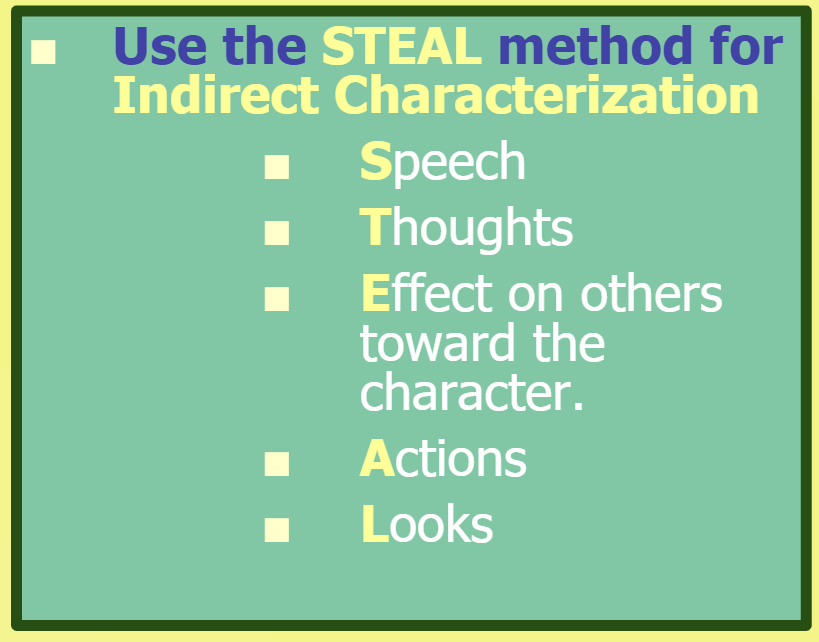
Ms. Peterson then showed us the methods for making an indirect characterization, which is STEAL, short for Speech, Thoughts, Effects on others toward the character, Actions and Looks. We then watched a short video on the indirect and direct characterization from the movie Frozen.

For the next classwork activity, we read Sailing from Troy, which described part of an adventure that Odysseus took. In this part of the adventure, Odysseus faced the Lotus Eaters. After reading the excerpt, we were put in breakout groups again to answer some questions. 
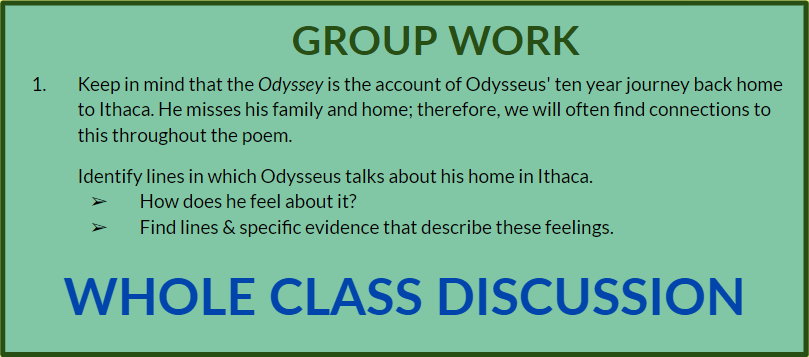

After conversing with my group, we decided that there was a strong bond between Odysseus and his home. For instance, from the sentence “I shall not see a place more dear,” we could tell that Odysseus wanted to see his home again. The class then shared their responses and thoughts regarding the problem above. Ms. Peterson then instructed the class to read the “Lotus Eater” and answer the questions with your group.
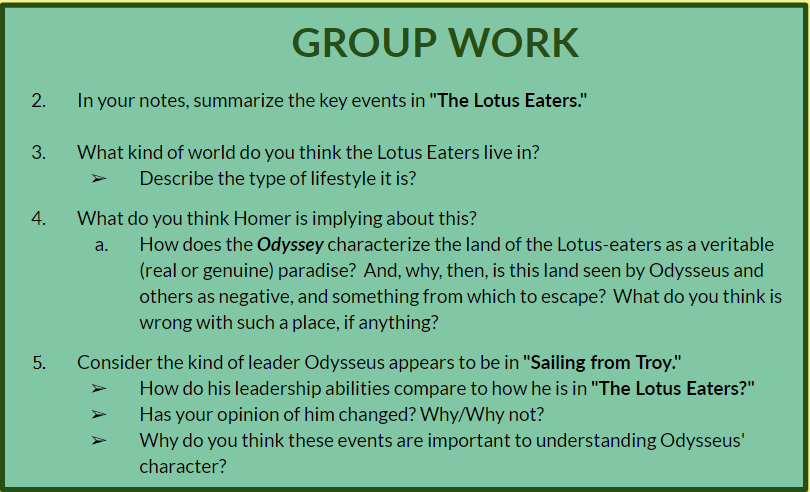


During the group discussion for this problem, we debated on why Odysseus viewed the Lotus Eaters as something negative rather than positive, and we came up with the conclusion that the Lotus Eater's life seemed too good to be true. People forget their worries and dreams there, which puts them in a state where they do not have a control over their own life. Therefore, it is viewed as something negative for Odysseus, who had his own goal. The following are my responses to the questions above.


  1. In your notes, summarize the key events in "The Lotus Eaters."

Odysseus and his crew sailed near the Island of the Lotus Eaters. Odysseus sent three of his men to the island and after they ate the peace offering the people offered there, they didn't want to leave. Odysseus tied them up and sailed away.

  1. What kind of world do you think the Lotus Eaters live in?

  • Describe the type of lifestyle it is?

  • It is a world where ignorance is bliss. They wouldn't have their own ambitions and hopes/ dreams, it is like a state of unconsciousness.


  1. What do you think Homer is implying about this? (Already answered above.)


  1. Consider the kind of leader Odysseus appears to be in "Sailing from Troy."

  • How do his leadership abilities compare to how he is in "The Lotus Eaters?"

  • Has your opinion of him changed? Why/Why not?

  • Why do you think these events are important to understanding Odysseus' character?

It is a world where ignorance is bliss. They wouldn't have their own ambitions and hopes/ dreams, it is like a state of unconsciousness.


We went back to our main room and each group shared their own answers regarding the problems. Unfortunately, that was the end of the lesson, Ms. Peterson then asked us to answer the aim of the lesson as homework, and so I did:


Aim: How does “Sailing From Troy” and “The Lotus Eaters” establish Odysseus’ role as a leader?


  “Sailing From Troy” and “The Lotus eaters” established Odysseus’ role as a leader by demonstrating the actions and decisions Odysseus had made. For example, through the action of Odysseus rescuing his crewmates from the Lotus Eaters, we could tell he genuinely cares for his crewmates and was selfless. 


Conclusion 

(TLDR (Too long didn’t read), AKA wrote too much, didn’t want to read them all):


Ms. Peterson taught us the distinction between direct and indirect characterization with the methods to identify them. We studied excerpt “Sailing From Troy” and identified key elements in the plot such as the action taken by Odysseus and how it reflects his emotions and thoughts for his crewmates. 


(P.S: The class found out about my toilet.)


Blogger #1 - Maximus Abdelnour - Period 2 - 12/21/2020 - Day A

 Aim: How do Odysseus' actions in "The Cyclops" support or refute his epic character?


Do Now: THINK/PAIR/SHARE

As previously discussed, the term, “Xenia” is the ancient Greek concept of hospitality, the generosity and courtesy shown to those who are far from home and/or associates of the person bestowing guest-friendship. The rituals of hospitality created and expressed a reciprocal relationship between guest hosts.
Therefore, based on your understanding of the term, how important do you believe this attribute or behavior is to exemplify? Why? (The class answer is provided in Slide 1 in Notes)


Upcoming Project
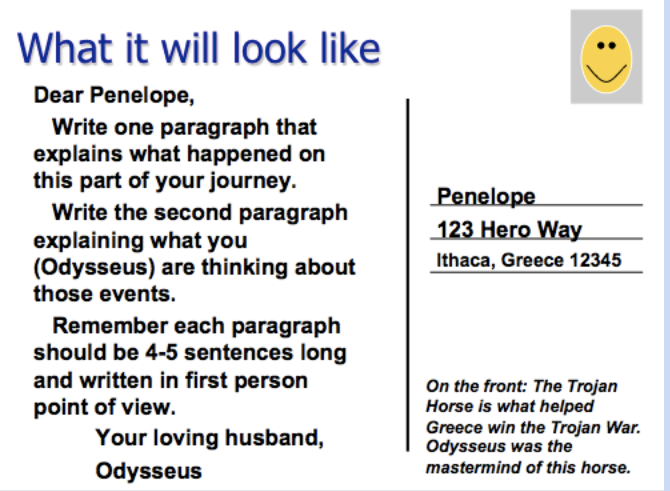
In the start of class we are introduced into a mini-project for making a postcard. In this project you’re supposed to be in the shoes of Odysseus and make two postcards about two different locations he’s been to for his son or wife.


Optional Foundation: https://www.canva.com/create/postcards/
Due Dates:
Cycle A: January 15, 2021

Cycle B: January 19, 2021

Cycle C: January 20, 2021

Homework
The homework we had to do was a virtual debate, of which we were allowed to choose the topic. The only constraints we had was that it had to be connected to Polyphemus and Odysseus and whose side we were on. The debate itself consisted of two steps, the first was making your argument in paragraph length with evidence. The second part was similar, however we had to respond to someone else’s argument and whether or not we agreed or disagreed. If they chose to agree then they would most likely have to add more evidence to strengthen the argument while disagreeing could use the similar evidence and turn it into their argument. The video is to help improve the debate between the students and they were encouraged to watch it.
Video: Discussion Board Etiquette: YouTube Video
Class Notes

Slide 1 - Xenia is the Greek concept of hospitality; for this the teacher asked us if hospitality is important and why. The general opinion of the class is that hospitality is important since it affects your morals, the way others treat you, etc. Some students specified with jobs, family, and being a host or/and being a guest.


Slide 2 - In this slide, we have to discuss the weaknesses of each hero. Some general examples included being one-sided, needing to grow courage, believing in mercy. A specified example is Sherlock Holmes not being able to understand love.

Slide 3 - 4 - Homeric similes are comparing something obscure or strange to something ordinary in a comedic and unexpected way (Slide 3). The ideas within slide 3 are expanded on by having us ask, why would Homer use this form of simile. The reason why Homer would use these is for the sense of interest, connection, and exaggeration (Slide 4).


Slide 5 - Foreshadowing is using special events to inform the reader what will happen later on, which is generally very subtle and in the beginning. Examples of foreshadowing include Shakespeare’s Hamlet, Julius Caesar's death,  and The Pearl. Hubris is an extreme amount of pride and overconfidence with an increased variation in self-esteem. Examples of this is humiliating a victim only for pleasure and lack of humility to themselves. Generally, Hubris is used only in literature. 

Slide 6 - 

The class reads "The Cyclops" [11 Pages]

Important information include:

  • Cyclops = Polyphemus 

Page 1: 

  • Odysseus sees the cyclopes are giants without law

  • Cyclopes live in a cave

  • A land had a lot of cattle

  • Odysseus kept his main crew on the ships and took his best 12 fighters with him and wine

Page 2:

  • Odysseus and his men went into a cyclopes home (Polyphemus) when no one was there

  • His men suggested to steal Polyphemus cheese and frame the cattle but, Polyphemus opposed this idea

  • The men waited with a burning of an offering and eating some cheese

  • Polyphemus came into the cave, acting normally and closing the “door” (rock slab) behind him

Page 3:

  • Odysseus and his men couldn’t have snuck out due to the stone door blocking their way

  • Polyphemus found the men from their fire and asked who they were

  • The men were fearful (including Odyessus) but Odyessus spoke truthfully to Polyphemus saying they were coming from Troy and asking for a guest gift under Zeus

  • Polyphemus mocked them, saying they won’t do anything under Zeus or them unless forced to and asked where their ships were

Page 4:

  • Odyessus was ready to respond to this with a lie that the ship was destroyed 

  • Polyphemus didn’t care for this and ate the men 

  • Once it was dawn, Polyphemus went back to his chores 

  • Odyessus planned to harm Polyphemus

Page 5:

  • Odysseus and his men used a nearby club and carved it into a stake

  • Odysseus offered wine to Polyphemus to cause him to sleep, which would allow him to stab Polyphemus

Page 6:

  • Odysseus also asked Polyphemus to remember his name but said “Nohbdy” (Nobody)

  • Polyphemus proceeds to mock Odysseus while drinking the wine and then fell drunkenly asleep

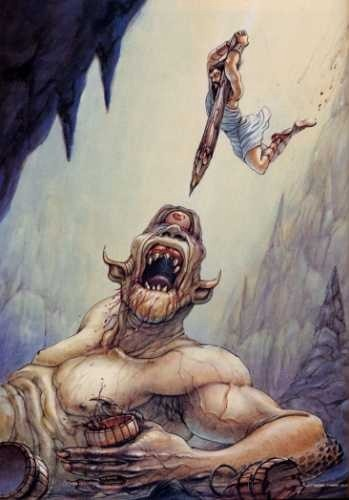
  • Odysseus and his men began to lift the stake towards Polyphemus’ eye and blinded Polyphemus

Page 7:

  • Polyphemus hollered in pain but no one came to help since it sounds like he’s saying “Nobody (Nohbdy) tricked me”

  • Odysseus was still trapped in Polyphemus’ home so he and his men hid under the cattle until they could escape

Page 8:

  • As dawn came and Polyphemus had to milk the cattle (rams) but, Polyphemus couldn’t feel the men from the wool covering them

  • At the last and most important ram (which Odysseus was on), Polyphemus ironically complained about his eye and the men and wished that the cattle could tell him where the men were

  • Once the cattle were let outside, the men fled from the cattle towards the ships (also stealing the cattle) 

Page 9:

  • Odysseus, far away from the land, mocked Polyphemus by saying how he liked the beating he gave

  • From this Polyphemus broke and threw the hilltop and tossed it at them

  • The resulting waves forced them right back to the shore and the men questioned Odysseus for angering the beast even further 

Page 10:

  • Once the men were on the shore, Polyphemus told them about a wizard who predicted the blinding of his eye at Odysseus’ hand but he never believed that it be a person so small

  • From this, Polyphemus offer Odysseus a form of peace and praying to his father, god of earthquake to treat odysseus kindly

  • Odysseus responded wishing for Polyphemus’ death

  • Polyphemus then prayed upon Poseidon to have hardship be placed upon Odysseus’ adventure back home 

  • Then, Polyphemus tried to hit their ship with a larger stone, but missed, which forced the ships onto a island

  • While they were on this island, they unloaded Polyphemus’ cattle and shared it among the men but the prized ram was only for Odysseus


Page 11:

  • Odysseus took this ram and sacrificed it for Zeus

  • Zeus, however, didn’t accept this offering and struck down his men’s ships, killing the companions within them

  • Once it was dawn, Odysseus used the remaining ships to sail off, thankful for their own lives and sadden for those who died


Slide 7 - 

  1. Based on your understanding of foreshadowing, review lines 153-156.  How is foreshadowing used, and what exactly is being foreshadowed?
    A: Foreshadowing was used to show that the someone (in this case the Cyclops) will become drunk because of the extreme detail over the wineskin and the how the cyclops act. 


  1. What heroic qualities does Odysseus display thus far?
    A: The qualities Odysseus having include foreseeing and being wise with him thinking: ahead, like the time when he didn’t kill the cyclops immediately since they would be trapped if he did. 

  2. Refer to line 232-243. How does Homer use figurative language to create imagery?
    A: Homer uses a metaphor to compare the men to puppies and the Cyclops to a lion making us imagine how afraid his men were while how powerful the Cyclops was. Furthermore, it used imagery to show how the men were eaten by the Cyclops with the idea of crunching and dismemberment.

  3. How should we judge the heroic qualities of Odysseus based on his actions with the cyclops?
    A: We should judge the heroic qualities of Odysseus based on his actions with the cyclops through the idea of his men since the Cyclops will see Odysseus negatively due to the fact they’re intruders while the men will see him as heroic since he’s saving their lives.


      5a. Can you identify any qualities/characteristics that both Odysseus and Polyphemus share?
            A: Both Odysseus and Polyphemus share the sense of selfish desire with Odysseus        

            focusing on the “moral high ground” with his men instead of fairness between man and

            cyclopes    through attacking Polyphemus’ eye. Meanwhile, Polyphemus was selfish for

            his desire of pride through mockery and the shaming of Odysseus and his men as well as

            eating them whole.

      5b. If Odysseus represents civilization, and Polyphemus represents nature, what do you

            think Homer is saying about the relation of man to nature?
          A: If Odysseus represents civilization and Polyphemus represents nature, then Homer is

           saying how man can’t coexist with nature. This can be seen over and over again through

           the text insistence of the way Polyphemus treated the men brutally and mockingly and

           Odysseus treating Polyphemus mischievously through his lies and acts of harm. 

  1. As previously discussed, the story is told through flashback (Odysseus is revealing the past events of his journey), therefore, how has Polyphemus’ curse impacted the course of Odysseus’ future.

A: Polyphemus’ curse impacted the course of Odysseus’ future through causing his journey to go towards a darkened path. This can be seen with the prayer Polyphemus had wished for Odysseus' travels to be cut short or at the very least be prevented for long with years of hardships to the gods. This can be immediately seen through the fact that Zeus struck down Odysseus’ ships which held his companions when Odysseus offered Polyphemus’ prized ram.


Slide 8 - Enrichment:
Odysseus and the Cyclops Part I

Odysseus and the Cyclops Part II

A odisseia - CĂ­clope ( The odyssey - cyclops )

Athena: The Goddess of Wisdom - The Olympians - Greek Mythology - See U in History: Watch


Reflection:
In class we learned about Homeric similes and foreshadowing and how it was used within “The Cyclopes”. This can be seen throughout the text with Polyphemus calling upon the gods to give Odysseus hardship (which is a form of foreshadowing) and the similes used to clearly express how Polyphemus treated the men. The reason for learning this is to be able to identify these elements and use them in other texts and have a better understanding of each line. I will use this lesson to improve my assessment of a text and introduce these elements to my responses within assignments and tests.


Blogger #28 - Cheng Jie Yau - Period 5 Day B - 12/17/20

 Blogger #28 - Cheng Jie Yau - Period 5 Day B - 12/17/20 Freshmen 2021


Aim: How does “Sailing From Troy” and “The Lotus Eaters” (Book IX) establish Odysseus’ role as a leader?


Do now:

We started off the class by considering the fact that Odysseus was trying to return home for 10 years and imagining us being in that situation. What would we miss and why? We each missed something different and unique. Some missed the comfort of their home, their family, and even their toilet. We also answered why we have sayings such as the ones below. We decided that we have these sayings because it helps us put the feelings we have about home into words.


We then learned about 2 types of characterization, indirect and direct characterization. Characterization is the method used by the author to create the personality and appearance of the characters. Direct characterization is when the author tells the reader what they want them to know. While indirect characterization is when the author shows the reader what they want them to know. We also talked about the STEAL method for indirect characterization which stands for Speech, Thoughts, Effect on others toward the character, Actions, and Looks.

Speech- What does the character say?

How does the character speak?

Thoughts- What is revealed through the character’s private thoughts and actions?

Effects- What is revealed through the character’s effect on other people? 

How do other characters feel or behave in reaction to the character?

Actions- What does the character do?

How does the character behave?

Looks- What does the character look like?

How does the character dress?


Then we watched this video to get a better understanding of characterization. https://www.youtube.com/watch?v=-ZnD0AGqQ7I


We then read Sailing from Troy (lines 18-69) from the Odyssey https://drive.google.com/file/d/1Db2LMqE9jPc2KWYqU-w6nlXJHnEVoqBB/view?usp=sharing

This was about Odysseus’ longing to go to his home back in Ithaca


We then worked in groups to answer these questions

Keep in mind that the Odyssey is the account of Odysseus' ten year journey back home to Ithaca. He misses his family and home; therefore, we will often find connections to this throughout the poem.

Identify lines in which Odysseus talks about his home in Ithaca.  

  • How does he feel about it? 

We decided that Odysseus misses his home as he doesn’t feel the same as he does at home anywhere else

  • Find lines & specific evidence that describe these feelings.  

Line 35-37 where he talks about a house of gold


Afterwards, we read The Lotus Eaters (Lines 70-108) from the Odyssey

https://drive.google.com/file/d/1Db2LMqE9jPc2KWYqU-w6nlXJHnEVoqBB/view?usp=sharing

This section was about Odysseus encountering the Lotus eaters who showed no will to do any harm to them and only care about offering the Lotus plant to them. However, those who ate the Lotus only longed to stay forever not caring about reporting nor returning anymore. However, Odysseus who did not want to abandon his men tied those who ate the Lotus under their rowing benches forcing them to sail away.


We then broke up into groups again to answer the following

  1. In your notes, summarize the key events in "The Lotus Eaters."

Odysseus meets the Lotus eaters and his men who ate the plant wanted to stay and lost their willingness to go home. So he tied them down and forced them to continue their journey home and told his other men not to eat the plant.

  1. What kind of world do you think the Lotus Eaters live in?

  • Describe the type of lifestyle it is?

The lifestyle of the Lotus Eaters is like a fantasy or paradise where they don’t have to worry about anything, and have no goals.


  1. What do you think Homer is implying about this?

    1. How does the Odyssey characterize the land of the Lotus-eaters as a veritable (real or genuine) paradise?  And, why, then, is this land seen by Odysseus and others as negative, and something from which to escape?  What do you think is wrong with such a place, if anything?

    2. The land of the Lotus eaters makes you forget about everything else other than the Lotus such as their longing to go home. The land is seen by Odysseus as negative and something to escape because it makes you forget your goals and problems and it is keeping them from completing what they have been trying to do. This place is wrong because it makes you forget your goals and dreams and keeps you on the land of the Lotus Eater forever.


  1. Consider the kind of leader Odysseus appears to be in "Sailing from Troy."

  • How do his leadership abilities compare to how he is in "The Lotus Eaters?"

  • Has your opinion of him changed? Why/Why not?

  • Why do you think these events are important to understanding Odysseus' character?

In Sailing from Troy, Odysseus appears to be a reckless leader and brutal as he storms Cicones, kills the men that fought and enslaved the women. While in the Lotus Eaters, he shows more leadership saving the men that ate the Lotus plants by tying them to the rowing benches and warning his other men of the effects of the Lotus plant. This has changed my opinions on him as he could’ve easily abandoned his men and just left them on the Lotus Eaters’ land instead of going through the trouble of bringing them along with him. These events are important to understanding his character because it depicts that though he is a hero, not everything he does is necessarily good and he has done both good and evil despite being a “hero”.


Reflection:


In this lesson I learned more about the two types of characterization. Direct characterization is when the author tells the readers what they want them to know. In indirect characterization, the author shows the readers what they want them to know. We also learned about the journey of Odysseus, what happened when he sailed from Troy and his encounter with the Lotus Eaters. This information will be important because it will give me a better understanding of Odysseus as a character. Through this lesson we learn about how Odysseus’ leadership is dynamic and changes based on the situation as he can sometimes be a reckless leader while other times, he can actually be a good leader who is capable of guiding his men. I will use this knowledge in the future to better understand complex characters such as Odysseus.