Tuesday, November 19, 2019

Blog #26

Blog #26
Gordon Liang | Period 1                               
November 19, 2019

Today we presented our projects for the Mythology Creation Project.

First to present is Team Ares.
They presented Taoism/Daoism using an illustrated piece and slides presentation.

TAOISM/DAOISM CREATION STORY

Image result for yin yang
Yin and Yang

Background

- originated in China around 4th or 3rd century BCE
- attributed to Lao Tzu
- official religion under Tang Dynasty
- Daoism is a complete philosophy of life reaching into religion, social actions, health

Yin Yang Symbol

- Yin = dark and shadows
- Yang = light, passion, growth

Major Gods
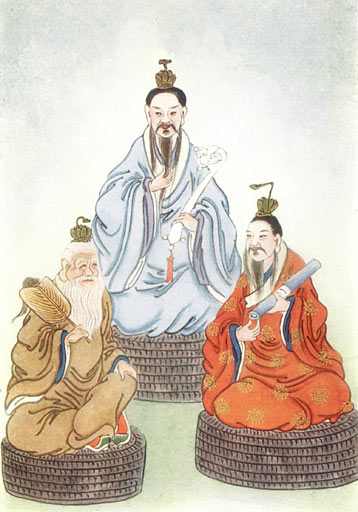
Three Pure Ones

- Three Pure Ones are highest gods in Taoist religion
- Tao produced one, one produced two, two produced three, and three produced all things

Eight Immortals
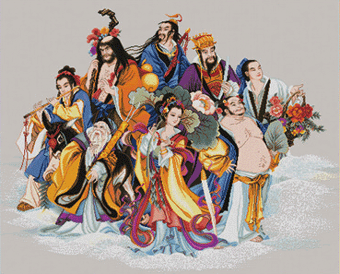
Eight Immortals

- They have the ability to transform into different creatures and objects, 
- controls people, animals, and objects through control of qi

How the Universe Came

- Similar to the Greek creation story, everything started with chaos, but the Chinese
further compared it to an egg
- Pan Gu was the first man to come from chaos (an egg) with two horns, two tusks, and a hairy body.

Important Concepts

- simplicity, patience, and compassion
- talks about daily problems mankind faces
- "when nothing is done,  nothing is left undone"

--------------------------------

Next to present is Team Zeus
They presented Hinduism using a sculpture of a god and a slides presentation

HINDUISM CREATION STORY
Team Zeus’ Creation

Background

- oldest religion, 4000+ years old
- no consistent structure- Vedas, Brahmans, Puranas
- nothing is fixed
- dharma- code of living that emphasizes morality
- henotheistic- worship single deity but recognizes other gods and goddess

Creation

- believed in periodic cycles of creation
- Hindu Trinity- creation and destruction of the world
- Brahma: creator, Shiva: destroyer, Vishnu: sustainer
- Lotus Creation Story: lotus sprouted from Vishnu navel with Brahma seated in it
- Cosmic Egg Story: Brahman created seeds that transforms into golden egg which Brahma sprang

Deities
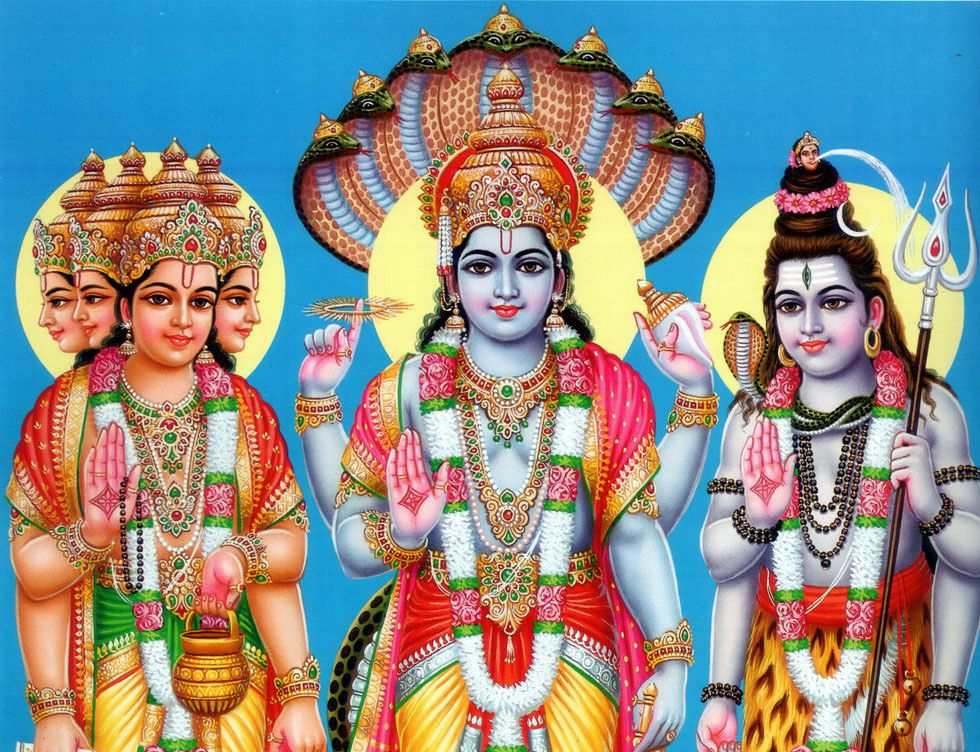
Brahma, Vishnu, Shiva
- Brahma
       - 4 heads recites four Vedas: rosary( meditation), Veda books (knowledge),
holy water (origins of the universe), lotus lower (nature and fertility of life)
- Vishnu
      - goal is to preserve and protect the universe
      - keep balance of good and evil
      - 4 arms holds conch (sound of creation), discus (mind), lotus (existence and freedom),
mace (physical and mental strength)
- Shiva 
      - goals was to destroy the world
      - 3 eyes third represents wisdom and insight
      - cobra necklace: power over over of the most dangerous creature
master of dance.  Tandav dance: cosmic dance of death
- Ganesha- remover of obstacles and new beginning
- Rama- often called before before death
- Hanuman- strength and energy
- Krishna- divine music

VS Modern Day

- Big bang- one cycle of any and before Brahma nothing and darkness, infinite cycle and prayala
- Multiverse theory- universe is one of many
- Twin paradox- Purana

---------------------------------

Reflection
The two groups presented excellently today and their projects were very creative and engaging. I learned a lot about two religions: Taoism and Hinduism. It was very interesting to learn about different people’s perspective on how the world came to be and similarities to today’s theories on the creation of the world. Team Ares did well on explaining the concepts and background of Taoism and Team Zeus did well on comparing Hinduism beliefs to modern day. It was really notable to have this project showcasing other religions and cultures.

Monday, November 11, 2019

How do the Greek Gods act like humanity? Post #25


Blog #25                                                                                         11/11/19
Junhong Li                                                                                         Period 1

Today we discussed how the gods in Greek mythology were similar to humans in class. 
We discussed some traits which these immortals share with us mortals. We talked about how the gods are jealous and they quarrel with each other. The gods are not all-powerful, they are subject to the fates as well as Cupid's arrow. The gods are very arrogant but they punish humans for their hubris. They have no empathy and are very selfish, they very often act on instinct and interfere with people's lives without consideration.

Some examples include: 
Hades and Demeter, who both love Persephone
The competition between Arachne and Athena (Minerva)
Hera, her marriage to Zeus, and her many punishments to Zeus's lovers
Zeus and his transformations and tricks to seduce women


Some other things which were mentioned:
Curiosity killed the cat, but satisfaction brought it back.
The existence of the Olympic Sports and Hyacinthus's death due to Apollo.
Pandora, although not a god, and her curiosity which gave humanity suffering and hope.
Rhoecus, although not a god, hurts a bee due to ignorance and gets blinded for life.
We then moved on to present 2 stories of our choice to the class. We took whiteboards and drew these stories out, but ran out of time in the end.


We did not reach the last slide.

Some additional notes:
Ms. Peterson will be absent on Wednesday the 13th.
There will be a test on Thursday the 14th. It will be an accumulative test on all that we have learned so far.

Thursday, November 7, 2019

Modern Mythology 2020

Angel Li
11/7/2019
Period 1

The Divide of Women

Think, Pair, Share: Compare the characterization of Danae and Andromeda against Medusa and her sisters. What is their plight?
         In Danae's case, her father was told the prophecy that his grandson (Danae's child) would kill him, so he decided to lock her up in a bronze bunker underground. Leaving the roof out so the bunker would be exposed to sunlight and air, it allowed Zeus to come down and rain gold. When the father learned that his daughter bore a child, he sent them away in a chest, hoping they would die as a result, In Andromeda's case, she was told she needed to be sacrificed to save the city. Both can be looked like a damsel in distress. Medusa is the only one from her two sisters that is mortal. The sisters are depicted as the bad guys even though they were cursed by the gods. Their plight is that they all are put in danger or negatively affected by someone of a higher status for something they didn't do or have control of.

We then learn that Medusa was cursed by Athena and that is why she looks the way she does. After this, we are shown a video that explains the origins of Medusa

In the video, it starts off by explaining how Medusa was not always considered a monster. She was born to sea gods and possessed great beauty, specifically her hair which was gorgeous. She wanted to dedicate her life as a priestess at a temple of Athena's, and in order to do this, she had to continue being a virgin, remaining pure. Thousands flocked to the temple just to get a glance at her and this made Athena extremely jealous. One day, she caught the attention of Poseidon, who she repeatedly turned down since she had to stay a virgin to be a priestess. Eventually, Poseidon became tired of this and took Medusa by force. As she ran back in the temple, she hoped to receive help from Athena but didn't. As a result of this, Athena cursed Medusa by turning her most beautiful quality (her hair) into snakes and anyone who looked at her turned to stone. She became the attraction for warriors hoping to get her head. Perseus was sent on a mission to get her head and was assisted by the gods. Receiving a helmet that makes you invisible from Hades, winged-sandals from Hermes, a sword that was able to cut through Medusa herself, and a shield chest plate from Athena. The video ends by saying how Medusa is mostly regarded as a cruel monster, although it was Athena who punished her beyond her own control. Even in death, her head can be used to keep evil away.

Whole Group Discussion: According to legend, Medusa only became the monster her figure embodied after falling into pits of despair. What can we understand about monsters in greek myth from the story of Medusa?

Monsters aren't born as naturally evil, but they get shaped through someone out of their own control. We were then asked if we can consider them as "monsters". The class came to a consensus that they aren't really monsters because it all starts with someone innocent living out their normal life but it was gods who intervened and created these monsters.

Danae: The curse
- The dichotomy of women either puts them into a monster status, such as Medusa or completely helpless such as Danae, Andromeda, Europa
        - What would be the purpose of passing this inference onto a younger generation?
                  The purpose would be to fit the mold; In the end, even if you are good, you have to fit the mold of the priestess

Perseus: The hero?
- Though much more likable than Jason, Perseus is able to succeed because of the extended help he receives from Hermes and Athena, yet he is regarded as a hero of this quest
- Even though he was entrapped by Polydectes, Perseus takes on this quest with blind arrogance and yet he is not punished for it
- What makes Perseus more deserving of help compared to his female counterparts
          - Prophecy has to be fulfilled because they always have to come true
         - Is an advantage that his father is Zeus
         - Also ties into the idea that male and females have their separate places; females are depicted as the jealous counterparts, so even with Hera turning others to animals. They may have insecurity issues but Athena still helps Perseus because she doesn't see a threat to her noble status
        - Considered to be demi-gods


Reflection:
Today, I learned that there is a good amount of dichotomy displayed for women. They are always seen as damsels in distress that get in the crossfire of a prophecy or create jealousy among the gods. Medusa, who was originally extremely beautiful was turned into a stone-killing monster and it highlights how helpless she became. I learned this because it helps to depict women's influence and how it evolved over time. In these greek stories, they are always shown as weak and manipulated either by a god or their male counterparts. They are the ones always getting the short end of the stick and suffering much more dearly than males would back then. However, as time passes, we can see their evolution and how the impact they have on society continues to increase up to the present day. I will use what I have learned to better understand a women's point of view from a different lens. 


Wednesday, November 6, 2019

Modern Mythology 2020 - Blog #23

Jia Yan Jiang
Modern Mythology Period 1
11/4/19

Aim: Why and how does Hercules' characterization make him one of the most memorable figures in Greek mythology?

Daimonic 
(adj.)
In the way of a daimon; befitting a demon; fiendish.
Motivated by a spiritual force or genius; inspired.

(n.)
(psychology) The unrest that exists in us all which forces us into the unknown, leading to self-destruction and/or self-discovery.
(psychology, spirituality, mythology, literature) The journey and transition from innocence to experience; part of the process of individuation.
(mythology, literature) The place where light and dark meet.

Anagnorisisis a moment in a play or other work when a character makes a critical discovery. Anagnorisis originally meant recognition in its Greek context, not only of a person but also of what that person stood for. Anagnorisis was the hero's sudden awareness of a real situation, the realization of things as they stood, and finally, the hero's insight into a relationship with an often antagonistic character in Aristotelian tragedy.


11/6/19
Aim: How are death and mortality approached in the Oedipus Trilogy?
Do Now: THINK PAIR SHARE
Suicide is a controversial topic because across cultures and time periods, the perspective and purpose has evolved. Japanese Samurais would stab themselves through the chest when faced with defeat, Japanese Kamikazi pilots would fly to their deaths during wartime, Islamic suicide bombers would do the same.

Think about how suicide is used in Antigone and compare it across time periods and cultures.
What kind of clout does suicide have? Why does/doesn't it bear the same weight now and today?
In the past, suicide was a way to be able and faithful to your country. As shown by Japanese Samurais and Kamikazi pilots, their lives were sacrificed for the belief that they were doing the right thing. Now, suicide has a much more different impact on society.  It can be seen as a result of mental illnesses. It is much more controversial and can be seen to be a result of psychological issues.  It is no longer seen as an honor but now seems to be caused due to emotional reasons.


FATE VS. FREE-WILL
In the lessons we have learned from the Greeks, the more we try to avoid fate, the more we play into it.
The Fates. In Greek Mythology, the Moiraioften known in English as the Fates—were the white-robed incarnations of destiny. Their number became fixed at three: Clotho (spinner), Lachesis (allotter) and Atropos (unturnable). They controlled the metaphorical thread of life of every mortal from birth to death.
They were often depicted as weavers of a tapestry on a loom, with the tapestry dictating the destinies of men.
- No one could control fate
- Fate = all-powerful
- Nothing could change fate
- Greeks believed in pre-destiny


ANTIGONE - THE FIRST REBEL FEMINIST
Antigone's crime was defying the laws of her land to appease her morality. Is this a crime? How would it play in our justice system (translating the circumstance into a modern perspective, of course)?

Antigone's actions were against the law but she did it to appease her morality.  To her, she is justifying her brother’s death while to the king, it is unjustifiable to break the law.

How do you determine your perspectives on justices? Is there a formula for deciding what is justified? If so, what is embodied in that formula?
Emotions + beliefs + morals

Why is it still a problem?
How will you fix it as you go into the world?
It is still a problem due to the flaws in the human mind.  Some may find things to be justified while others may not.

TURN AND TALK
The Oedipus Complex explains the emotions and ideas that the mind keeps in the unconscious, via dynamic repression, that concentrates upon a child's desire to have sexual relations with the parent of the opposite sex (i.e. males attracted to their mothers, and females attracted to their fathers). Sigmund Freud, who coined the term "Oedipus complex" believed that the Oedipus complex is a desire for the parent in both males and females (though it is called Electra Complex for females).

What are your thoughts about this?
In Greek mythology, there are a lot of stories where the child desires to have sexual relations with the parent of the opposite sex, for example, Oedipus marrying his own mother. This might be common throughout Greek mythology while in modern times, people will look at it weird and strange for having sexual relations with your own parents.

Reflection: 
Today in class, I've learned about how suicide is viewed through different cultures. Before today's lesson, I thought suicide means the same in every culture, I was not expecting there to even be a difference. Everyone has a different view and opinion on the thought of suicide. Suicide plays a crucial part in today's lesson because it was important for us to understand Antigone's crime, how she believed that she was right for burying her own brother. Although her actions were against the law, she still did it to appease her morality. In addition, I also learned that we cannot control our own life due to fate. Fate is something we cannot physically change it. Your life is set since birth and there is no way for you to avoid what is going to happen later on in your life no matter if it is good or bad. I can use the information I learned today and care about the people around me more and cherish the time and experience right now since our future still forever remain mysterious. 

Friday, November 1, 2019

Modern Mythology 2020 Blog #22- Hercules

Justin Huang
Mythology PD1
11/01/19

Aim: Why and how does Hercules' characterization make him one of the most memorable figures in Greek mythology?

Do Now:Write about a time when you did something wrong either purposely or inadvertently, but for which you were extremely sorry for afterwards.
     We shared times when we felt remorse right after doing something wrong. This relates to Hercules because he was flawed in that his emotions often took over him, and he killed people in rage, but afterwards he felt sorrow and wished to pay for it with penance. Personally, I shared about a time I went to my aunt's house for a birthday. My aunt had bought me a beautiful Pikachu birthday cake and I told her I did not like it.

Did you apologize or make the situation right? We're you successful?
     I changed my mind about the cake after tasting it, but the damage was already done. I think that I had made my aunt cry. Looking back I cannot believe I had actually said what I did.

Video
Write down raw emotions you experience as you watch the commercial.
Video Link

- Joy
- Love
- Anxiety
- Longing
- Betrayal
- Happiness

At first, the video was lighthearted as it showed a puppy growing and playing with a man. Then the man leaves the dog home alone as he goes drinking. The dog waits for the man but he does not come back. This commercial points out that those that drink and drive may leave their dogs waiting for the rest of their lives. However, the man returns and it is revealed he stayed a night as to not drive and drive. The dog and man rejoice.

Why do Americans like guy and dog videos so much?
     The commercial employs the use of pathos, emotional appeal, to achieve its message. Americans value their pets, and they are familiar with the anxiety pets experience when their owners leave them for even a short period of time.

Psychology and Philosophy of Interesting Characters
Humans enjoy finding vulnerability in the seemingly perfect. We know that perfection does not exist, and mistakes happen often. So we expect wrong, yet respect those that wish to make things right. Hercules embodies this as a powerful demigod. His strength is unmatched, and he cannot be defeated. Despite this, he is often overcome with rage and he regrets his actions during those fits of rage. What's appealing is his willingness to atone. He endures suffering during penance and is unwilling to be unpunished for any actions.

Article
"Why Myths Still matter: Hercules and His Twelve Healing Labors"
Ultimately Hercules was able to channel his rage, the very thing that lead him to his misdeeds, in order to do good. He penanced to right his wrongs, and was successful in completing his twelve tasks because he redirected his anger. To Hercules, the only way to quench his guilt was to offset them with his own suffering.

Reflection
     Hercules' tale teaches that flaws exist in all people. His greatness could not excuse his wrongs. So, we will all make mistakes and do things we wish we hadn't, but as long as we realize our faults, and as long as we strive to make things right then we can be forgiven. Thus there is much to learn from every misstep, and the only way we can hope to become better is to correct our mistakes. To bask in misery and failure does no good; had Hercules killed himself after realizing what he'd done to his wife and children, he would never have achieved his status as a hero. Hercules' story does demonstrate the range of human emotion, he goes from a mad fit of anger to surrendering himself to guilt. Such extremes portray the capabilities of humans, they can do great or terrible things, and often times they cannot seem to pick one side over the other.

Wednesday, October 30, 2019

#21 What it takes to love someone- Psyche and Zephyr

Eri Dumesh
10/23 Aim- How do fairy tales juxtaposed against ancient tales highlight the evolution of language, as well as the classic theme of love conquering all? 


Do now? What does it take to love someone? (This can be romantic, filial, pets, whatever you love hard.) I personally think that the person you love must have a unique, discerning quality, whether it be blood or not. 
Psyche (noun): The human soul, mind or spirit


Zephyr (Noun): A gentle, light breeze


Do the tales create the language, or does the language create the tales?
Narcissus named the flower after him, so I believe the tales create the language. Also, what came first? The orange color or fruit?


  1. Review the tale of Cupid and Psyche
  2. Review the Grimm’s Cinderella. Compare the literature
    Both stories have a common lesson that love is worth fighting for and that there are no boundaries in love. Both couples face trial and tribulation but overcome it to find each other. 


  1. Why do these themes seem to transcend time?

These stories tend to transcend time because they have simple morals that are common
throughout time. Although the stories are in a very different time and aren't very similar between
each other, their morals are similar and lifelong. They will apply as long as man lives,as it is a
basic human lesson. Love is not defined by class, position, or background. 

Psyche+ Hardship = Cupid

Human Spirit, soul, + Hardship = eternal love
Image result for psyche
https://simple.wikipedia.org/wiki/Psyche_(mythology)

More information can be found in the following link
https://www.theoi.com/Ouranios/Psykhe.html
https://www.youtube.com/watch?v=Gjj_-CPxjCM

Sunday, October 27, 2019

Blog #20

Zuting Chen, Period 1

Aim: How do the punishments of Prometheus, Io, and Europa, and Polyphemus demonstrate the forces of wrath?

Do now: We had to write a poem about Prometheus or Polyphemus individually or as a group.

I wrote one individually on Polyphemus:

Shepard on a remote land
Whose statue is grand
Thinks is greater than god
And is not flawed

One day came Odysseus and his men
Caught and put into den
The cyclop ate many
But that wasn’t plenty

Blocked was the entrance
And arose the tension


We went over the stories from pages 95-111 about Io, Europa, and Polyphemus. They all faced or enforced wrath in some way.
Io:
Zeus saw Io while looking down and fell in love with her quickly. He disguised himself as a cloud and went down to Io, but Hera caught on. Zeus realizes that his disguise didn’t work very well, so he turns Io into a beautiful white cow. Hera, knowing what’s up with her husband, asked for the cow. She made Argus, a giant with 100 eyes that sleeps with not all of its eyes closed. Zeus gets Hermes to help kill Argus. Hermes told many tales before all of Argus’s eyes closed and he killed him. Hera took the eyes of Argus and put them on the feathers of peacocks. She then sent a gadfly after Io to sting her as she made her way to Egypt, not giving her any time to be comfortable. On the way there, she came across Prometheus, who used his foresight to tell her that she’ll become human and give birth to someone great. When she got to Egypt, Zeus turned her back into a human and she gave birth to Hercules.

Io faced a lot of wrath from Hera as a result. She represents marriage and was faithful to it. Therefore, she almost always took action against the other women Zeus was engaged with. Examples would be how Hera took Io away and that she sent the gadfly after her to torment her even when she fled Argus.

Europa:
Prior to the events, Europa had a dream about two continents who fought over her and someone else who said that Zeus would give Europa to them. That same morning, Zeus fell in love with Europa because of Cupid’s arrow. When going down to meet her, he disguised himself as a bull and came down to greet her. There were others who were playing around the bull, but when Europa got on the bull, Zeus darted off through the water. He took her to Crete because it was hard for others to find that place. In particular, Rhea had formerly hid Zeus from Cronus on that island. Eventually, Europa gave birth to many famous men, such as Minos and Rhadamanthus.

Unlike Io, Hera wasn’t present in this story for some unknown reason, therefore she didn’t face Hera’s wrath. However, we suggested in class that she “still dealt with wrath” because she was taken away from her previous life (friends, family, and home) without any notice. This is why it’s often referred to as “The Rape of Europa”; where she had no say in the matter.

Polyphemus:
During Odysseus’s long journey home, he passed by many areas, one of them being an island of cyclops. Edith Hamilton added that cyclops didn’t care what others say, making it a dangerous place for explorers, especially for Odysseus and his men. Unknowing that he had stumbled on such an island, Odysseus got off his ship with his men and some wine (to offer to the inhabitants). When he went inside a cave, the cyclop Polyphemus questioned why they were there, and enclosed the cave with a huge stone and ate a few of the men. It wasn’t after a few more men died that Odysseus came up with a plan to escape. He fashioned a pointed stick, hid it, and then fed Polyphemus the strong wine. As Polyphemus was asleep, the men stabbed the stick into Polyphemus’s eye. Polyphemus, confused and startled, rolled over the rock blocking the entrance, allowing the the men clinging onto the bottom of the sheep to leave. As Odysseus sailed away and Polyphemus was upset on the shore, Odysseus yelled out to the cyclops about his success.

The story of Odysseus and Polyphemus in particular, teaches a lesson about being humble. When Odysseus finally fled, he shouted out who he was and where he was from. With this information, the cyclop was able to get Poseidon to enact revenge on Odysseus and his men. This led to an even rougher journey home for them, especially with the waters being Poseidon’s domain.

Towards the end of this lesson, we questioned whether Polyphemus was inhospitable or misunderstood. In a way, he could be seen as both. Polyphemus was very self-centered (he did whatever he wanted to) and some people just came into his home where he kept food and his sheep.


Reflection:
The lesson, as suggested by the title, showed some mythological stories about how wrath affected those individuals. Io and Europa were both innocent and targeted by Zeus who loved them without revealing himself as a god. Polyphemus on the other hand, couldn’t do anything, but his wrath went through to his father, who then made sailing difficult for Odysseus and his men. I liked how this lesson reflected characteristics of people even among mythical beings, such as gods, goddesses, and monsters. Though this lesson wasn’t meant to convey “morale” (as with the flower myths), it still shows the impact of wrath on the lives of various figures in Greek Mythology and helps reveal more about their world.