Wednesday, June 2, 2021

Blogger #31- Jessica Yan Yim- Period 7- 5/25/21- Day C

 Aim: How does Odysseus establish his authority as an epic hero in the episode of “The Challenge” and “Odysseus’ Revenge?”


Do Now:

The Ancient Greeks viewed revenge as a form of social justice. They believed that if a horrid wrongdoing was done upon them, they had the right to return the favor; in whatever means they found just. The Greek values greatly resembled the Hammurabi Code of Law for Justice: “An eye for an eye, a tooth for a tooth” mentality, meaning that whatever crime the perpetrator committed, the punishment brought upon him should be equal or fitting of the crime.

1) How does this compare to the way our society views revenge today?

2) How does it compare to the way that you view revenge?


The class all agreed on how society sees revenge today. We are a lot more forgiving compared to how the Ancient Greeks would carry our punishments and revenge. The Ancient Greeks followed the concept of “and eye for an eye” while modern day society looks for forgiveness rather than revenge. The Ancient Greeks were a lot more harsh when they dealt with crime while society today is more forgiving. However, revenge still happens in society today as “revenge is the best medicine.


Words to know:

implacable (adj): unrelenting, stubborn; impossible to calm or appease. quiver (n): a portable case for holding arrows

entrails (n –pl): internal organs, the intestines; within


We read “The Challenge” [2 pages] and “Odysseus’ Revenge” [4 pages] for homework prior to this lesson and went ahead to the whole class discussion.


Whole Class Discussion: 

“But the man skilled in all ways of contending, satisfied by the great bow’s look and heft, like a musician, like a harper, when he draws with quiet hand upon his instrument he draws between his thumb and forefinger a sweet new string upon a peg; so effortlessly Odysseus in one motion strung the bow. Then slid his right hand down the cord and plucked it, so the taut gut vibrating hummed and sang a swallows note” (Homer 1370-1379).


  1. What epic simile is created in the lines above, from “The Challenge”? Explain the comparison.

The epic simile that is created in the lines above is comparing Odysseus’ skill using the bow to an expert harp player. 


  1. Which of Odysseus’ qualities are being highlighted here? a. How is Homer presenting Odysseus to the audience ?

His best qualities are his ability to string the bow and use it. Homer is presenting Odysseus to the audience as being elegant and talented.


We watched a video Acting The Odyssey 1997 (Odysseus’ Revenge) [9:18] and were given another video about justice and vengeance that we can watch after class Law and Justice - Justice and Vengeance: Homer - 3.5 Debate: Revenge in Justice? [3:10] 


Odysseus’ Revenge in Art


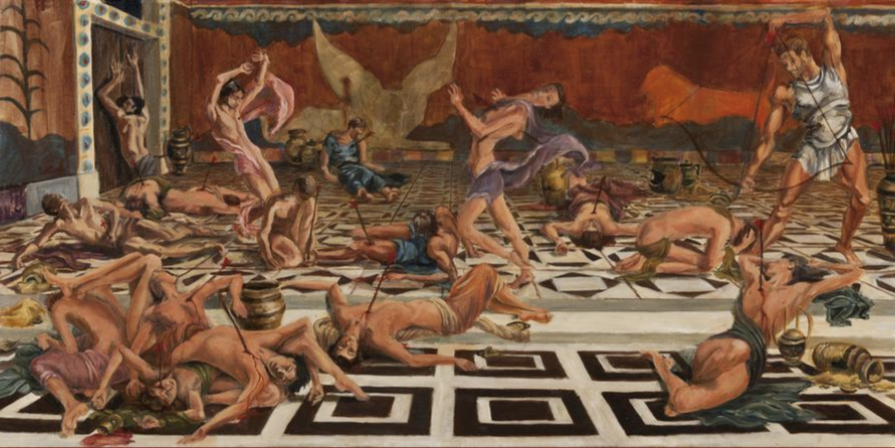
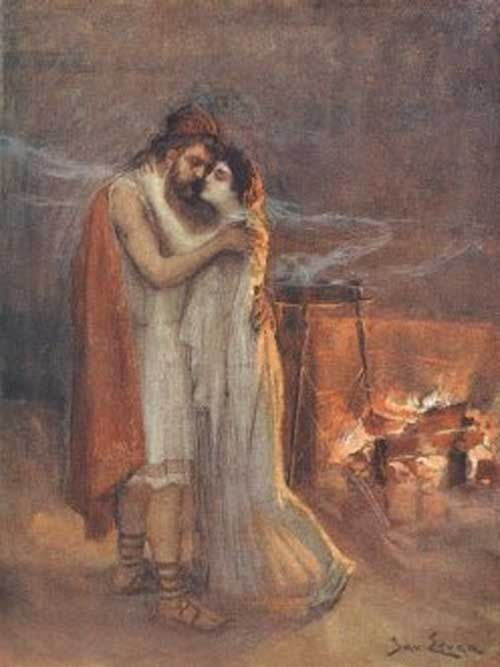
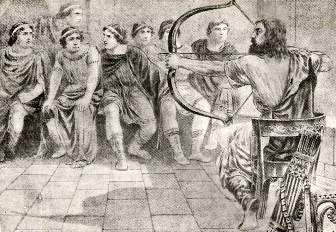
Analyze both paintings depicting Odysseus killing the suitors. Do you believe the artists accurately depicted Odysseus’ attack on the suitors? Would you evaluate this to be a “fair” fight-- why or why not?

Our class did not come to an agreement whether this was a fair fight or not. I don’t agree that this was a fair fight because not everyone had weapons. The artists did accurately depict his attack.


Teamwork

  1.  Why does Odysseus invoke Apollo in line 1411?

Odysseus invoked Apollo, the god of archery, hoping that he would be on his side.


  1. In the episode of "Odysseus' Revenge,“ who is the first to die? Describe the immediate

reaction of the suitors to this initial killing.

Antinous was the first to die as he was the one leading the suitors, causing them to be outraged.

  1. What argument does Eurymachus use to try to persuade Odysseus to spare him and the

others?

Eurymachus tries to persuade Odysseus by putting all the blame on Antinous.


  1. What three crimes of the Suitors does Odysseus mention when he begins the slaughter

(lines 1438-1444)?

The three crimes of the suitors that Odysseus mentions when they were beginning  the slaughter are ignoring the power of god, trampling into his home, and trying to steal his wife.


  1. Why do you believe Odysseus denies Eurymachus’ request to provide restitution for all

they have consumed, and then some (lines 1467-1473)?

Odysseus denies his request to provide restitution because what they had to offer were only goods and couldn’t repair the stress and trauma that his family experienced.


  1. List at least two images/examples of figurative language that help you picture some of the most tense or most horrifying moments in the battle. Include line references!

  • “Backward and down he went, letting the wine cup fall from his shocked hand. Likes pipes his nostrils jetted crimson runnels, a river of mortal red, and one last kick upset his table knocking the bread and meat to soak in dusty blood.” (Lines 1421-1425)

  • But the kingly man let fly an arrow at that instant, and the quivering feathered butt sprang to the nipple of his breast as the barb stuck in his liver. The bright broadsword clanged down. He lurched and fell aside, pitching across his table. His cup, his breast and meat, were split and scattered far and wide, and his head slammed on the ground.” (Lines 1486- 1412)


  1. Odysseus is described as "implacable" in the revenge episode. Is he justified in killing all of the suitors? Why or why not?

He was not justified in killing all the suitors because it was too harsh. 


Enrichments 

What Is Justice?: Crash Course Philosophy #40 [10:15]

Is Revenge More Bitter Than Sweet? [4:01]

The Odyssey by Homer | Books 17-18 Summary and Analysis [2:58]

The Odyssey by Homer | Books 19-20 Summary [3:04]and Analysis 

The Odyssey by Homer | Book 21 Summary and Analysis [2:21] 

The Odyssey by Homer | Book 22 Summary and Analysis [1:58]


Aim: How does Penelope’s test for Odysseus establish their fidelity toward each other while finally providing closure for Odysseus and his journey?


The class discussed that Eliot is trying to say that gaining something means sacrificing another. In a journey, lessons must be learned and experiences will be gained.


Reflection:

In these two lessons, I’ve learned more about revenge and fidelity. I learned that revenge is viewed a lot differently than it was during the time of the Ancient Greeks. Revenge in the Ancient Greeks was a form of justice and peace, while revenge is disapproved of by today's society. Instead of getting revenge, we are expected to mature and forgive. Fidelity is being loyal and having faith in a person. Odysseus shows his fidelity to his wife throughout his time being away. During his journey, he stayed loyal to her. These are useful because it teaches us that revenge isn’t always the “right” answer, being forgiving is usually the better option. It shows that it is good to always stay loyal to the people you care about. These can both higher our morals and teach us to make better decisions in the future when it comes to it.

Blogger 32 Carmen Zeng Period 7 5/25/2021 Day C

Aim: How does Odysseus establish his authority as an epic hero in the episode of   "The Challenge" and "Odysseus‘ Revenge”?


Do Now: WHOLE CLASS DISCUSSION

The  Ancient Greeks viewed revenge as a form of social justice.  They believed that if a horrid wrongdoing was done upon them, they had the right to return the favor; in whatever means they found just.  The Greek values greatly resembled the Hammurabi Code of Law for Justice:  “An eye for an eye, a tooth for a tooth” mentality, meaning that whatever crime the perpetrator committed, the punishment brought upon him should be equal or fitting of the crime.


  1. How does this compare to the way our society  views revenge today?  

  2. How does it compare to the way that you view revenge?


Classmates Answers: 

“Nowadays we are taught to forgive people. Be more mature in the situation, revenge isn’t always the way to go no matter how attempting. Revenge is frowned upon, confrontation and solving the problem is better. The phrase, Revenge is like Medicine, shows the power you feel when you get to take revenge or action against the person who messed you over, however, it isn’t the best way to solve problems. In the case of a Hammurabi code, I do somewhat agree with it. When a possession of yours gets stolen from you, in this case it would be okay to take something back, however, in more extreme scenarios, I think it would be unreasonable and should just result in prison. 


“But the man skilled in all ways of contending, satisfied by the great bow’s look and heft, like a musician, like a harper, when he draws with quiet hand upon his instrument he draws between his thumb and forefinger  a sweet new string upon a peg; so effortlessly Odysseus in one motion strung the bow. Then slid his right hand down the cord and plucked it, so the taut gut vibrating hummed and sang a swallows note” (Homer 1370-1379). 


  1. What  epic simile is created in the lines above, from “The Challenge”? Explain the comparison.


  1. Which of Odysseus’ qualities are being highlighted here?


  1. How is Homer presenting Odysseus to the audience ?


Combined = The epic simile here is that Odysseus strings the bow as gracefully as a musician turning his lyre. He was elegant, graceful, his movements and stringing of the bow were fluid, and skilled. Odysseus' heroic qualities are being highlighted here and he is finally being presented as a strong hero/king after all the humiliation he experienced in his 20 years of travel back to Ithaca. 


Odysseus’ Revenge in Art


    Analyze both paintings depicting Odysseus killing the   

    suitors.  Do you believe the artists accurately 

    depicted Odysseus’ attack on the suitors?  Would 

    you evaluate this to be a “fair” fight-- why or why 

    not?


The artist was biased and painted Odysseus participating in a one-man fight. It wasn’t considered a fair fight since none of them had weapons, and Odysseus had just finished them all. 


TEAMWORK

Odysseus believes Apollo is watching over him. He wants Apollo to help him because, if not, the suitors will kill him. He seeks Apollo for luck or a blessing since he was the god of Archery. Antinous is the first to die. The suitors' initial reaction was for shields/cover to defend themselves because they did not want to die next. Eurymachus tries to persuade Odysseus to spare him and the other by blaming Antinous for their crimes, he says that he was the leader. Eurymachus also offers wine and food as pay. The three crimes are 1. they tried to take his city Ithaca while he was away 2. They enjoyed and spoiled themselves in his palace 3. He tried to take his wife. I believe that Odysseus denies Eurymachus’ request to provide restitution for all they have consumed because he thinks that providing cattle and land isn’t suitable enough for their punishment. 

Aim: How does Penelope’s test for Odysseus establish their fidelity toward each other while finally providing closure for Odysseus and his journey?


Do Now: WHOLE CLASS DISCUSSION


To arrive where you are, to get from where you are not,

You must go by a way wherein there is no ecstasy.

In order to arrive at what you do not know

You must go by a way which is the way of ignorance.

In order to possess what you do not possess

You must go by the way of dispossession.

In order to arrive at what you are not

You must go through the way in which you are not.


—T. S. Eliot, “East Coker III” (From Four Quartets)


I think that Eliot wanted to say that in order to gain something you must be able and willing to sacrifice something for it. In order to gain a new thing you must be able to lose your possessions. 

TEAMWORK: 

Odysseus is made to look like a young king again by Athena. At first, Odysseus is unhappy with Penelope since when his true identity was revealed, she didn’t seem to remember or recognize him. She explained to him that in the past there have been many people that tried to trick her into believing that they were Odysseus when they truly weren’t. To see if it was the real Odysseus she tells him she moved the bed he had made himself to see if he would get enraged. 


Reflection

What did I learn?

Why did I learn it?

How will I use what I learned?


In these lessons I have learned that revenge is similar and can be compared to Hammurabi’s code. (In the sense that perpetrators could get an extreme and severe punishment for any crime that has been committed.) In Ancient Greek, whatever punishment had been given, it wasn’t given to the extent of whether it was fair or not but if it would satisfy the person the crime was committed against. A lesson to be learned is that there is nothing to gain if you don’t lose something as a result. In this scenario, Odysseus had to go through a process of losing his men and murder to be able to go back home to Penelope. The troubles that have been faced by Penelope while Odysseus was gone had been introduced and explained as well. Penelope had been lied to numerous times by people claiming to be her husband, Odysseus. At the end, the sacrifice Odysseus made had led him back home safely to his wife. The lesson of understanding that the loss of things is necessary to gain something in return will give me a mindset that hardships are necessary. In the end, the hardships will have led me to a better place than I was in the start. 


Blogger 33 Natalie Zheng Period 7 5/25/2021 Day C

 17  RL SP Odyssey: Odysseus' Revenge (Bk 22)


Aim: How does Odysseus establish his authority as an epic hero in the episode of "The Challenge" and "Odysseus‘ Revenge”?


Do Now: WHOLE CLASS DISCUSSION

The Ancient Greeks viewed revenge as a form of social justice. They believed that if a horrid wrongdoing was done upon them, they had the right to return the favor; in whatever means they found just. The Greek values greatly resembled the Hammurabi Code of Law for Justice: “An eye for an eye, a tooth for a tooth” mentality, meaning that whatever crime the perpetrator committed, the punishment brought upon him should be equal or fitting of the crime.

  1. How does this compare to the way our society views revenge today?

  2. How does it compare to the way that you view revenge?


We started off our lesson with our discussion of the question mentioned above. Most of us agreed that compared to the way we viewed revenge today, the Ancient Greeks were too cruel. As nowadays taking revenge is usually frowned upon and it would be a better idea to talk it out peacefully instead of engaging in revenge. This compares to the way I view revenge because taking revenge would be tempting but it would definitely be a very bad decision to make. 


Some specific responses from my peers-

  • Oscar said that compared to our views on revenge today the Ancient Greek were too harsh. If you take revenge today it wouldn’t be very good cause it could be considered doing the same thing as the person.

  • Raymond said that modern society sees revenge completely differently because the ancient Greeks viewed it as an eye for an eye. People nowadays look for forgiveness. 

  • Joanne said that nowadays we are taught to forgive people and not go the aggressive way. I view revenge as something nice and tempting but not a good idea. 

  • Mohammed R said that revenge is frowned upon and you should just talk it out and bring someone else. Personally, revenge is something nice that is tempting but isn’t the best idea. 


Words to Know

  • implacable (adj): unrelenting, stubborn; impossible to calm or appease. 

  • quiver (n): a portable case for holding arrows

  • entrails (n –pl): internal organs, the intestines; within


Reading that we were supposed to read before the lesson as mentioned below.

“The Challenge” [2 pages]

then 

“Odysseus’ Revenge” [4 pages]


WHOLE CLASS DISCUSSION


“But the man skilled in all ways of contending, satisfied by the great bow’s look and heft, like a musician, like a harper, when he draws with quiet hand upon his instrument he draws between his thumb and forefinger  a sweet new string upon a peg; so effortlessly Odysseus in one motion strung the bow. Then slid his right hand down the cord and plucked it, so the taut gut vibrating hummed and sang a swallows note” (Homer 1370-1379).

  1. What  epic simile is created in the lines above, from “The Challenge”? Explain the comparison.


  1. Which of Odysseus’ qualities are being highlighted here?


  1. How is Homer presenting Odysseus to the audience ?


The class discussed that comparison being made is between Odysseus and a musician. This is because the way he attached the string to the bow was effortless like someone playing the harp as both looked graceful. Homer is presenting Odysseus as someone who’s skilled is comparable to a musician as both are graceful.


After the class discussion we watched a video about his revenge.


Acting The Odyssey 1997 (Odysseus’ Revenge) [9:18]


Odysseus’ Revenge in Art


Analyze both paintings depicting Odysseus killing the suitors.  Do you believe the artists accurately depicted Odysseus’ attack on the suitors?  Would you evaluate this to be a “fair” fight-- why or why not?

The class was divided as some thought it was a fair fight while some other thought that it clearly wasn’t. I thought it wasn’t a fair fight as one side was armed while the other wasn’t. It was more like a one sided fight as the suitors weren’t able to do much other than watch each other die slowly. 


Some specific responses from my peers-


  • Bernice said that the artist depicted them well and it was a fair fight. Odyessus won many fights and both sides had weapons.

  • Joanne said that the artist is a little biased because Odysseus is there killing everyone and it isn’t a fair fight as the others didn't have any weapons.

  • Eric said it wasn’t a fair fight because Telemachus was also there and nailed some of the suitors. Also that it was a one sided fight. 

  • Wilson said that it wasn’t a fair fight and his action was rash as there could have been a revolution led by the suitors’ family. This could have been one of Odysseus' mistakes.


Then we were assigned into our breakout rooms to discuss and work together to answer the question listed below. 


Teamwork

  1. Why does Odysseus invoke Apollo in line 1411?

Odysseus invoked Apollo as he was the god of archery. He was against many people so he prayed to Apollo to be on his side.


  1. In the episode of “Odysseus’ Revenge,” who is the first to die? Describe the immediate reaction of the suitors to this initial killing.

Antinous died first as he was like the one in charge and led the other suitors to take Odysseus’ wife. The immediate reaction of the suitors was that they were angry and outraged. 


  1. What argument does Eurymachus use to try to persuade Odysseus to spare him and the others?

Eurymachus blames everything on Antinous and says they will make restitution of wine and meat used and a tithe of twenty oxen with the gift of bronze and gold. He tries to trivialize everything they have done. 


  1. What three crimes to the Suitors does Odysseus mention when he begins the slaughter (lines 1438-1444)?

Odyessus mentioned that they ignored the power of the god, trampled his home and tried to steal his wife. 


  1. Why do you believe Odysseus denies Eurymachus’ request to provide restitution for all they have consumed, and then some (lines 1467-1473)?

Odyessus most likely denied his request because all the things they were offering were materialist and is nothing compared to all the stress and trauma they have afflicted on to his family. 


  1. List at least two images/examples of figurative language that help you picture some of the most tense or most horrifying moments in the battle. Include the line references!

  1. “Backward and down he went, letting the wine cup fall from his shocked hand. Likes pipes his nostrils jetted crimson runnels, a river of mortal red, and one last kick upset his table knocking the bread and meat to soak in dusty blood.” (Lines 1421-1425)

  2. But the kingly man let fly an arrow at that instant, and the quivering feathered butt sprang to the nipple of his breast as the barb stuck in his liver. The bright broadsword clanged down. He lurched and fell aside, pitching across his table. His cup, his breast and meat, were split and scattered far and wide, and his head slammed on the ground.” (Lines 1486- 1412)


7. Odysseus is described as “implacable” in the revenge episode. Is he justified in killing all of the suitors? Why or why not?

Odyessus wasn’t justified in killing as it was way too harsh. Killing Antinous might have been justified as he was the ringleader but all the suitors didn’t deserve to die. Instead Odysseus could have given another punishment. 


ENRICHMENTS

What Is Justice?: Crash Course Philosophy #40 [10:15]

Is Revenge More Bitter Than Sweet? [4:01]

The Odyssey by Homer | Books 17-18 Summary and Analysis [2:58]

The Odyssey by Homer | Books 19-20 Summary [3:04]and Analysis 

The Odyssey by Homer | Book 21 Summary and Analysis [2:21]

The Odyssey by Homer | Book 22 Summary and Analysis [1:58] 


18 RL SP Odyssey: Penelope's Test


Aim: How does Penelope’s test for Odysseus establish their fidelity toward each other while finally providing closure for Odysseus and his journey?


Do Now: WHOLE CLASS DISCUSSION 


Do To arrive where you are, to get from where you are not,

You must go by a way wherein there is no ecstasy.

In order to arrive at what you do not know

You must go by a way which is the way of ignorance.

In order to possess what you do not possess

You must go by the way of dispossession.

In order to arrive at what you are not

You must go through the way in which you are not.


—T. S. Eliot, “East Coker III” (From Four Quartets)


As always, read the above poem twice. Note any & all poetic devices that catch your eye and try to interpret Eliot’s perspective on the concept of “journey.”


In a journey you experience and overcome many foreign and unknown obstacles that help you grow. In order to get to where you are at you have to start at the beginning and learn and grow along the way. Eliot’s perspective on the concept of “journey” is that in order to be at where you are at you have to delve into the unknown and learn through the experience and mistakes you make along the way. 


Reflection

From these two lessons I learned two important concepts that were key points in the Odyssey; revenge and fidelity. Concepts that aren’t really touched upon or rather not really acknowledged in my life. I learned that the revenge viewed today is very different from ancient societies like Ancient Greece. How the same concept/idea can be perceived differently depending on the time period. In Ancient Greece, revenge is viewed as something that was a form of social justice. It was considered right or moral to inflict the favor back as the saying an “eye for an eye, a tooth for a tooth.” This however is very different from our modern society, as revenge is frowned upon. Rather it makes you the same as the person who inflicted wrongdoing to you. In modern society the right thing to do would be to seek forgiveness as it is more mature. I learned that fidelity is a faithfulness to a person that is demonstrated by continuing loyalty and support. This is displayed in the Odyssey as Odysseus’s faithfulness to his wife even after all the years he was gone. The true example of this was when Penelope realizes that stranger is actually Odysseus and their reunion after so many years. Despite all the things that came in between them in the end they were reunited again. All the things we learned today were good lessons about morals that I can later apply later in my life. I will know that taking revenge is never the right thing to do and that seeking forgiveness is the right decision to make. Showing fidelity to my friends and family by trusting them and supporting them. Overall this lesson was one really worth learning as it taught us something important about values and morals. 


Blogger #2 - Marooha Atif - 4/5/21 - Period 2 - Day A

 Aim: How are metaphors used by writers to send meaning to readers?


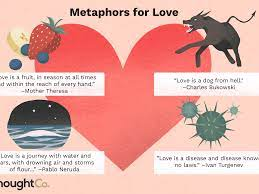
For our do-now, we had to answer the prompt, ‘love is…’ I wrote that love is thinking of somebody even when you’re apart. When it was time to share out answers, Ms Peterson called on Vallerie, whose response was ‘love is effortless.’ Vallerie was prompted to call on another person in turn and called on Ayah, who had written “love is life.” Fiona and Vanessa were the last two girls selected to share their answers, which were ‘love is family’ and ‘love is an expression’ respectively. Ms Peterson then wanted to hear some responses from the boys and asked Mikita what he had written. He said that love was an uphill battle. She then called on Will, who said that love is a bond between two creatures.


After we had completed our do-now question and shared out our answers, we started to go over metaphors, which are figures of speech that often use variations of the word ‘to be.’  Metaphors do not use ‘like’ or ‘as’ like similes do, thus making them implicit comparisons. This means that the comparison is hidden and not explained outright. Explicit comparisons, on the other hand, would be clearly explained and precise, with no hidden meaning. Ms Peterson showed us a way to remember the versions of the phrase ‘to be’ commonly used in metaphors by singing them to the tune of a song.


When we had finished with that, we had to do some spirit reading for the next slides. Fiona spirit read the next slide about extended metaphors, which were defined as metaphors that are developed over a few lines or throughout the whole poem. An example poem was provided for us: 


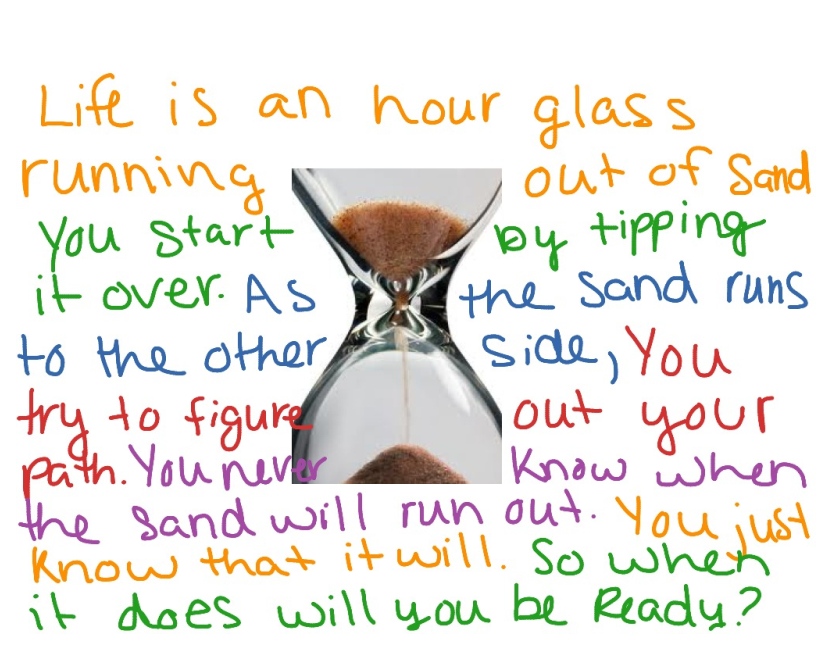
Ms Peterson pointed out the forms of the phrase ‘to be’ within that poem and explained what the formula for writing an extended metaphor poem was. The metaphor was developed throughout the course of the poem by not asking questions and making implicit statements and comparisons that alluded to a deeper meaning than what was being directly stated. To help us further differentiate between the two, she gave two more common examples: All men are dogs, and all women are witches. She explained how those metaphors didn’t question the statement, but rather made a singular straightforward comparison to develop a point. If the metaphor had started listing the ways all women were witches and all men were dogs, then it would have become extended.


Next, we did some more spirit reading and annotated as we read along. Vanessa, Jerry, Justin, and Terrence were a few of the people who volunteered for reading. After completing that task, Ms Peterson read out an Emily Dickinson poem entitled “Hope is the Thing with Feathers.”


“Hope is the thing with feathers

That perches in the soul,

And sings the tune – without the words,

And never stops at all,


“And sweetest in the gale is heard;

And sore must be the storm

That could abash the little bird

That kept so many warm.


“I’ve heard it in the chilliest land,

And on the strangest sea;

Yet, never, in extremity,

It asked a crumb of me.”


We then had to answer the following question: 


How does the author utilize the extended metaphor to express a theme or message to the reader?


Ayah raised her hand and said that the author utilizes the extended metaphor by utilizing many words and phrases with connotations that made us have feelings of hope. I wrote something in connection, saying that the author kept expanding on the initial metaphor and adding more layers to the feeling of hope she was trying to describe.


We then started on Team Group Work. We had to collaboratively read and annotate the poems “Mother and Son” by Langston Hughs and “The Rose That Grew from Concrete” by Tupac Shakur, and answer comprehension questions about the contents of the poems and the metaphors used.


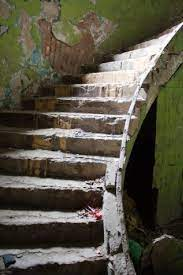
When we completed the collaborative work, we reentered the main session and began to share our answers. The first question for the poem ‘Mother to Son’ asked how the extended metaphor was used in the poem, and the response to that was that the extended metaphor used was comparing life to a crystal staircase. The next question was a subset of that question, and asked what Hughes was expressing through the use of the metaphor. The response provided was that the tacks and splinters described in the poem represented adversity and difficulty that the mother had to overcome. Ayah responded to the final question, which asked what the mother’s message to her son in the final stanza was, and said that the mother’s message to her son was to never give up and to keep on going in spite of those hardships.


Then we switched over to the second part to review the questions assigned for ‘The Rose that Grew from Concrete.’ The questions for that poem asked how the poem utilized an extended metaphor and what the rose and concrete represented. Asdaq answered that the rose represented the person while the concrete represented an impoverished town, and the whole poem was describing aspirations and overcoming hardship in order to blossom.


Lastly, we had to individually reflect on and compare the two poems and the common theme of the extended metaphors used in each. I wrote that the extended metaphors both commonly compare a person that faces adversity and hardship and must keep persevering despite all the odds. The extended metaphor in the first poem is the crystal stair, which represents the course of life, and the imperfections are the challenges and obstacles we face as we journey through life. The extended metaphor in the second poem is the rose, which represents a person who has to weather through challenges in order to become something and reach their goals, while the concrete represents everything that could be holding them back.


Reflection:


Today I learned about extended metaphors and how they differ from regular metaphora. In addition to this, I also learned how to identify an extended metaphor and determine the deeper meaning of implicit comparisons through in-depth reading and annotation. I think we learned this so we could apply this knowledge to an assignment or project in the future, since we are currently working through a poetry unit. Learning how to identify an extended metaphor poem and learning ‘the formula’ to write one seems like the kind of knowledge we would have to file away for future reference or use. Aside from that, I would use this knowledge about extended metaphor poems and metaphors in general to help me better understand any that I might encounter, since they have the tendency to be somewhat complicated because they’re so detailed and layered. Overall, I think I have a good understanding of what we learned in this lesson and I know where I would apply this knowledge, as well as where it could come in use.