Thursday, March 12, 2020

Blog #16: Wenyan Li: Period 7: 3/11/20

Wednesday March 11 
Winnie Li 
Period 7 
Blog #16 

Aim: How can a comparison of speeches reflect the continued relevance of ideas held in society today?

Do now: Think/Pair/Share 
  1. Why do you believe that when some people speak they seem to grab and maintain the attention of those who are around them?
  •  “Some people they touch upon ideas that others have but are too embarrassed to share themselves” 
  • “Make eye contact and project your voice”
  • “Be confident, in order to make others believe in what you are saying” ”
  1. Why do you believe that a person's words are vital to the message they’re trying to make, and why do we often place so much emphasis on our “choice of words”? 
  • “Don’t use words like ‘like’ and ‘a lot’ and ‘um
  • Choice of words are important as certain words can add to the emotional context of your speech or aid you in capturing the attention of those around you. However, it could also do the same as using the wrong phrase can lead to those around you to misinterpret the message you were trying to give.

Reflection:
  • In today’s lesson we discussed speeches and the qualities that go into them that make them grab and maintain the attention of those listening. This was important as we learned that when speaking you want to be careful with your choice of words as some such as “like” and “um” can become repetitive and take away the impact your speech has on someone. We were able to hear an impactful speech such as I have a Dream by Martin Luther King, Jr. and compare the structure of it with Old Major’s speech in chapter one of Animal Farm. By comparing the structure we were able to see that qualities such as word choice and confidence were both present in the speeches as they allowed the speakers to have an emotional connection with the audience that made them feel drawn to the subject and be inspired by it. 

Blog #17 - Peter Seifen - Period 1 - 3/12/20

Blog #17 - Maxim Livit - Period 9 - 3/11/2020

Maxim Livit

Sophomore 2020

Period 09

Blog - 03/11/2020

Aim: How can a comparison of speeches reflect the continued relevance of ideas held in society today?

Do Now: THINK/PAIR/SHARE
  1. Why do you believe that when some people speak, they seem to grab and maintain the attention of those who are around them?
  2. Why do you believe that a person’s words are vital to the message they’re trying to make, and why do we often place so much emphasis on our “choice of words?”

Notes and Class Discussion:
We started the class period, as usual, answering the Do Now questions. For the first question, there seemed to be a similarity in all of the answers. It was obvious that the class knew what had to be done to stand out and properly deliver a speech or any form of verbalizing that requires an audience’s attention. For the first question, most students pointed out that the tone and diction of a speaker is the key to grabbing that attention. For example, speakers that are loud, clearly confident, and emotional to where they believe in their words so much that it is hard for the audience not to, are the best at calling attention. Additionally, one has to be articulate in their words, not wasting any time on useless thoughts, not constantly including “uhh” or “umm” to sentences, and prudently choosing words that carry the perfect connotation to get a point across. All of these points were later applied to our examination of Martin Luther King Jr. and his most famous speech. Following this discussion, we built on these answers with a list of charismatic leaders in history, including Hitler, Mussolini, JFK, Lenin, Malcolm X, Ronald Reagan, Abraham Lincoln, George Bush, and many more. The second part of the Do Now was discussed with parallel ideas, basically concluding that choosing stronger words are the best way to get thoughts across better.

After this, Ms. Peterson showed the class a viewing of Martin Luther King Jr.’s full speech while we all read along on a document located in today’s Google Classroom attachments. Although this took up most of the period, it was very helpful in applying our discussion to his extremely famous speech, as his method in delivering each sentence was clearly successful.


Reflection: All of these aspects to today’s lesson came together at the end when we began working on the “Analyzing Political Speeches: Part 1” worksheet, also found on Google Classroom from today’s attachments. We began to fill out the takeaways from Martin Luther King Jr. 's speech such as who he depicted as the group suffering from those current circumstances, the group benefiting, and what life in the United States would be like if these said circumstances were to become more “fair.” Beginning to complete this worksheet brought light upon the second half of the worksheet and made it clear how comparable Martin Luther’s speech was with Old Major’s speech in Animal Farm, in regards to their content and structure. What we learned was useful in analyzing the extent to which Martin Luther King Jr. delivered an extremely historically-successful speech and the extent to which we can relate it to our current reading of Animal Farm.

Wednesday, March 11, 2020

Blog #17 - Carol Lian - Period 2- 3/11/20

Blog #17
March 11th, 2020
Carol Lian, Period 2

Aim: How can a comparison of speeches reflect the continued relevance of ideas held in society today? 

Do Now: Think/Pair/Share
  1. Why do you believe that when someone speaks they seem to grab and maintain the attention of those who are around them?
  2. Why do you believe that a person’s words are vital to the message they’re trying to make, and why do we often place so much emphasis on our “Choice of Words”?

  • Charismatic leadership → method of persuasion/ communication that captures the attention of others/followers 
    • Ex: Martin Luther King Jr. - “I Have A” Dream speech 
    • Ex: George Washington - convince an army of soldiers to fight 
    • Ex: Theodore Roosevelt - the ability to convey his visions to other people through actions and words 
  • Vocabulary - using different vocabulary can affect how people may view you as an individual 
    • Ex: Using medical terminology on a  daily basis or first impressions can lead people to believe that you work in the medical field
  • Limits - using different vocabulary words can be useful during conversations but if used too many times/have too many exotic words in one breath can make the conversation hard to follow
  • Posture - body language can speak more than you think
    • Maintaining eye contact can tell a person that you’re interested/listening to their conversation
    • Fidgeting and spinning your body can be mistaken as boredom 


“I Have A Dream” speech - August 29, 1963 (video is not the exact video shown during class) → https://youtu.be/smEqnnklfYs 

Worksheet (Empty Version): 


Reflection: 
For today’s lesson, we discussed the different ways in history by famous leaders that were used to maintain the attention of followers/those around them. For example, Martin Luther King Jr. is widely known for his inspiring “I Have A Dream Speech” which he presented on multiple occasions. George Washington, the first president, was able to convince the soldiers to fight for the country and Theodore Roosevelt who was able to convey his visions to his followers through actions and words. We also mentioned charismatic leadership and how many historic leaders possess this trait that allows them to gain many followers. Facts aside, personally, I believe that a person’s ability to persuade others can be seen through their speech and actions whether they’re the presenter or the audience. For example, as an audience, keeping eye contact on the presenter tells the presenter that you’re interested in their presentation and it also shows respect towards the person in general. Overall, by highlighting these different techniques, we were able to understand how many historic leaders were able to persuade the audience.

Blog #17 - Brian Lum - Period 3- 03/11/2020


March 11, 2020
Brian Lum 
Period 3

Aim: 
How can foundational knowledge of history and an author’s experiences add insight to the rationale for their works?


Do Now:
Certain people are good at saying speeches because of certain characteristics. These characteristics may include:
  • An upright posture (to demonstrate confidence and strength)
  • A loud voice to project an opinion
  • Strong words that can empower people 


I think that our choice of words matters because it is important to convey what kind of tone and what kind of audience we want our statement to apply to. For example, it would be inappropriate to use slang in a formal speech. Additionally, if you were to explain something to children it would not be a good decision to use complex words or jargon.


Reflection: Today we watched a video accompanied with a speech showing Martin Luther King Jr.’s famous “I Have A Dream” speech. It connects back to the “Do Now” questions because in the speech King demonstrated that tone that he wanted to convey: he wanted to be seen as strong, empowering, and confident that the civil rights movement would gain further attention. He uses words that are inspiring in order to gain followers. An example of this is when he says:


I have a dream that one day even the state of Mississippi, [a desert state,] a state sweltering with the heat of injustice, sweltering with the heat of oppression, [will] be transformed into an oasis of freedom and justice.”


I learned that we need to have some of the same characteristics as King in order to make ourselves recognizable as strong leaders. We need to be confident and strong in order to project our voices so that others will listen.


Blog #14- Douaa Labdouni- 3/10/2020- Period 2

 March 10 Douaa Labdouni Period 2
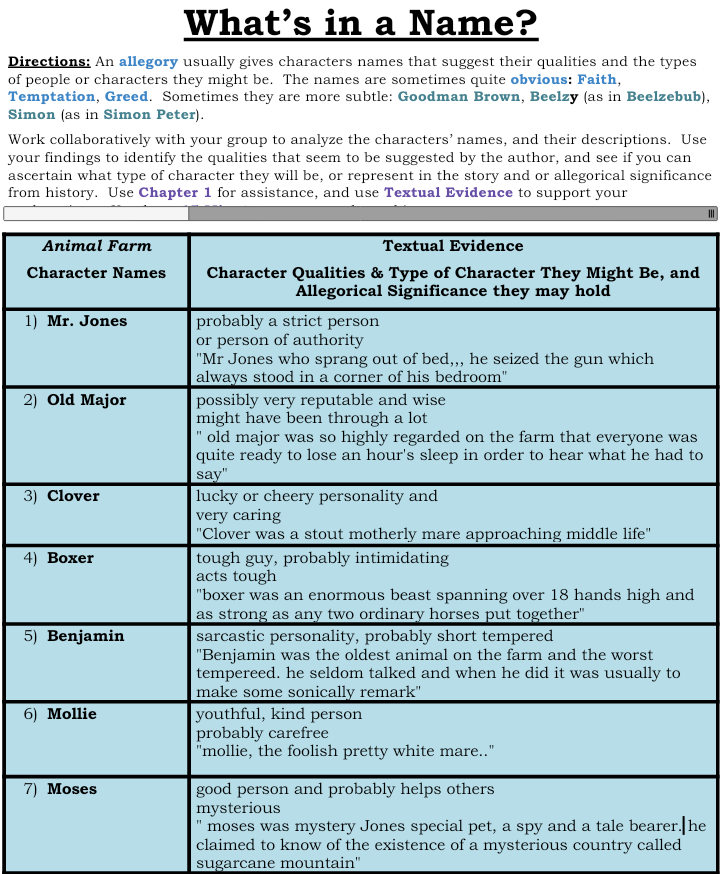
aim: How can we analyze the importance of names, while symbolically analyzing the characters of the novel?
do now: i think that what a person is named matters because that is how they are going to be seen by others for the rest of their lives. that is what everyone will know them as, and therefore it is very important.
your name might impact outcomes if they suggest something negative about you. for example swiper the fox might have a harder time gaining the trust of others than honest abe.


  reflection: today I learned that what's in a name is more than just what other people call you. since it can be used to represent hidden qualities about a character, authors may use the characters names to help the reader understand them better. for example, in animal Farm all of the animals names correlate to their personalities. I will be able to use this new perspective on the author's choice of names for their characters in the future whenever I read a book or story. by analyzing the names of characters I can gain some more insight on their qualities.

Blog #16 - David Schwartzman - Period 1 - 3/10/20

Freshman 2020
3/10/20
David Schwartzman 
Blogger #17


Aim: How can a concise reading of both an epic poem and the Iliad enhance our reading of the odyssey?


Class Notes for the Day
  1. Xenia
-Ancient Greek concept of hospitality 
-Cautionary tales warned mortals that a god/goddess could be disguised as a guest 
  1. Trojan War
-Aphrodite promises to Paris, Prince of Troy, that Helen, wife of Spartan King Menelaus’, will fall in love
with him
-Troy seizes Helen once welcomed into the city(Xenia)
-Helen’s former suitors help Menelaus attack Troy
-The Greeks moved their ships away to make it look as though they had surrendered, and left a wooden
Trojan Horse(packed with soldiers), at the gates of Troy. Once it was let into the city, the soldiers utterly
obliterated it.
  1. Odysseus 
-Main character of The Odyssey
-Trojan Horse was his idea
-Former suitor of Helen, and thus one of her sworn protectors 
-Led the Greeks to victory 
  1. Importance of Homer’s Epics
-Values: Honor, Bravery, Hospitality
-Faults: Disrespect for gods, lack of hospitality, hubris 
  1. Odyssey 
-Sequel to Iliad 
-Focuses on end of Trojan War
-Focuses on Odysseus’ journey home
-Was much like the Bible to Ancient Greeks 
  1. Plot Strands
-Story about Odysseus’ family in Ithaca 
-Odysseus’ journey back home 
-Merging of the strands 


Reflection 
What did I learn? Why did I learn it? How will I use what I learned?

Today we learned about some aspects of Ancient Greek culture, the Trojan War, Greek Mythology, as
well as the significance of The Odyssey and Iliad, and some of their key plot points. We learned this to
help bolster our knowledge of the time period at which these books were created, and the fundamental
values that people were expected to have. Additionally, we learned this so that we could get a glimpse
into the lives of Ancient Greek citizens, and what their day to day lives entailed. Furthermore, by reading
the Mythology, the class was able to understand more about the Gods and their key traits. Finally, I will
use what I learned in class today to provide me with insight once we get to reading The Odyssey and the
Iliad. I will be able to create meaningful connections between what was written and what I already knew
about the time.