Wednesday, December 23, 2020

Blogger #33 - Marcus Yuen - Period 1 - 12/21/20 - Day A - Freshmen Lit 2021


Blogger #33 - Marcus Yuen - 12/21/20 - Day A - Freshmen Lit 2021


Aim: How do Odysseus' actions in "The Cyclops" support or refute his epic character?


Do Now: As previously discussed, the term, “Xenia” is the ancient Greek concept of hospitality, the generosity and courtesy shown to those who are far from home and/or associates of the person bestowing guest-friendship. The rituals of hospitality created and expressed a reciprocal relationship between guest host.


Therefore, based on your understanding of the term, how important do you believe this attribute or behavior is to exemplify? Why?


Mini-Post card project

We started off today’s class with Mrs. Peterson explaining this new project she gave us. She explained thoroughly the format on what to do and how to do this project. We are supposed to write in first person view as Odysseus, and send a postcard home to your wife or/and son. We send home what happened on our journey and think in relation about what happened. We can turn in a postcard either physically or digitally.


Virtual Debate

Mrs. Peterson then explained what to do for the virtual debate due on December 23, 2020 This virtual debate is on Polyphemus vs. Odysseus. We are to choose a side and possible topic, or create our own. Then we would make a statement on Google Classroom, and then respond to at least one of our classmates’ posts.


Do Now Review
When reviewing the do now, many of my classmates thought the saying “treat others how you want to be treated”. One such connection that was made was by Marianna, where she talked about The Beauty and The Beast, where . Another connection that was made was of Greek Mythology, where gods would curse the people that talked bad about them and things like that.


Lesson

We start off the lesson with a class discussion on superhero movies. We identify how there may be weaknesses a superhero has. One such weakness is a close one dying to them and they lose their will to fight.


After the discussion we went on to spirit reading about Homeric similes.

  • Homeric simile, also known as Epic Similes, are elaborate comparisons, consisting of many lines, between two different objects using “like”, “as”, “so”, or “just so”. It is a comparison made between something unfamiliar or strange to the audience and something that is more familiar to them.


We then did some spirit reading on foreshadowing after that.


  • Foreshadowing - Where future events in a story, or perhaps the outcome, are suggested by the author before they happen.

After doing some spirit reading on foreshadowing, we watch a video on it. Foreshadowing | Definition & Examples of Foreshadowing [2:31]

Right after we finish the video, we go onto spirit reading on what Hubris is.


  • Hubris is a Greek term meaning excessive pride or over-confidence (think arrogance)

After the spirit reading, we watch another video, but on Hubris this time. What Is Hubris | Its Greek Origin & Usage In Modern Literature | Definition and Examples of Hubris [2:51]


Directly after we finish the video, we go to the next slide, where there is a copy of “The Cyclops” for us to spirit read. "The Cyclops" [11 Pages]


Group Discussion

The last thing we did in class today was the class discussion. We go into our group breakout rooms to answer the questions together.


1) Based on your understanding of foreshadowing, review lines 153-156. How is foreshadowing used, and what exactly is being foreshadowed?

In the class discussion, Joshua John’s team said that foreshadowing is used to show that something bad is going to happen in the future and Polyphemus coming back is being foreshadowed.


2) What heroic qualities does Odysseus display thus far?
        a. What does the fact that he doesn’t want to attack the Cyclops reveal about his character?

In the class discussion Charlton answered that the fact that he doesn’t want to attack the cyclops shows that he is smart and wise.


3) Refer to line 232-243. How does Homer use figurative language to create imagery? (identify examples and explain their effect)

In the class discussion, Wilson said that the cyclops is being compared to a mountain lion. It is like a savage. Jason also said that the humans were like squirming puppies.


4) How should we judge the heroic qualities of Odysseus based on his actions with the cyclops? (Heroic Qualities: Intelligence/Resourcefulness, Strength, Bravery and loyalty, Weakness)

In the class discussion, Marianna said that he was quite analytical and resourceful according to his actions from the text. She also said he was able to use his surroundings like the wine and the objects inside his escape to this carefully before making any actions. An example would be that, he chose not to stab the cyclopes because he knew it would do nothing to benefit him and his men.


5) Contrast Polyphemus’ values and the values of Odysseus (hospitality [xenia], respect for the gods, protections for his men).

        a. Can you identify any qualities/characteristics that both Odysseus and Polyphemus share?
        b. If Odysseus represents civilization, and Polyphemus represents nature, what do you think Homer is saying about the relation of man to nature?

            i. Can you see potential dangers (that are becoming increasingly evident, especially in the modern era) in this position taken by Homer?

In the class discussion, Summer said that they both are really prideful. The cyclops compares themselves to Odysseus’ men, saying they are puny and stuff. Odysseus also is prideful because he had to reveal his actual name to Polyphemus so he could get credit for it.

We did not have enough time to go over question b and i of question 5 or the entire question 6 of the class discussion questions and then Mrs. Peterson went to explain the virtual debate further.

Reflection

Something I learned from this lesson was to always stay calm. Although Odysseus’ crewmates kept getting killed by Polyphemus, Odysseus remained calm. He was able to formulate a plan to get the rest of his people out alive. He did so successfully, but probably shouldn’t have revealed his actual name at the end. I learned this so I can predict how he might solve his problems as he continues his journey. I will use what I learned in the future by being able to calmly solve problems that appear so there is no violence or conflict in general.


Blogger #32 - Shilin Yu - Period 1 - 12/21/20 - Day A - Freshmen Lit 2021


Aim: How do Odysseus' actions in "The Cyclops" support or refute his epic character?


Do Now: As previously discussed, the term, “Xenia” is the ancient Greek concept of hospitality, the generosity and courtesy shown to those who are far from home and/or associates of the person bestowing guest-friendship. The rituals of hospitality created and expressed a reciprocal relationship between guest hosts.


Therefore, based on your understanding of the term, how important do you believe this attribute or behavior is to exemplify? Why?


I believe that this attribute or behavior to exemplify is very important. I believe this because having manners and being hospitable to guests are very significant things. If you were rude to guests, then others might not like you or they might not see you as someone to associate with. If you did honor “Xenia” and had good house manners shown to the guest, then they would see you as someone respectable and want to get to know you better and be your associate.


Ex: Beauty and the Beast, the Prince being cursed due to poor manners to the princess that had dressed as an wandering old woman.


Class Discussion: Reflect on the heroes you have encountered throughout your life, in various forms: literature, movies or TV. Identify any weaknesses the hero(es) may have, and explain how it impairs their ability.


Weakness: Mental issues like losing a loved one, getting their weapons taken away,


Homeric similes: also known as Epic Similes, are elaborate comparisons, consisting of many lines, between two different objects using “like”, “as”, “so”, or “just so”. It is a comparison made between something unfamiliar or strange to the audience and something that is more familiar to them


Foreshadowing: Future events in a story, or perhaps the outcome, are suggested by the author before they happen. They are usually considered to be ominous, warning signs, or signs of bad things to come. Foreshadowing can take many forms and be accomplished in many ways, with varying degrees of subtlety. However, if the outcome is deliberately and explicitly revealed early in a story (such as by the use of a narrator or flashback structure), such information does not constitute foreshadowing.


Foreshadowing can be shown through events, dialogue, super-natural events.

Foreshadowing | Definition & Examples of Foreshadowing [2:31]


Hubris: a greek term meaning excessive pride or overconfidence (Arrogance)

Examples: Icarus, Bellerophon, Arachne.

What Is Hubris | Its Greek Origin & Usage In Modern Literature | Definition and Examples of Hubris [2:51]


"The Cyclops" [11 Pages] : Spirit reading


Group Discussion:

1. Based on your understanding of foreshadowing, review lines 153-156. How is foreshadowing used, and what exactly is being foreshadowed?

Foreshadowing is being used as it describes the cyclops and the size and shape of it. What was being foreshadowed was that the cyclops wouldn’t care for xenia, and didn’t have any care for treating his guest.


2. What heroic qualities does Odysseus display thus far?


What does the fact that he doesn’t want to attack the Cyclops reveal about his character?

The heroic qualities Odysseus displayed thus far were his cunningness, loyalty, xenia, resourcefulness, brave, self-confidence. The fact that he doesn’t want to attack the Cyclops reveals that his character is someone who is smart and patient , realizing that he stood no chance, and so decided to bide his time instead.


3. Refer to line 232-243. How does Homer use figurative language to create imagery? (identify examples and explain their effect)

Homer uses figurative language to create imagery by describing just how Odysseus and his crew were compared to the cyclops Polyphemus, tiny and punny compared to Polyphemus, who caught two of Odysseus’ best men while the two of them were struggling like squirming puppies. This showed just how weak the men were while showing off just how strong the cyclops Polyphemus was.


4. How should we judge the heroic qualities of Odysseus based on his actions with the cyclops? (Heroic Qualities: Intelligence/Resourcefulness, Strength, Bravery and loyalty, Weakness)

The heroic qualities Odysseus based on his actions with the cyclops was that he was very intelligent, able to bide his time, extreme resourcefulness, used the wooden spike to poke out the cyclop’s eye, hid his men under his sheep, used the wine to make Polyphemus drunk.


5. Contrast Polyphemus’ values and the values of Odysseus (hospitality [xenia], respect for the gods, protections for his men).
            a. Can you identify any qualities/characteristics that both Odysseus and Polyphemus share?
            b. If Odysseus represents civilization, and Polyphemus represents nature, what do you think Homer is saying about the relation of man to nature?

                    i. Can you see potential dangers (that are becoming increasingly evident, especially in the modern era) in this position taken by Homer?

Polyphemus’ values of xenia is that he doesn’t care very much about it as shown when he dismissed Zues, and ate two of Odysseus’ men with care while Odysseus shows great care, as when he brings his best wine to give to the cyclops and didn’t steal the any of the cyclop’s belongings.


Qualities/characteristics that both Odysseus and Polyphemus share are that they are very prideful, as Polyphemus dismissed Zeus when Odysseus brings up his name and also says that they are puny compared to him the cyclops while Odysseus had told Polyphemus his real name at the end and taunted him without caring for the consequences.


If Odysseus represents civilization, and Polyphemus represents nature, I believe that Homer is saying that the relation of man to nature is that they are incompatible. Polyphemus is a barbican, not caring about civility or hospitality, while Odysseus is civilized and caring great about manners and hospitality.


I can see the potential dangers in this position taken by Homer as humans are generally becoming less connected with nature and so are becoming much less concerned with the environment than before.


Reflection:

During this lesson, I had learned a lot from this part of the journey of Odysseus. I learned about foreshadowing and hubris with how each were applied during the story. Foreshadowing was used to give an omen about the cyclops while both Odysseus and Polyphemus possessed hubris, which would lead to them underestimating the other and cause problems for the both of them later on. This let me learn to not be hubris or be arrogant as having hubris is a dangerous thing. I will use this information to make sure I will not slack off due to my hubris. If I would think that I reached by best, I wouldn’t try and go past my limits which would cause me to fall behind.

Tuesday, December 22, 2020

Blogger #17 Eliot Livson, Pd 6, 12/1/20 Cycle B

RL: Poem Anthology Proj Assign - Eliot Livson Blog


Aim: How can our knowledge and experience with poetry and poetic techniques ensure the successful creation of our Poem Anthology project?


Before we begin doing the do now we had a class discussion on the aim. We had a group discussion about what anthologies are and other examples of them. Then be going the do now.


Do Now: CLASS DISCUSSION


How do you usually feel when you learn you are being assigned a new project? Why?


A majority of the class agreed that being assigned a new project can be stressful and cause us to feel worried because the project is unknown and can be difficult and stressful.


Notes:

After the do now we discussed the Poem Anthology Project Assignment. This slide included what our project was going to be on and what must be included in the project. Our Poem Anthology project is to create a poetry anthology with 4 original poems with at least one poem structured like an extended metaphor


Our anthology poem MUST INCLUDE:

  1. A creative cover, which clearly identifies your First and Last Name, period, TEAM NAME, and Cycle Letter. 

  2. A Table of contents,  clearly identifying each poem type [(1) free verse, (2) extended metaphor, (3) sonnet, and (4) an additional poem structure of your choosing] the Title, and the page number where it can be found.

  3. An introduction to the collection, explaining the basis for your poem choices.

  4. One poem must be your extended metaphor and must be annotated. Highlight some of your poetic choices just like we did in class, and explain the reason behind them.

  5. All 4 original poems should include complementary visuals/images/drawings.

  6. Your last page must include a reflection that explains the experience of creating poetry along with a discussion of the style, language choices, and thematic intent of your poems at the conclusion of your anthology. 


To better understand the project, Ms. Peterson gave us two example projects. These sample anthologies helped us better understand the requirements of the anthology we were going to write.


We then discussed the information of the project such as the due date and where to submit it. We also received an enrichment video to learn more about poetic devices if we needed it.

Poetic Devices Defined [4:02]


We then went after the rubric for the project.


Blogger #31 - Crystal Yeung - Period 1 - 12/21/20 - Day A - Freshmen Lit 2021


Blogger #31 - Crystal Yeung - Period 1 - 12/21/20 - Day A - Freshmen Lit 2021


RL: 5 The Odyssey: Cyclops

HOUSEKEEPING: First, we did attendance for the class. Next, she explains the different things posted today. The Post Card mini-project assigned is due January 15th and for the project, everyone will be making 2 locations and which point of the journey for the 2 postcards. More information about this project will be on the Post Card Mini project google document. Second, there is a virtual debate which is The Odyssey: Polyphemus vs. Odysseus Virtual Debate. She posted an assignment where you can write down your statement and then also debate with another classmate’s statement.


AIM: How do Odysseus' actions in "The Cyclops" support or refute his epic character?


DO NOW: THINK/PAIR/SHARE

As previously discussed, the term, “Xenia” is the ancient Greek concept of hospitality, the generosity and courtesy shown to those who are far from home and/or associates of the person bestowing guest-friendship. The rituals of hospitality created and expressed a reciprocal relationship between guest host.

Therefore, based on your understanding of the term, how important do you believe this attribute or behavior is to exemplify? Why?


My Response- This is an important attribute because being hospitable can be a sign of respect. You must treat others how you want to be treated

Joshua J - It’s important to treat others how you want to be treated

Marianna - Important to treat others the way you want to be treated for example in beauty and the beast, a witch cursed the beast because he was rude to her and he needed to find Bella to break the curse.

Shilin - Important because if you show poor house manner they won’t like you or want to associate with you. If you do show house manner they will think you’re respectful and want to associate with you

CLASS DISCUSSION

Reflect on the heroes you have encountered throughout your life, in various forms: literature, movies, or TV. Identify any weaknesses the hero(es) may have, and explain how it impairs their ability.


Joshua - enemy takes advantage of hero loved ones

Chase -Most heroes have weapons for example superman has a suit, their weakness could be not having their weapon bc it could e a big source of their power

Oriana - mental weakness, lost a loved one and affect the ability to fight

LESSON

Homeric simile - also known as epic simile, elaborate comparisons consisting of many lines between two different objects using “like”, “as”, “so”, or “just so”. It is a comparison made between something unfamiliar or strange to the audience and something that is more familiar to them. We often use short similes in everyday speech, like the example, “She’s tough as nails.” A Homeric Simile, however, is used to redirect the reader’s attention in unexpected, humorous, gruesome, or heroic ways.

Why might homer to choose to use this technique?

Use objects of comparison that were familiar with the audience, meant to ensure you understand the visual being presented, can help glorify his characters, enrich his texts and deepen the readers understanding


What is foreshadowing - when future events in a story or the outcome is suggested by the author before they happen, author gives hints various technique: supernatural elements, a dialogue of a character

Build an atmosphere, build suspense, and inform readers about what possible things might happen in the future.


Hubris - extreme of foolish pride or dangerous overconfidence Can cause the character to disregard reality or offend the gods, often leading to their downfall

A character flaw is often seen in the heroes of classical Greek tragedies

Committing hubris was very much looked down upon in Ancient Greece

Usually a characteristic of an individual rather than a group


We spirit read The cyclops.pdf (https://drive.google.com/file/d/0B9xgktq1tg9eZkRKVWw4ODk2SnM/view?usp=sharing)


GROUP DISCUSSION


1) Based on your understanding of foreshadowing, review lines 153-156. How is foreshadowing used, and what exactly is being foreshadowed?

Foreshadowing is used to describe the cyclops size, they said there will be a brute. Polyphemus coming back and not respecting them is what is being foreshadowed.


2) What heroic qualities does Odysseus display thus far?
        a. What does the fact that he doesn’t want to attack the Cyclops reveal about his character?

The fact that Odysseus doesn’t attack the cyclops shows that he is smart because it wouldn’t have done anything if he attacked the cyclops. He is analytical and can assess the situation so he knows if he needs to retreat or attack.


3) Refer to line 232-243. How does Homer use figurative language to create imagery? (identify examples and explain their effect)

Homer used figurative language to create imagery by showing how the two people are small compared to Polyphemus. The 2 men were described as squirming puppies and it showed how those men could not escape.


4) How should we judge the heroic qualities of Odysseus based on his actions with the cyclops? (Heroic Qualities: Intelligence/Resourcefulness, Strength, Bravery and loyalty, Weakness)

We can judge the heroic qualities of Odysseus based on his actions with cyclops by showing that he is analytical and able to be cunning.


5) Contrast Polyphemus’ values and the values of Odysseus (hospitality [xenia], respect for the gods, protections for his men).
            a. Can you identify any qualities/characteristics that both Odysseus and Polyphemus share?
            b. If Odysseus represents civilization, and Polyphemus represents nature, what do you think Homer is saying about the relation of man to nature?
                    i. Can you see potential dangers (that are becoming increasingly evident, especially in the modern era) in this position taken by Homer?

Characteristics that both Odysseus and Polyphemus share is that they are both very prideful. Homer is saying that the relation of man to nature is that man is superior because while nature can be strong, man can learn and adapt a way to defeat nature. There can be potential dangers in this position because it can cause people to continue to hurt nature instead of maybe working with nature.


6) As previously discussed, the story is told through flashback (Odysseus is revealing the past events of his journey), therefore, how has Polyphemus’ curse impacted the course of Odysseus’ future.

Polyphemus’ curse impacted the course of Odysseus’ future by making his journey home bad. Since Odysseus was being too confident and told Polyphemus his name, Polyphemus used it against him. He reveals his dad is Poseidon and prays that Odysseus reaches home without any of his crew and for him to have a bad journey.


REFLECTION :

What did I learn? Why did I learn it? How will I use what I learned in the future?

Something I learned while reading The Cyclops is to not be foolishly prideful/confident. This led to Polyphemus getting blinded by Odysseus and his men but also led Odysseus to get cursed. When they are overly confident they both believe they are unbeatable and that ends up biting them in the butt. I can use what I learned to always work hard. For example, if I am the best at a sport on the team I have to make sure to not slack off. If I believed no one can surpass me I may stop practicing and everyone can surpass me.

Blogger #29 - Songen Tang (Jessie) - Period 9 - 12/18/20 - Day C - Freshmen 2021

 Aim: How does “Sailing From Troy” and “The Lotus Eaters” (Book IX) establish Odysseus’ role as a leader?


Do Now: Team List

Consider the fact that Odysseus has been trying to return to his home in Ithaca for 10 years. Imagine being away from your home for that long. 

  1. What would you miss the most and why? 

  2. Why do we have sayings like the ones below?


We were put into groups to discuss the do now. Most groups had the common idea of missing their families and some talked about how they would miss their surroundings such as their house or neighborhood because it was something familiar to them. The general theme of the answers was the security of familiarity. We don’t have to worry about the dangers of the unknown because we know everything about our homes, such as our parents' food or our own bed. For the second part, we explained that the reason these saying exist is because most people agree with the fact that home is a place that is special to us. 


Next we learned about  direct and indirect characterization which are defined in the notes below. 

Notes:


We then watched a video on the characterization of Frozen to see some examples: Characterization Lesson | Using Disney's Frozen [4:55]


After that, we continued reading The Odyssey from Sailing from Troy (lines 18-69) and answered the group questions with our breakout room. 


1. We answered that Odysseus loves his home more than any other place. The evidence for this was in line 28 which states, “I shall see on earth a place more dear.” We also added that Oddyseus was captured by the loveliest goddess, Calypso, but still wanted to go home. He also shows how he doesn’t like traveling through the lines 35-37 and 46-47 where he says how he doesn’t find anything better than home when traveling and how he turned back the second he defeated Troy. 


Continuing with the text, we read Lotus Eaters (lines 18-69) and completed more group work with our teams. 


2. A brief summary we came up with was that Oddyseus’s ship had been swept away by a storm and landed near the Lotus Eaters. The Lotus Eaters offer Oddyseus’s crew lotuses but Odysseus realized that anyone who ate one would want to stay there forever. So, he dragged his crew with him because he wanted everyone to go home. 


3. We answered that the Lotus Eaters probably lived a very relaxed lifestyle because they had all the lotuses to eat and were all very happy to stay there. 


4. The Odyssey characterises the land of the Lotus eaters as a veritable paradise by describing how happy the people are who live there. Odysseus sees this as a place to escape from because he realises that the lotus is controlling them and they are not there by their own free will. We said that this place is bad because it makes you forget about everything else like how the crew didn’t want to return home after eating the lotus. 


5. We explained that Odyssey seems to be a more forceful leader in “The Lotus Eaters” because he had to make a decision for his crew when they were being controlled by the lotuses. In “Sailing From Troy” he wasn’t able to convince his crew to turn back but in “The Lotus Eaters” he tied his crew to the ship to prevent them from staying with the Lotus Eaters. There were varying opinions on Odyseus. Some people said that they didn’t change their opinion on him while others said that they thought he was a better leader. These events show the progression of his character and how he is learning to be a better leader. Some also said that it further reinforces his love for his home. 


We also discussed the concept of a dynamic character. A dynamic character is someone who changes and develops during the course of the story. 


Reflection:

In this lesson, I learned about characterisation. Although I had a basic knowledge of it already, we delved deeper into understanding and recognizing it, especially indirect characterization. We learned this because it would help us with understanding the development of the characterization of Oddyseus. By analysing the indirect characterization of Odyseseus, we can see how he has become a better leader through his actions. Moving forward, I can use this knowledge to see how Odysseus further develops throughout the course of “The Odyssey” as well as using it to characterise other characters in the future. 


Monday, December 21, 2020

Blogger #29 - Annie Zhao - Period 6 - Day B - 12/17/2020

RL: 4 The Odyssey: Sailing from Troy & Lotus Eaters


Aim: How does “Sailing from Troy” and “The Lotus Eaters” (Book IX) establish Odysseus’ role as a

leader?

Do Now: (In Groups)

Consider the fact that Odysseus has been trying to return to his home in Ithaca for 10 years.

Imagine being away from your home for that long. 


  1. What would you miss the most and why? 


My group and I collectively agreed on missing our families the most. Of course, friends and special possessions would be missed as well. Personally, I would definitely miss the comfort of my room and my own space. We also talked about missing the stability of having a home. With Odysseus struggling for years to get home, he was mostly at sea during this period of time, surrounded by the many dangers that are the ocean and other godly threats. He didn’t have a stable home, or rather, base, for he was never in the same place for too long. Without the stability and comfort of being able to “go home”, there would definitely be feelings of anxiety and fear. I can say the same for us humans. Without our family and friends, or a possession we hold dearly, feelings of loss and fear are inevitable. 


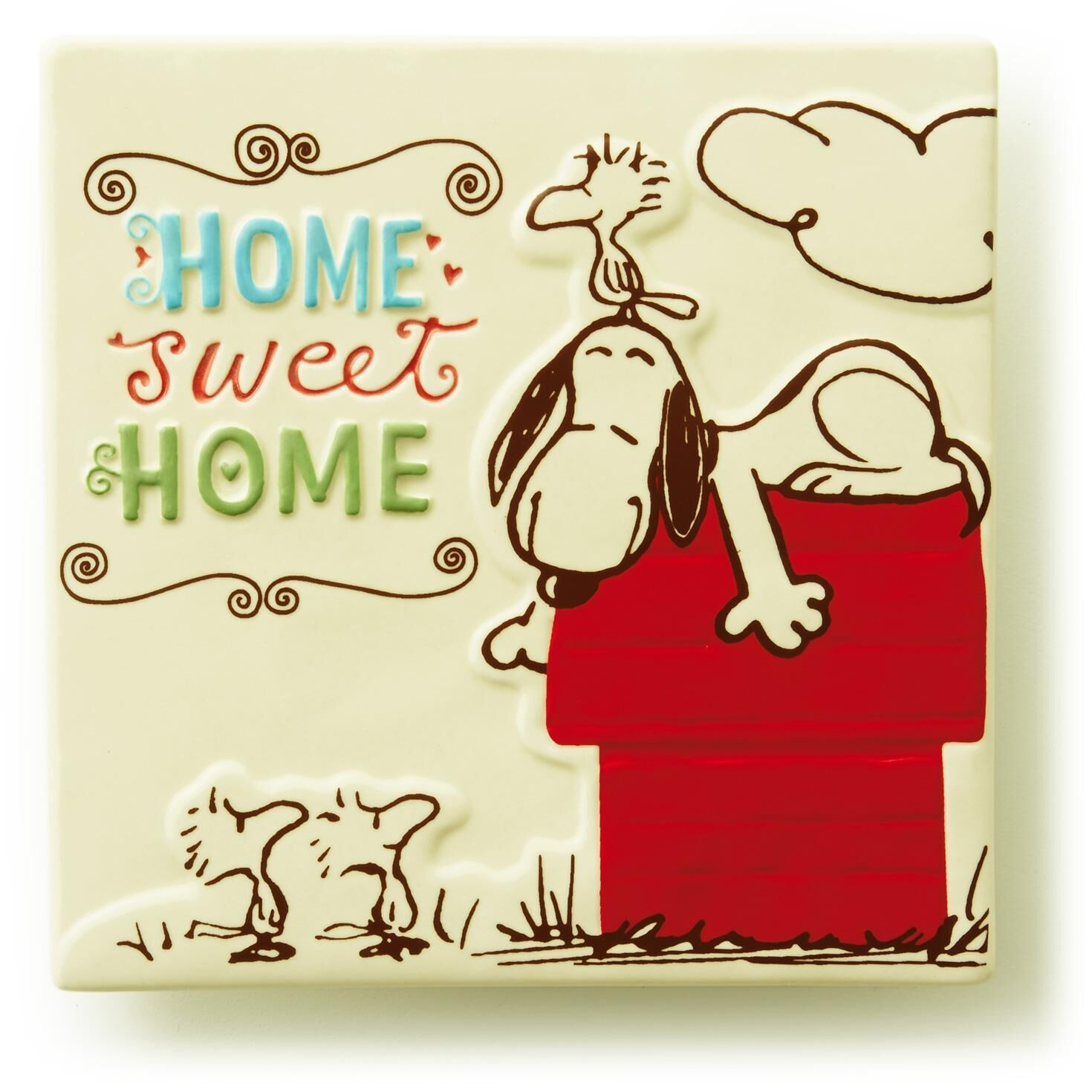
  1. Why do we have sayings like the ones below?


The word homesick is used to describe how we feel when we miss our home. The feelings of longing and yearning to be back in the comfort of your home can be heart-aching and painful ones, similar to that of feeling sick. “Home sweet home” and “there’s no place like home” however, can be used to describe how fond one is of their home. Calling your home “sweet” means that it is a welcoming and pleasant place, one that you treasure. If “there’s no place like home”, it means that no matter how beautiful or tranquil or delightful a place is, it’s still not better than your own home. We use these phrases to emphasize how much we love and adore our homes, to the point of them being a pillar of stability and comfort. 


Characterization

-The method by which an author creates the personality and appearance of their character.

Direct Characterization: The author makes direct statements about the character (can be revealed through a narrator or through another character in the story). The author TELLS the reader what they want them to know.

Indirect Characterization: indirectly stated from characters' actions, choices they make, dialogue/relationships with others, thoughts, feelings. The author SHOWS the reader what they want them to know.

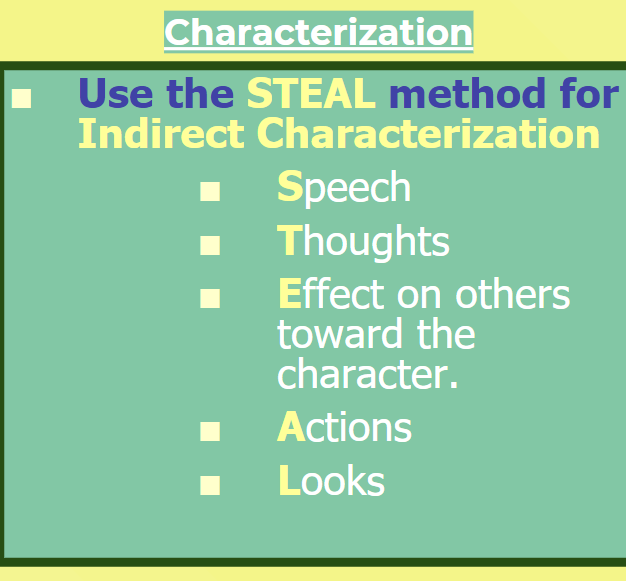
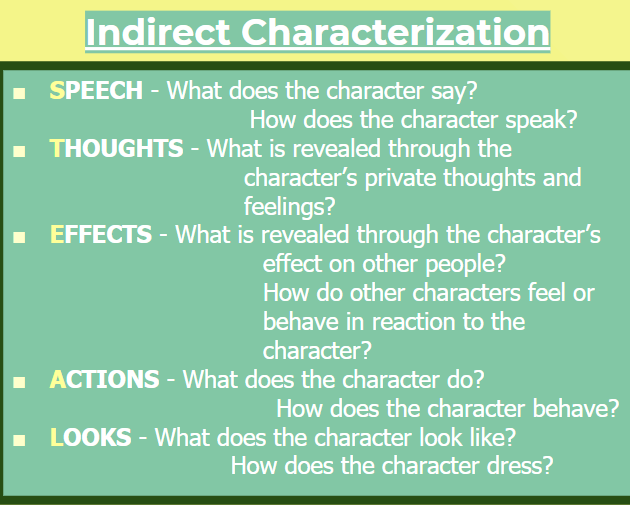
  • Use the STEAL method for Indirect Characterization

SPEECH - What does the character say? How does the character speak?

THOUGHTS - What is revealed through the character’s private thoughts and feelings?

EFFECT - What is revealed through the character’s effect on other people? How do other characters feel or behave in reaction to the character?

ACTIONS - What does the character do? How does the character behave?

LOOKS - What does the character look like? How does the character dress?

After, we watched a video focused on the indirect characterization of Anna from Frozen to aid our understanding of this topic.    →     Characterization Lesson | Using Disney's Frozen [4:55]


The Odyssey: Group Work & Class Discussion


Sailing from Troy (lines 18-69)


  1. Keep in mind that the Odyssey is the account of Odysseus' ten year journey back home to Ithaca. He misses his family and home; therefore, we will often find connections to this throughout the poem.  

Identify lines in which Odysseus talks about his home in Ithaca.  

  • How does he feel about it? 

  • Find lines & specific evidence that describe these feelings.  

Odysseus holds his home in Ithaca in a special position, even saying that “I shall not see on earth a place more dear”, longing to hurry back after the end of the Trojan War. We can see how much he adores and treasures his home. Odysseus’ love for his home is unrivaled for even the temptation of “Calypso, the loveliest among goddesses…Circe of Aeaea, the enchantress,” could not sway him, as he claims that “in my heart I never gave consent”. In the ending lines of this poem, Odysseus asks “Where shall a man find sweetness to surpass his own home and his parents?” and answers with “In far lands he shall not,” clearly stating how he will never find a place better than his home. With lines 21 to 37, it is evident how Odysseus loves his home dearly and how important it is to him. 

    Lotus Eaters (lines 18-69)


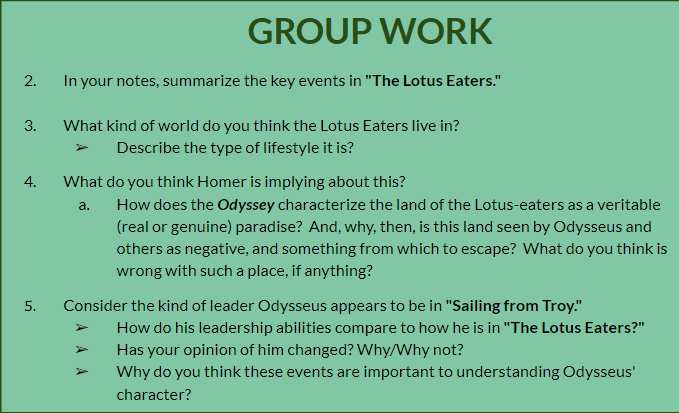
  1. In your notes, summarize the key events in "The Lotus Eaters."

After angering Zeus, Odysseus and his shipmates get swept away by Zeus’ storm, eventually landing on the coast of the Lotus-Eater’s home. Odysseus sends two picked men and a runner to scout but finds that the Lotus-Eaters bear no ill intent and even offer lotus’ to the starved men. However, the men who ate the sweet lotus flowers changed and didn’t want to go home. They only wanted to stay there forever. Odysseus realizes the truth of the lotus flowers and immediately brings the men back to their ship, even tying them to their rowing benches. He orders his men to get on board and leave quickly because if you were to eat a lotus flower, you would lose your “hope of home”. 

  1. What kind of world do you think the Lotus Eaters live in?

  • Describe the type of lifestyle it is?


My group and I came to the conclusion that the Lotus-Eaters probably live in a beautiful and tranquil place full of lotus flowers but, with the “brain-washing” effect that these flowers had, no one would have any real dreams or emotions. These Lotus-Eater’s have no reason other than wanting to live on that little island forever, not caring for their home and families, rendering their seemingly nice lives, emotionless. Although life would be peaceful living in this type of world, it would be like living in a cage. A pretty cage, but a cage nonetheless. 


  1. What do you think Homer is implying about this?

  • How does the Odyssey characterize the land of the Lotus-eaters as a veritable (real or genuine) paradise?  And, why, then, is this land seen by Odysseus and others as negative, and something from which to escape?  What do you think is wrong with such a place, if anything?

With the use of pretty lotus flowers, a symbol of purity and sacredness, and the kindness of the Lotus-Eaters, Homer paints their land as a peaceful and floral paradise. He even describes the lotus flowers as sweet, honeyed plants, lifting the image of these flowers and the Lotus-Eaters. But with Odysseus’ cleverness, he sees the corrupting effect that comes with consuming the lotus flower and quickly escapes from the trap. Since the flowers cause one to desire to live on that forever and forget their homelands, Odysseus, who longs to return home, sees this land negatively. On the surface, the land of the Lotus-Eaters is a paradise filled with sweet flowers but the flowers trap you into never leaving and forgetting your real home. And even if the land was a true paradise, living peacefully yet monotonically without any real emotions doesn’t sound as nice anymore. Of course, that is only if the land of the Lotus-Eaters was a true paradise. Since Odysseus left early enough to not get trapped, we’re unsure of what lies beyond, deep in the so-called paradise. For all we know, the Lotus-Eaters could be monsters in disguise who lure you in just to eat you. Even if it is a little exaggerated, it is a possibility. Either way, the weird effects of the lotus flowers are enough to make anyone wary of this “veritable paradise”.  In class, we also talked about the Percy Jackson movies and how in one of them, Percy and his friends go to a casino in hopes of finding what they need but, after eating the Lotus cookies, they forget about their goal and end up staying there for days. 

  1. Consider the kind of leader Odysseus appears to be in "Sailing from Troy."

  • How do his leadership abilities compare to how he is in "The Lotus Eaters"?

  • Has your opinion of him changed? Why/Why not?

  • Why do you think these events are important to understanding Odysseus' character?

In "Sailing from Troy”, Odysseus leads his men to Cicones and storms the place, kills the men, enslaves the women, and steals the goods. Although these are terrible deeds, Odysseus does try to stop his “mutinous men” when they go too far and try to leave Cicones before it was too late. But, they were indeed too late, so they fought against Cicones’ army regardless of being outnumbered. However, this only led to the foolish death of his many crewmates and friends and the wrath of Zeus. From this portion of the text, we can see that Odysseus did not do his duty as leader and instead, led his men to their doom. Odysseus’ leadership abilities in this text are far inferior to his leadership abilities in “The Lotus Eaters” where even after encountering a potentially dangerous island, Odysseus takes the liberty to lead his crew back on their ships and warn them of the lotus flowers. He even ties the men who have the flowers under their rowing benches, showing that he cares about his shipmates and doesn’t want to lose anymore. “All hands aboard; come, clear the beach and no one taste the Lotus, or you lose your hope of home.” With these words, my opinion of Odysseus is that he is a good person and has good leadership skills but, he is human and probably makes a lot of mistakes throughout his journey. 

Reflection: 

In this lesson, I felt that I learned more about Odysseus as a character and how he acts as a leader. His foolishness and inability in “Sailing from Troy” contrasts with his leadership in “The Lotus Eaters”, which could be something we see throughout the rest of the journey. I am curious to see how Odysseus changes as a person and how he manages against his troubles during his journey. I enjoyed doing the group work this class because I found the questions for “The Lotus Eaters” really interesting and my group and I had quite a long discussion about them. I think one of my favorite parts of this lesson was the Frozen video not only because it showed the Frozen characters, Anna and Elsa, but I find indirect characterization to be fun when reading. Although it might be hard to understand a character this way, I think it’s way more fun to figure out a character and find the mysteries behind them. I also enjoyed the story of the Lotus-Eaters. I find it fascinating to figure out the truth behind the weird “brain-washing” flower and the oddly nice people who eat them.